Send the assessment and we build the instrument for you, test items with defensible stems, rubrics with behavioral descriptors, an item analysis read correctly, delivered in 24 to 48 hours and revised free until the criteria clear. The course is NURS FPX 6116, Nursing Education Assessment and Evaluation, worth 2 program points inside the Nursing Education specialization of the FlexPath MSN. That program runs 27 points total, self-paced against scoring guides rather than weekly deadlines. Of the four specialization courses, this is the one where a single careless sentence, a stem that leaks its own answer, can cost a criterion. In Capella's catalog the course code is written NURS-FPX6116.
What NURS FPX 6116 actually grades
The course title names two different jobs and the criteria keep them apart. Assessment is what you do to an individual learner, testing, observing, scoring, deciding whether that person met an objective. Evaluation is the judgment you make about a course, a curriculum, or a program using assessment results in aggregate. Blur the two words and points leak across several criteria, since a section asked for program evaluation and answered with a quiz plan has not answered at all.
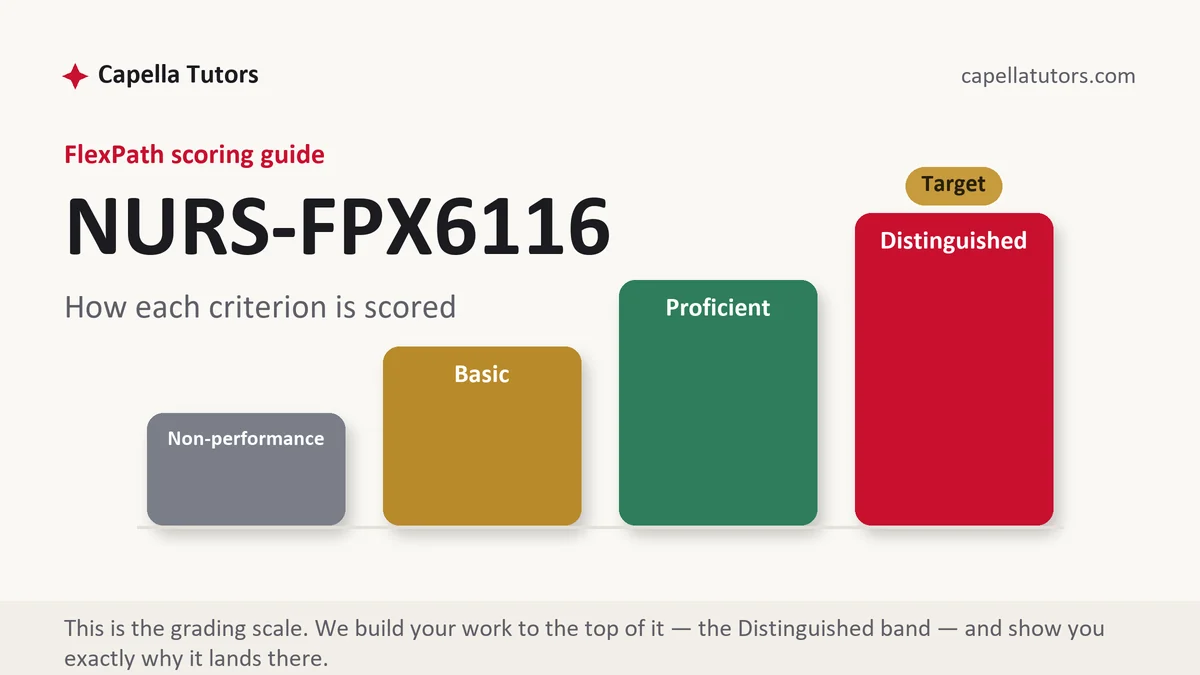
What earns the top column is technical craft made visible. The assessments in this course typically want you to build something and then defend it: selected-response items with clean stems, a scoring rubric whose levels can be told apart by a second rater, a plan that separates formative from summative purpose, and evidence that you can read item statistics instead of quoting them. Basic work says the test should be valid and reliable. Distinguished work shows the blueprint that gives the test its validity argument, then names which items to revise and why.
Nursing adds a constraint the general education literature does not. Items have to sit at the level nurses practice at, application and analysis rather than recall. Asking for a definition of neutropenia measures memory. Giving a client's counts, current medications, and a roommate with a productive cough, then asking which action comes first, measures judgment.
How we help in this course
This is the most technical course in the specialization, and it is the one where our desk saves the most time. Our writers here have written and defended item banks, revised items after the statistics came back ugly, and built rubrics that survived being handed to a second grader. What you get is an instrument that holds up: a blueprint mapping items to objectives and levels, stems free of the four common giveaways, distractors drawn from real learner errors, and an analysis section that says what each number means and what you would do about it.
Order handling matches the rest of the studio. Your scoring guide is mapped criterion by criterion before drafting, a subject-matched writer builds the deliverable, and it clears scoring-guide QA plus APA and originality QA before it reaches you inside 24 to 48 hours, with revisions until you hit your target. Send any item bank, rubric, or statistics table your courseroom provided; those criteria are graded on the specific data in front of you.
Writing items or a rubric this week?
Send the scoring guide plus any item bank or data table you were handed. Your opening sample carries no charge and returns within 24 to 48 hours.
The assessments, one by one
Assessment 1
Send the scoring guide and we assemble the setup document with you, the site, the mentor, the assessment data you may use, the objectives, and the minuted call, back in 24 to 48 hours with revisions until it clears. Read the full Assessment 1 manual.
Assessment 2
Hand this one to us and you get the course definition, the objective set, and an alignment table that reaches graded evidence, delivered in 24 to 48 hours and revised free until the criteria clear. Read the full Assessment 2 manual.
Assessment 3
Send the scoring guide and we build the rubric, the criteria, the level descriptors, the weighting, and the reliability plan, back in 24 to 48 hours with revisions until every criterion clears. Read the full Assessment 3 manual.
Assessment 4
Send the scoring guide and the numbers you were given and we build the evaluation, the item analysis, the interpretation, and the revision decisions, back inside 24 to 48 hours with revisions until the criteria clear. Read the full Assessment 4 manual.
Assessment 5
We build the deck and the speaker notes to your scoring guide and return them in 24 to 48 hours, revised free until the criteria clear. Read the full Assessment 5 manual.
How to actually write NURS FPX 6116: where to begin
Open the scoring guide and turn every criterion into a heading before you write a single item. The instructions describe a testing or evaluation scenario, the criteria decide the grade, and here the criteria are unusually concrete. Expect them to cover purpose and alignment, construction of the instrument, the balance of formative and summative measures, interpretation of results, and evaluation at the program level.
Build a blueprint first, because the blueprint is the validity argument. Make a small table with objectives down the side, cognitive levels across the top, and the number of items or points in each cell. Content weight should follow instructional weight, so if two of ten class hours went to fluid and electrolytes, roughly two of ten items belong there. Cite the blueprint later when a criterion asks how you know the assessment is valid, and you have answered with structure instead of adjectives.
Then write items the way item writers do, one stem at a time. State the whole problem in the stem, so a knowledgeable nurse could answer before reading the options. Keep it positive; negatives such as which action should the nurse avoid test reading speed under pressure. Then hunt the four leaks. Grammatical cues, where a stem ending in an quietly points at the only option beginning with a vowel, or a plural verb rules out three singular options. Length cues, where the key is the longest, most carefully hedged option because you wrote it first and qualified it properly. Absolutes, since a distractor containing always or never is dismissed by every test-wise student. Repeated wording, where a distinctive term from the stem reappears only in the correct answer. Keep options parallel in grammar, length, and specificity, and most of the leaking stops on its own. Build distractors from mistakes you have heard on the unit; a plausible wrong answer is what makes an item discriminate.
After the test runs, read the statistics rather than reciting them. Difficulty index is the proportion of learners who answered correctly, so a p of 0.95 means the item measured almost nothing, and a p of 0.15 means either the content was never taught or the item is broken. Most classroom items live usefully between about 0.30 and 0.90, with a working band nearer 0.60 to 0.80. Discrimination tells you whether the item sorted learners the same way the total test did. Compare the top and bottom scoring groups, or read the point-biserial, and treat anything around 0.20 and above as acceptable. Negative discrimination is the alarm: strong students chose a distractor, which usually means a keying error or two defensible answers, and the honest remedy is to accept both or drop the item and document it. Finish with distractor analysis, since a distractor selected by no one is dead weight, and replacing it is a cheaper fix than rewriting the stem. Internal consistency such as KR-20 belongs in the reliability paragraph, reported with what it does and does not tell you.
Rubric work follows the same discipline. Analytic rubrics, a row per criterion, suit papers and projects where feedback matters; holistic rubrics deliver one global judgment and leave the learner little to act on. Write performance-level descriptors as observable behavior, since excellent and poor are labels rather than descriptors, and cites three specific evidence sources beats uses evidence well. Change one thing at a time between levels so two raters can tell them apart, then pilot on two real submissions with a colleague before you defend reliability. Keep formative and summative straight by purpose, not timing, because the same quiz is formative when it informs the next lesson and summative when it fixes a grade. At program level, aggregate what the individual assessments produced, attach a numeric threshold, and name the review cycle.
| Section | What goes in it | What Distinguished looks like |
|---|---|---|
| Purpose and blueprint | The objectives being measured, the learners, and a table mapping content to items and levels. | Content weight matches instructional weight, and the blueprint is used later as the validity argument. |
| Instrument construction | The items or rubric themselves, with rationales and the keyed answers. | Stems carry the full problem, distractors come from real learner errors, and every item sits at practice level. |
| Formative and summative plan | Which measures inform learning, which measures decide grades, and when each occurs. | The distinction is made by purpose, and formative results visibly change the next teaching decision. |
| Item analysis and revision | Difficulty, discrimination, distractor counts, and reliability, each interpreted. | Every flagged item gets a decision, revise, retire, or credit both answers, with the reason stated. |
| Program-level evaluation | Aggregated results, benchmarks, data sources, review cycle, and who acts on the findings. | Thresholds are numeric, the loop closes with a named action, and accreditation language is used correctly. |
Developing the synthesis
Analyze and evaluate are the verbs, so a literature section that agrees with itself scores Basic. Testing research gives you real disagreement to work with. Frequent low-stakes quizzing is credited with better retention through retrieval practice, while other studies report that heavy testing pushes learners toward surface memorization and raises anxiety enough to depress performance in high-stakes courses. Both patterns exist, and the question worth answering is which one your course would produce. Adjudicate on design and population first, a controlled study across multiple cohorts beats a single-semester survey, then on setting, since findings from prelicensure classrooms may not transfer to experienced staff in a certification review. Then name what remains unsettled, whether the retention benefit survives once quizzes become graded, and the criterion is satisfied.
Citations that survive faculty review
Evidence is usually its own criterion, so treat sourcing as construction work. Peer-reviewed sources from roughly the last five years, an author and date on every factual claim, in-text citations matched to the reference list with nothing left uncited, and the citation placed inside the sentence doing the reasoning rather than at the end of a paragraph. Give every source a job in a named section. Search the Capella library, CINAHL, and PubMed for the research spine, and for the standards layer use NLN material on assessment and evaluation practice, the AACN Essentials where competency measurement is in play, QSEN competencies when the content being tested is safety or quality, and the Standards for Educational and Psychological Testing when you need formal language for validity and reliability. Measurement textbooks are legitimate for item-writing rules, cited as books in APA 7, but they cannot carry a claim about nursing learners.
The mistakes that land Basic instead of Distinguished
- Using assessment and evaluation interchangeably, which quietly costs credit in the program-level criteria.
- Writing recall items for practice-level objectives, then defending them as application without a client scenario.
- Reporting difficulty and discrimination numbers with no interpretation and no decision attached to any flagged item.
- Rubric levels built from adjectives, excellent through poor, which no second rater can apply the same way.
- Asserting validity and reliability as qualities of the test instead of showing the blueprint and the data behind them.
NURS FPX 6116 questions students actually ask
How do I write a stem that does not give the answer away?
Write the stem so a knowledgeable nurse could answer it with the options covered, then check it for four leaks. Grammatical cues, where a stem ending in an points at the only option starting with a vowel. Length cues, where the key is the longest and most carefully qualified option. Absolutes, since any distractor containing always or never gets dismissed on sight. And repeated wording, where a word from the stem reappears only in the correct answer. Keep the four options parallel in grammar and length and most of the leaking stops.
What do I do with an item whose difficulty index comes back at 0.95?
Read it as an item that measured almost nothing, because 95 percent correct leaves no room to separate learners who studied from learners who did not. Check discrimination before you touch it: a very easy item on foundational safety content can be worth keeping if the whole class must know it. Otherwise rewrite it at application level with a client scenario, or retire it and replace the item in the blueprint cell it occupied. For classroom tests, most items usefully sit between about 0.30 and 0.90 correct, with a good working band nearer 0.60 to 0.80.
Rubric or test items, which does this course want?
Whichever one measures the objective in front of you, and the choice itself is scored. Knowledge and clinical reasoning that can be judged right or wrong belong in selected-response items. Performance, writing, and communication belong in a rubric, because no multiple-choice item can measure how a learner teaches a patient. Read your scoring guide, since some assessments in this course specify the instrument, and when it does not, justify your pick against the objective's verb and defend the reliability of whatever you built.