This manual is for NURS FPX 6116 Assessment 1, start to submission. Send the scoring guide and we assemble the setup document with you, the site, the mentor, the assessment data you may use, the objectives, and the minuted call, back in 24 to 48 hours with revisions until it clears. Assessment 1 of NURS FPX 6116 opens the measurement course, and the arrangement that decides your project is data access. Exam statistics, item banks, rubric scores, and clinical evaluations are student records, and the permissions attached to them are not the same as permission to visit a department. The method below comes from the criteria, followed by a structure and an annotated sample excerpt. Capella's catalog lists the course as NURS-FPX6116, and some courserooms print NURS6116; both point to this same Assessment 1. In current courserooms this assessment typically appears as "Conference Call Scheduling and Notes".
One honesty note before the manual: Capella revises courses and scoring guides over time, so always write to the exact scoring guide attached to your assessment in the courseroom. The course identity above is verified on capella.edu; the method and structure below are our tutors' approach to it, not Capella's official rubric text.
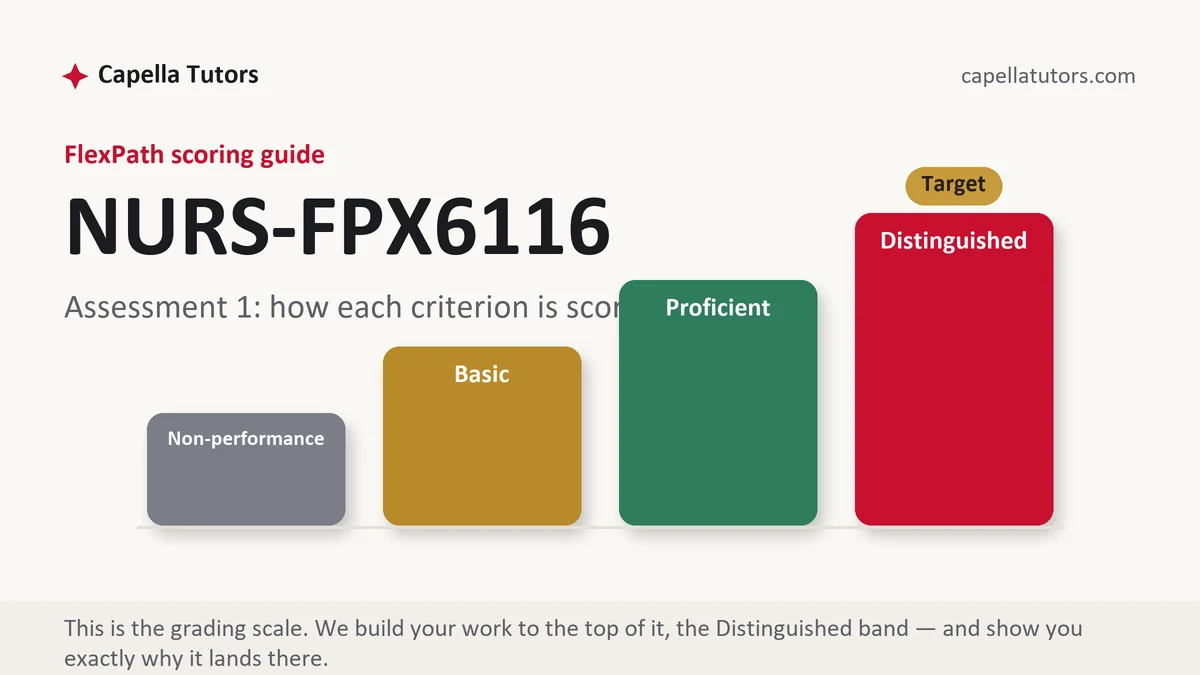
How NURS FPX 6116 Assessment 1 is scored
Each criterion in your scoring guide resolves to one of four levels, and the level wording tells you what to write:
| Level | What it means on a measurement practicum setup document |
|---|---|
| Distinguished | Data access is documented at the level of the specific dataset, de-identification and handling are described, the objectives are measurable against artifacts you will produce, and the plan says what the project becomes if identifiers are withheld. |
| Proficient | The arrangements are complete and the project would run. Nothing accounts for the records you may not be given, which is the anticipation the top column rewards. |
| Basic | A site, a mentor, and a plan to look at test results, with objectives written as intentions and no mention of who owns the data or under what conditions. |
| Non-performance | A required element is absent, most often the mentor's qualifications or the documented meeting, and absence rather than weakness puts a criterion on the floor. |
One distinction is worth settling in this document before it costs you anything. Aggregate item statistics from an examination, difficulty and discrimination values with no names attached, are ordinarily shareable with a faculty mentor's approval. Individual student scores, clinical evaluations, and remediation records are education records with their own rules. Writing the difference into your plan reads as professional judgment; discovering it in week five does not.
The NURS FPX 6116 Assessment 1 method, step by step
-
Turn the criteria into headings and answer them there
Copy each criterion out with its verb intact and let it structure the document. A setup deliverable feels like a form, and a form invites you to describe rather than to commit. Where the guide asks for the intended project, say what instrument or analysis you will produce and what the program keeps at the end.
-
Pick a measurement problem that already exists
The project needs a live problem: an examination whose results nobody has analyzed, a clinical evaluation tool that two faculty cannot apply the same way, a rubric that produces the same score for everyone, a course with no blueprint. Name the program, the course, the cohort size, and the number that shows the problem is real.
-
Name the datasets, their owners, and their conditions
List each dataset separately: the item analysis output for a named examination, the rubric scores for one assignment, three years of course pass rates, the current evaluation instrument itself. Beside each one, the person who controls it and the condition of release, whether that is de-identified only, aggregate only, or on a signed data request. This list is the strongest paragraph in the document.
-
Vet the mentor for measurement authority
Your mentor should hold responsibility for assessment where you are working: a course lead who owns an examination, an assessment coordinator, a nursing professional development specialist who validates competencies. State the degree, the role, and what they can authorize, specifically whether they can release item statistics and approve a pilot of a revised instrument with real raters.
-
Write objectives against a measurement standard
Anchor the objective set so the level is checkable. The testing standards published jointly by the educational research, psychological, and measurement associations supply the validity and reliability language faculty expect, and the nursing education accreditation criteria supply the program level frame. Each objective needs an observable verb and its artifact: a completed blueprint, a revised instrument, an item analysis with revision decisions attached.
-
Hold the call, and write down what you may not have
Bring an agenda covering datasets, de-identification, rater access, hours verification, and checkpoints, then record date, attendees with roles, agreements, refusals, and the next review. Where a dataset is refused or delayed, state the alternative project in the same paragraph. A setup document that already knows its fallback is the one faculty approve without comment.
A structure that maps to the criteria
Word figures are our tutors' planning targets for a setup document of this shape rather than Capella rules; your scoring guide decides the weighting.
| Section | What it must do | Guide |
|---|---|---|
| Setting and measurement problem | The program, the course, the cohort, and the number that shows the problem is real. | ~200 words |
| Datasets, owners, and conditions | Every dataset named, with who controls it and the condition under which it is released. | ~250 words |
| Mentor and authority | Degree, role, and exactly what your mentor can authorize about data and raters. | ~150 words |
| Project scope and artifact | The instrument or analysis you will produce, and what the program keeps. | ~200 words |
| Objectives and evidence | Measurable objectives anchored in a published measurement standard, each with its artifact. | ~250 words |
| Handling, hours, and the meeting record | De-identification, storage, hours by week, and the minuted call with refusals recorded. | ~250 words |
| References | Current APA, testing standards and accreditation criteria cited as organizational reports. | as needed |
Annotated sample excerpt
A model paragraph from our writers, showing how a permissions section reads once it has been thought through. Build your own around the same structure.
The measurement problem is the med surg clinical evaluation tool used with 62 students across five clinical sections, which produced satisfactory ratings for every student in two sections and four unsatisfactory ratings in another with the same faculty guidance document.1 Three datasets carry the project and each releases differently: the evaluation instrument and its faculty guide, held by the course lead who is also my mentor and available immediately; two terms of completed evaluation forms, held by the same course lead but released only with student identifiers removed by her before I see them; and the clinical failure appeal outcomes, held by the associate dean, who will confirm counts but will not release documents.2 My plan therefore rests on the instrument and the de-identified forms, and if the de-identified set is delayed past week four the project narrows to an interrater reliability pilot on four written case vignettes scored by three faculty, which needs no student data at all.3
- 1States the measurement problem as a discrepancy between sections rather than a general concern, which gives the project a target an evaluator can check.
- 2Separates the datasets by condition of release, including the one that will only ever be a count. This paragraph is what distinguishes a plan from an intention in a measurement practicum.
- 3Names a fallback that requires no student records, so a refusal does not end the project. A written contingency is the top column's move on a setup deliverable.
The full premium sample for your exact assessment, written fresh to your scoring guide and issue, is free to request. Study it, revise it into your own voice, and submit work you understand.
The five mistakes that cost Distinguished
- Data assumed rather than requested. Expecting item statistics or evaluation forms to arrive on a verbal request is the usual reason a measurement practicum stalls.
- Records treated as documents. Student evaluations and scores carry handling obligations, and a plan that ignores them invites a judgment mark down.
- A mentor with no assessment role. A supportive colleague who does not own an instrument or an examination cannot authorize the work this course requires.
- Objectives with no artifact. Learn about item analysis cannot be verified. Produce an item analysis with a revision decision for every flagged item can.
- A call with no record. The documentation criterion asks for attendees, agreements, and refusals in writing, not for confirmation that a conversation occurred.
Pre-submission checklist
- Measurement problem stated with a cohort size and a number that shows it is real
- Every dataset named with its owner and its condition of release
- Mentor's degree, role, and authority over data and raters all stated
- Objectives measurable, anchored in a published measurement standard, each tied to an artifact
- De-identification, storage, and handling addressed explicitly
- Call minuted with date, attendees, agreements, refusals, and a written fallback project
Data permissions blocking your start?
Send the scoring guide, the measurement problem you can see, and your mentor's role. We write the dataset and permissions section properly, anchor the objectives in published testing standards, and build the fallback that needs no student records. Back inside 24 to 48 hours, revised until faculty approves, and the first sample carries no charge.