This manual is for NURS FPX 6116 Assessment 2, start to submission. Hand this one to us and you get the course definition, the objective set, and an alignment table that reaches graded evidence, delivered in 24 to 48 hours and revised free until the criteria clear. Assessment 2 of NURS FPX 6116 usually asks you to define a course and then show, in table form, that what it measures is what it promised to teach. It looks mechanical and it is not: the table is where a course's contradictions become visible, and the criteria pay for finding them rather than for tidiness. The method, the structure, and an annotated alignment excerpt are below. Capella's catalog lists the course as NURS-FPX6116, and some courserooms print NURS6116; both point to this same Assessment 2. In current courserooms this assessment typically appears as "Course Definition and Alignment Table".
One honesty note before the manual: Capella revises courses and scoring guides over time, so always write to the exact scoring guide attached to your assessment in the courseroom. The course identity above is verified on capella.edu; the method and structure below are our tutors' approach to it, not Capella's official rubric text.
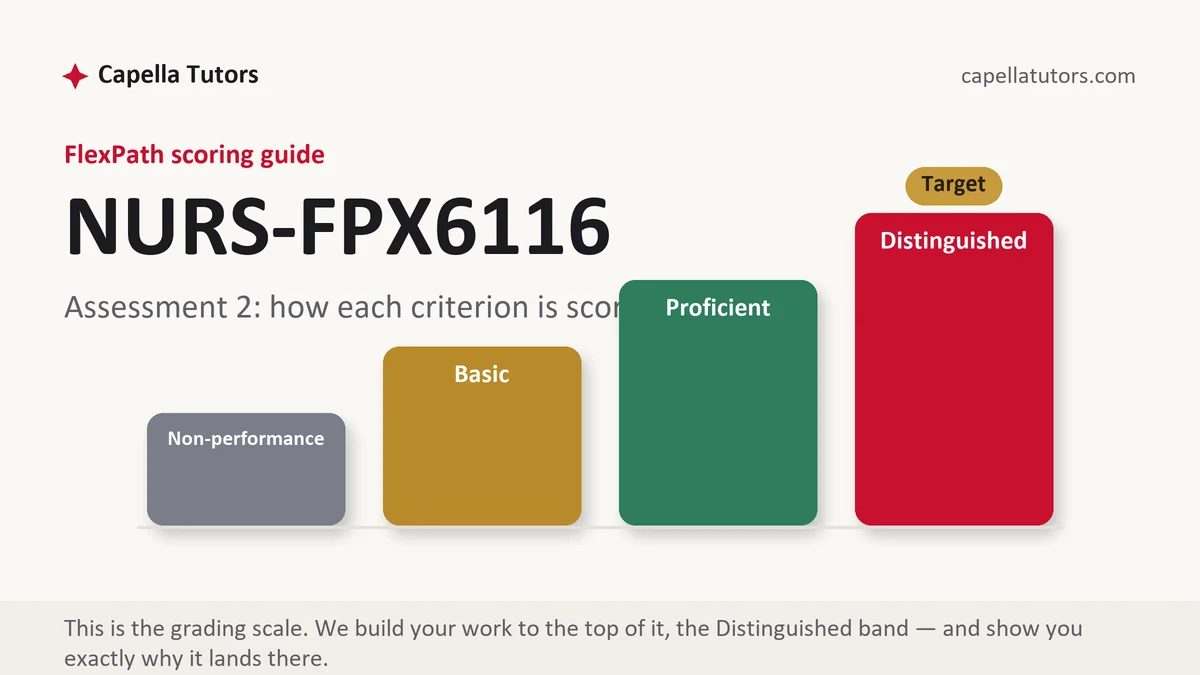
How NURS FPX 6116 Assessment 2 is scored
Each criterion settles on one of four levels, and the level text is the specification for the table:
| Level | What it means on a course definition and alignment table |
|---|---|
| Distinguished | The definition states learners, prerequisites, and purpose precisely, every objective is observable at the level its outcome demands, each row travels to a named assessment with a threshold, and at least one mismatch is exposed and repaired. |
| Proficient | A complete definition with measurable objectives and a full table. Every row agrees with every other, so nothing has been analyzed, which is the gap to the top column. |
| Basic | A course described by topics and weeks with objectives that use unobservable verbs, and a table whose last column names an activity rather than evidence. |
| Non-performance | The alignment table is missing, or objectives appear with no outcomes above them, and a missing element scores below a weak one. |
The unit of this table is the objective. A row for every objective and no rows for weeks, because a week is a container and an objective is a claim. Two orphans surface in every honest table: an objective nothing measures, which means the course teaches something it never checks, and an assessment with nothing above it, which means learners are graded on a promise the course never made. Report both.
The NURS FPX 6116 Assessment 2 method, step by step
-
Read the criteria and check for a required format
Your scoring guide or courseroom may specify columns, and faculty who supply a template grade against it. Build the criterion headings first, then confirm the format. Where no format is given, treat the seven column version below as the floor rather than the ceiling.
-
Define the course in facts, not adjectives
Title, credit hours, contact hours, delivery mode, prerequisite behind it, course it feeds, cohort size, and who teaches it. Then one sentence on purpose: what a learner can do afterwards that they could not do before. A definition made of counts lets every row in the table be tested against something.
-
Walk the verb ladder down, level by level
Program outcome, then course outcome, then module objective, and the cognitive level may not rise as you descend. Use the revised taxonomy from Anderson and Krathwohl and keep the ladder visible in the table itself. If the course outcome says evaluate and an objective stops at define, that is a documented mismatch, not a rounding error, and reporting it is what the analysis criterion asks for.
-
Write objectives with condition, verb, and standard
Three parts. The condition sets the situation, given a client receiving a continuous heparin infusion. The verb is observable, calculate, prioritize, differentiate, evaluate. The standard says how well, within a 10 percent margin, in order of urgency, with two supporting findings. Objectives missing the standard are the reason so many tables cannot produce a threshold in the final column.
-
Choose the assessment that can actually produce the evidence
Match instrument to verb. Knowledge and reasoning that is right or wrong belongs in selected response items written at practice level. Performance, teaching, and communication need a scored observation with a rubric, because no multiple choice item can measure how a learner explains an inhaler to a patient. Say in one line why each instrument fits its objective, and where you use selected response items, note that a stem which telegraphs its own answer measures test wiseness rather than the objective.
-
Fill the table, then attack your own rows
Seven columns carry it: competency or standard, program outcome, course outcome, module objective, teaching method, assessment producing the evidence, and the threshold. Then test each row with one question: could a learner meet the objective and still fail this assessment, or fail the objective and still pass it. Any row where the answer is yes is a finding, and findings with proposed repairs are what the top column pays for.
A structure that maps to the criteria
Word figures are planning targets our tutors use for a deliverable of this shape, not Capella rules; follow any format your scoring guide supplies.
| Section | What it must do | Guide |
|---|---|---|
| Course definition | Title, credits, contact hours, mode, prerequisites, cohort size, and the purpose in one sentence. | ~200 words |
| Outcomes and their sources | Program and course outcomes with the competency set they map to, named. | ~200 words |
| Objective set | Module objectives with condition, observable verb, and standard, at the level above them. | ~300 words |
| Assessment choices justified | Why each instrument can produce evidence for its objective, in one line each. | ~250 words |
| The alignment table | One row per objective, running from competency to assessment and threshold. | ~200 words |
| Findings and repairs | Orphan objectives, orphan assessments, and ladder breaks, each with a specific fix. | ~250 words |
| References | Current APA, taxonomy cited to its primary source, competency sets as organizational reports. | as needed |
Annotated sample excerpt
An original model from our team. The interrogation of the row, rather than the row itself, is the part worth learning here.
The revised pharmacology course carries a course outcome at the level of analyze, so the anticoagulation objective reads: given a client receiving a continuous heparin infusion and a rising activated partial thromboplastin time, the learner will analyze which two findings require immediate provider notification, taught through worked cases with feedback and measured by four selected response items at application level with a threshold of three correct.1 The row survives interrogation because a learner who can do the analysis will answer at least three, and a learner who cannot will not be rescued by test wiseness, since the options are parallel in length and none contains an absolute term.2 Two rows below it do not survive: the objective on adverse effect recognition stops at list while its outcome says analyze, and it has no assessment at all, so I am proposing the verb be raised to differentiate and the objective be measured by two of the case items already written for the infusion row.3
- 1Writes the objective with condition, verb, and standard, then carries it straight to an instrument and a threshold, which is the full journey a row is supposed to make.
- 2Applies the interrogation test out loud and names the item writing property that makes the evidence trustworthy. Reasoning about the instrument, not just naming it, is what lifts this criterion.
- 3Reports a ladder break and an orphan objective in the writer's own table and repairs both. Self exposure is the analysis the criterion is buying.
The full premium sample for your exact assessment, written fresh to your scoring guide and issue, is free to request. Study it, revise it into your own voice, and submit work you understand.
The five mistakes that cost Distinguished
- A table built on weeks. Rows that correspond to sessions rather than objectives cannot demonstrate alignment, because a week makes no claim to be measured.
- Unobservable verbs. Understand, know, and be aware of cannot be assessed, and they are the first thing an evaluator scans for.
- Objectives with no standard. Without a how well clause, the threshold column has nothing to hold and the table stops one step short.
- An instrument that cannot reach the verb. A multiple choice quiz attached to a performance objective is a mismatch, and leaving it unremarked costs the analysis criterion.
- A table with no findings. Perfect agreement across every row reads as decoration, and the criterion that pays for judgment goes unearned.
Pre-submission checklist
- Course defined with credits, contact hours, mode, prerequisites, and cohort size
- Outcomes mapped to a named competency set rather than asserted
- Every objective carrying a condition, an observable verb, and a standard
- One row per objective, travelling from competency to assessment and threshold
- Each instrument justified in one line against the objective's verb
- At least one orphan or ladder break reported with a specific repair
Alignment table due and nothing lines up?
Send the scoring guide, the course, and any syllabus or objective list you hold. We define the course in facts, rewrite the objectives with conditions and standards, build the table row by row, and report the mismatches with repairs attached. Delivery in 24 to 48 hours, revisions until you hit your target, first premium sample free.