Tell us which deliverable this course has put in your way and a premium original sample comes back within 24 to 48 hours, walkthrough included. The identity: NURS FPX 6020, Advanced Nursing Practice 1: Biopsychosocial Concepts, 2 program points. It is an MSN core course, taken by every FlexPath specialization, scored criterion by criterion inside a 27-point program. In Capella's catalog the course code is written NURS-FPX6020.
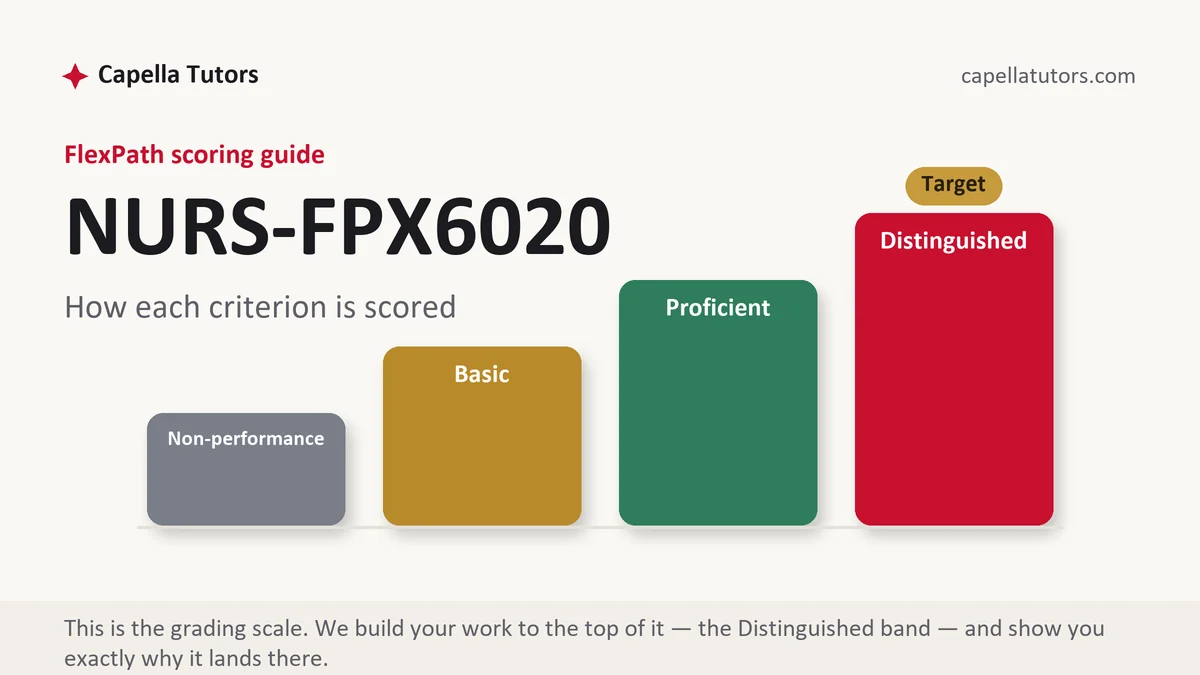
What NURS FPX 6020 actually grades
In current courserooms, this first advanced practice course follows one disaster from start to finish. Assessment 1 is a risk assessment of a real community after a disaster or catastrophic event, with a focus on infection control. Assessment 2 answers those risks with a disaster management plan delivered as a presentation. Assessment 3 turns to the team, with a communication handout and a narrative that evaluates the strategies that fit the event.
What the criteria reward across all three is the biopsychosocial lens the course is named for. A risk is never only biological: an outbreak in a shelter spreads faster among older residents with chronic illness, among people who cannot leave because they have nowhere else to go, and among families who did not understand the instructions they were given. Papers that show those layers acting on each other score higher than papers that list risks by category.
How we help in this course
Send the prompt, the scoring guide and the event or community you chose, and the draft returns built on public data: the community profile from census and county health sources, outbreak evidence from comparable disasters, and shelter guidance from public health agencies. Each later assessment is written against the risks the first one documented, so the course reads as one argument.
The standard promise covers every deliverable in the course: a premium original sample inside 24 to 48 hours, written at the Distinguished column, run through our eight-person pipeline with two quality passes, and revised free until it answers the guide in your courseroom.
One disaster, three deliverables
Choose the event once and choose it well. A disaster with public reporting, such as a tornado, flood or hurricane that displaced residents into shelters, gives you numbers for the risk assessment, real conditions for the infection control plan, and real communication problems for the handout. An invented event leaves every assessment guessing.
Carry the same priorities forward. The risks you rank highest in Assessment 1 should be the ones the strategies in Assessment 2 answer, and the communication problems in Assessment 3 should be the ones that plan would actually meet. Evaluators notice when the thread breaks.
The assessments, one by one
Assessment 1: Risk Assessment
The health risks, especially infection, that follow a disaster in a real community, and who is most vulnerable. Read the full Assessment 1 manual.
Assessment 2: Disaster Management Plan
A presentation that answers the prioritized risks with infection control strategies, roles and resources. Read the full Assessment 2 manual.
Assessment 3: Communication Handout and Narrative
A communication handout for the disaster team and a narrative evaluating the strategies. Read the full Assessment 3 manual.
How to actually write NURS FPX 6020: where to begin
Open the scoring guide first and rebuild it as your outline, one heading per criterion with the Distinguished description underneath. Read each criterion for its verb: identify wants coverage, analyze wants a reason, evaluate wants a judgment, and justify wants a citation in the same paragraph as the claim.
Then gather the community data before you write a word: population, age structure, income, housing, language, health resources and what the disaster damaged. The risk assessment in recent versions runs about five to six pages, so the data has to be specific enough to fill it with analysis rather than description.
| Section | What goes in it | What Distinguished looks like |
|---|---|---|
| Event and community | The disaster, the place and the people affected, with data. | A real event with dated sources and numbers that later sections reuse. |
| Health risks | Infection and other risks in shelters and the community. | Each risk supported by evidence from comparable disasters. |
| Vulnerable populations | Who faces higher risk and why. | Biological, psychological and social factors shown acting together. |
| Disaster management plan | Strategies, roles, resources and evaluation. | One strategy per prioritized risk, with owners and measures. |
| Communication | Handout and narrative for the response team. | A handout usable under pressure and a narrative that evaluates fit. |
Citations that survive faculty review
Two kinds of sources carry this course: peer-reviewed studies of health effects after disasters, from roughly the last five years, and current guidance from public health and emergency management agencies such as the CDC and FEMA. Place the citation in the sentence that makes the claim, and check that guidance is the current edition.
The mistakes that land Basic instead of Distinguished
- A hypothetical community with no data behind it.
- Risks listed by category with no analysis of who is most vulnerable and why.
- A management plan whose strategies do not match the risks the first assessment ranked.
- Presentation slides with no speaker notes carrying the evidence.
- A communication handout too dense to use during a response.
- A different disaster in each assessment.
NURS FPX 6020 questions students actually ask
Which disaster should I choose for NURS FPX 6020?
A real event with public reporting, such as a tornado, flood or hurricane that moved residents into shelters. You need numbers for the risk assessment and real conditions for the plan and the communication work, and a well-documented event supplies all three.
Does NURS FPX 6020 still ask for a patient care plan?
Not in current courserooms. The three assessments follow one disaster: a risk assessment with a focus on infection control, a disaster management plan presented as slides with notes, and a communication handout with a narrative. Check the instructions in your own courseroom, since course versions change.
How long is the NURS FPX 6020 risk assessment?
Recent instructions describe it as a paper of about five to six pages. Follow the length in your own scoring guide, and spend the space on analysis of risk and vulnerability rather than on describing the disaster.
In NURS FPX 6020 right now?
Attach the guide, the prompt, and whatever case material the courseroom gave you. Your first premium sample is free and arrives within two days.