This manual is for NURS FPX 6020 Assessment 2, start to submission. The Disaster Management Plan takes the risks you identified in the Assessment 1 risk assessment and answers them with a plan, delivered as a presentation: infection control strategies for evacuation shelters and other settings, the roles of the interprofessional team, the resources required, how information will reach the public and staff, and how you will know the plan is working. In most versions it is slides with speaker notes or a recorded presentation; check your courseroom. The grade turns on matching each strategy to a risk you already documented. Below is the method our tutors use, a structure that maps to the criteria, and an annotated sample excerpt. Prefer to hand it off? A premium original sample for this exact assessment comes back in 24 to 48 hours, revised free until it meets the guide. Capella's catalog lists the course as NURS-FPX6020, and some courserooms print NURS6020; both point to this same Assessment 2. In current courserooms this assessment typically appears as "Disaster Management Plan".
One honesty note before the manual: Capella revises courses and scoring guides over time, so always write to the exact scoring guide attached to your assessment in the courseroom. The course identity above is verified on capella.edu; the method and structure below are our tutors' approach to it, not Capella's official rubric text.
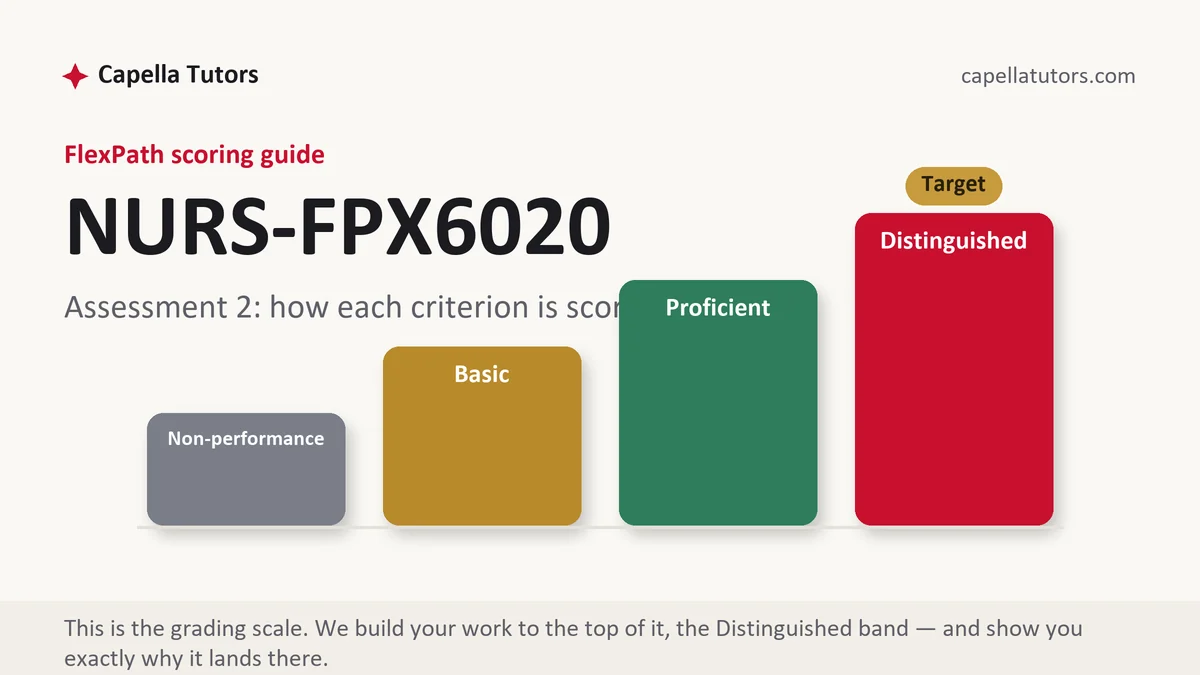
How NURS FPX 6020 Assessment 2 is scored
FlexPath does not use letter grades. Each criterion in the scoring guide lands on one of four levels, and the level descriptions are the real writing brief:
| Level | What it means on a disaster management plan |
|---|---|
| Distinguished | Each prioritized risk from Assessment 1 has a specific, evidence-based strategy, team roles and resources are concrete, communication and coordination are planned, evaluation measures are named, and the notes carry the evidence. |
| Proficient | Strategies are appropriate and supported, but some are not tied to specific risks and evaluation is general. |
| Basic | The plan restates general disaster guidance with little connection to the risk assessment. |
| Non-performance | Infection control, team roles or evaluation is missing. |
Keep the same event and community. Evaluators read this plan against the risks you documented, so a new disaster breaks the chain.
The NURS FPX 6020 Assessment 2 method, step by step
-
List the prioritized risks
Carry forward the top risks from Assessment 1, with the figure that made each one a priority.
-
Match a strategy to each risk
Hand hygiene stations and cleaning schedules, symptom screening at shelter entry, isolation space, safe water and food handling, vaccination where relevant. Cite CDC shelter guidance or similar.
-
Assign team roles
Nursing, public health, emergency management, infection prevention and volunteers, each with a defined task.
-
Name the resources
Supplies, staff, space and funding sources needed to carry out each strategy.
-
Plan communication and coordination
How staff, residents and partner agencies will receive information, including people with limited English.
-
Set evaluation measures
Infection cases in shelters, supply levels, screening completion, and when each will be checked.
A structure that maps to the criteria
Slide counts and timing vary by version; follow your scoring guide. The note lengths below are planning targets our tutors use.
| Section | What the slide and notes must do | Guide |
|---|---|---|
| Introduction | The event, community and purpose of the plan. | 1 slide, ~100 words of notes |
| Prioritized risks | The risks from Assessment 1 that the plan answers. | 1 slide, ~150 words |
| Infection control strategies | One strategy per risk, with evidence. | 2 to 3 slides, ~300 words |
| Team roles and resources | Who does what and what it requires. | 2 slides, ~200 words |
| Communication and coordination | Messages, channels and partners. | 1 slide, ~150 words |
| Evaluation and close | Measures, review points, references. | 2 slides, ~150 words |
Annotated sample excerpt
An original model excerpt from our team, written to show the register that reaches the top of the guide. Learn the moves, then write your own version.
Our first priority is the risk of gastrointestinal and respiratory outbreaks in the two shelters, so the plan starts at the door.1 Every resident and volunteer is screened for fever, vomiting or diarrhea on entry and once a day, anyone with symptoms is moved to the separate classroom set aside for isolation, and hand-washing stations are added so there is one for every 20 people rather than one per room, in line with shelter guidance from public health agencies.2 The infection prevention nurse reviews the daily screening log each morning, and two linked cases in 48 hours trigger a call to the county health department, which gives us a clear point at which the plan escalates.3
- 1Ties the strategy to the top-priority risk from Assessment 1.
- 2Gives specific, evidence-based actions with numbers.
- 3Assigns a role and an escalation trigger, which makes the plan measurable and coordinated.
The full premium sample for your exact assessment, written fresh to your scoring guide and topic, is free to request. Study it, revise it into your own voice, and submit work you understand.
The five mistakes that cost Distinguished
- A new disaster. Use the event and risks from Assessment 1.
- Strategies not tied to risks. Each strategy should answer a documented risk.
- Roles left vague. Name who does each task.
- No evaluation. Say how you will know the plan works.
- Slides without notes. The notes carry the evidence.
Pre-submission checklist
- Same event and community as Assessment 1
- A strategy for each prioritized risk, with evidence
- Team roles and resources specified
- Communication and coordination planned
- Evaluation measures and review points
- Speaker notes with current APA citations
Want the disaster plan presentation built?
Send the scoring guide and your risk assessment. Our team returns a premium original slide deck with full speaker notes in 24 to 48 hours, revised free until it meets the guide.