This manual is for NURS FPX 6020 Assessment 1, start to submission. In current courserooms, Assessment 1 of Biopsychosocial Concepts for Advanced Nursing Practice is a risk assessment: you choose a disaster or catastrophic event in a real community, such as a tornado, flood or hurricane, and identify the health risks it creates, with a focus on infection control in settings such as evacuation shelters, then analyze the biopsychosocial factors that make some residents more vulnerable. It is a paper, and the assessment instructions in recent versions set its length at about five to six pages; follow the length in your own guide. The risks you identify here become the basis of the disaster management plan in Assessment 2. Below is the method our tutors use, a structure that maps to the criteria, and an annotated sample excerpt. Prefer to hand it off? A premium original sample for this exact assessment comes back in 24 to 48 hours, revised free until it meets the guide. Capella's catalog lists the course as NURS-FPX6020, and some courserooms print NURS6020; both point to this same Assessment 1. In current courserooms this assessment typically appears as "Risk Assessment".
One honesty note before the manual: Capella revises courses and scoring guides over time, so always write to the exact scoring guide attached to your assessment in the courseroom. The course identity above is verified on capella.edu; the method and structure below are our tutors' approach to it, not Capella's official rubric text.
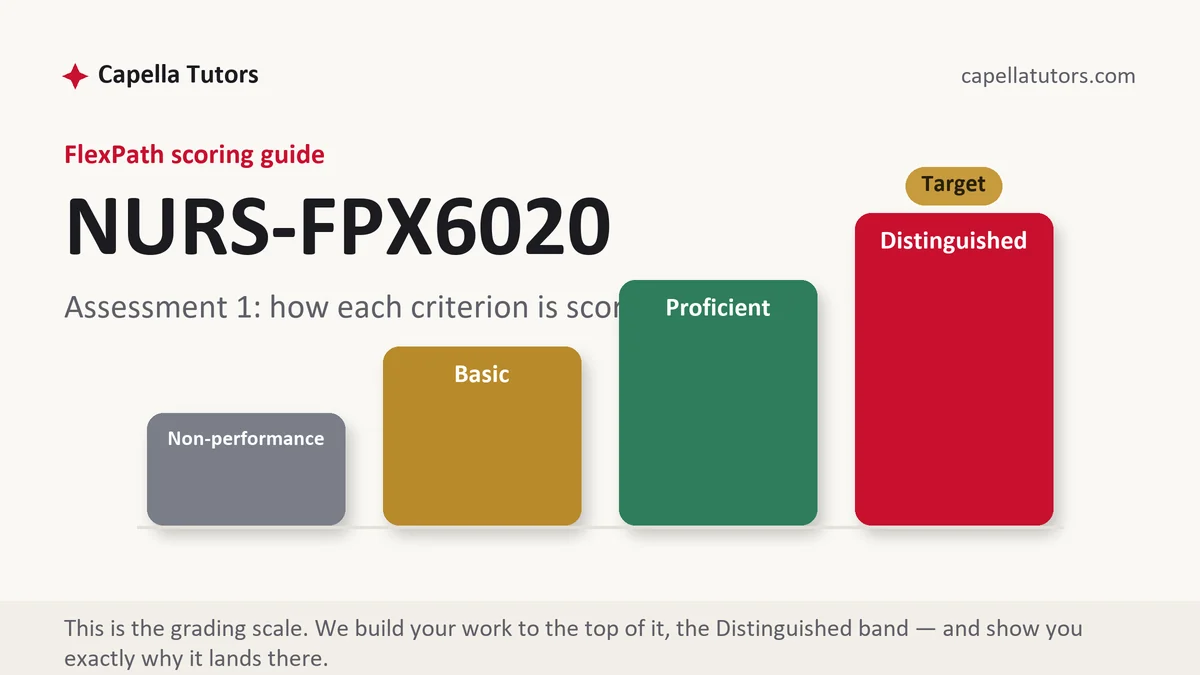
How NURS FPX 6020 Assessment 1 is scored
FlexPath does not use letter grades. Each criterion in the scoring guide lands on one of four levels, and the level descriptions are the real writing brief:
| Level | What it means on a disaster risk assessment |
|---|---|
| Distinguished | The event and community are described with data, infection and other health risks are identified with evidence, vulnerable groups are analyzed through biological, psychological and social factors, and the risks are prioritized for the plan that follows. |
| Proficient | Risks and vulnerable groups are identified accurately, but the analysis is general and the risks are not prioritized. |
| Basic | The paper describes the disaster with little analysis of health risks or vulnerability. |
| Non-performance | A required element, such as infection risk or the vulnerable populations, is missing. |
Choose a real event and community with public data: local news, county health data, FEMA or CDC reports. Specific numbers make every later section stronger.
The NURS FPX 6020 Assessment 1 method, step by step
-
Choose the event and community
A disaster that happened or could plausibly happen in a named place, with enough public data to describe its effects.
-
Describe the community
Population, age structure, income, housing, language and health resources, with sources.
-
Identify the health risks
Infectious disease in crowded shelters, contaminated water, interrupted chronic care, injuries and mental health effects. Prioritize infection risks as the guide directs.
-
Analyze vulnerability biopsychosocially
Which groups face higher risk and why: older adults with chronic illness, people without transportation, children, people with limited English.
-
Support with evidence
Cite studies of disease outbreaks and health effects after similar disasters.
-
Prioritize for the plan
End with the risks you rank highest and why, since Assessment 2 builds a plan to address them.
A structure that maps to the criteria
Word counts are planning targets our tutors use; recent instructions set the paper at about five to six pages, so follow your scoring guide.
| Section | What it must do | Guide |
|---|---|---|
| Introduction | The event, the community and the purpose of the assessment. | ~150 words |
| Community profile | Demographics, resources and baseline health with data. | ~250 words |
| Health risks after the disaster | Infection and other risks with evidence. | ~350 words |
| Vulnerable populations | Biological, psychological and social factors behind higher risk. | ~300 words |
| Prioritized risks and conclusion | The highest risks and why, setting up the plan. | ~200 words |
| References | Current APA, data sources dated. | as needed |
Annotated sample excerpt
An original model excerpt from our team, written to show the register that reaches the top of the guide. Learn the moves, then write your own version.
In the first week after the tornado, about 400 residents moved into two school gymnasiums with shared bathrooms and a single hand-washing station per room.1 Outbreaks of norovirus and respiratory infections have been documented in shelters after comparable events, and the conditions here, crowding, shared surfaces and limited sanitation, match the conditions those reports describe.2 The risk is highest for the shelter's older residents with diabetes or heart disease, who are more likely to become seriously ill and who also lost access to their usual pharmacy, which is why infection control in the shelters ranks first among the risks this assessment identifies.3
- 1Describes the setting with numbers, which grounds the risk in this event.
- 2Links the setting to documented outbreaks, supporting the risk with evidence.
- 3Identifies the most vulnerable group and prioritizes the risk for the next assessment.
The full premium sample for your exact assessment, written fresh to your scoring guide and topic, is free to request. Study it, revise it into your own voice, and submit work you understand.
The five mistakes that cost Distinguished
- A hypothetical community. Use a real place with public data.
- Risks without evidence. Support each risk with reports or studies.
- Vulnerability treated as one group. Analyze specific groups and their factors.
- No priorities. Rank the risks for the plan in Assessment 2.
- Ignoring the length. Recent instructions set about five to six pages.
Pre-submission checklist
- Real event and community with data
- Infection risks and other health risks identified with evidence
- Vulnerable groups analyzed biopsychosocially
- Risks prioritized for the disaster plan
- Length matches the guide
- Current APA references
Want the risk assessment written for your community?
Send the scoring guide and the event you chose. Our team returns a premium original risk assessment in 24 to 48 hours, revised free until it meets the guide.