Help for every MBA FPX 5016 deliverable lives on this page — a premium original sample with a walkthrough, back in 24 to 48 hours. The course itself: Core Operations Management for Leaders, listed at 2 pts / 4 quarter credits in Capella’s MBA catalog, offered in FlexPath. In Capella's catalog the course code is written MBA-FPX5016.
What MBA FPX 5016 actually grades
Operations assessments turn process thinking into written improvement cases: flow analysis, bottleneck identification, quality methods, and capacity reasoning on real or cased operations. The criteria reward the math shown and the improvement quantified, cycle time, throughput, cost, not adjectives about efficiency. Managers who live operations often under-formalize exactly the analysis the rubric weighs.
How we help in this course
We formalize what you already know how to see: the process mapped, the constraint computed, the fix costed and sequenced. Drafts read like the improvement proposals good plants actually run on, which is precisely the genre the course is teaching.
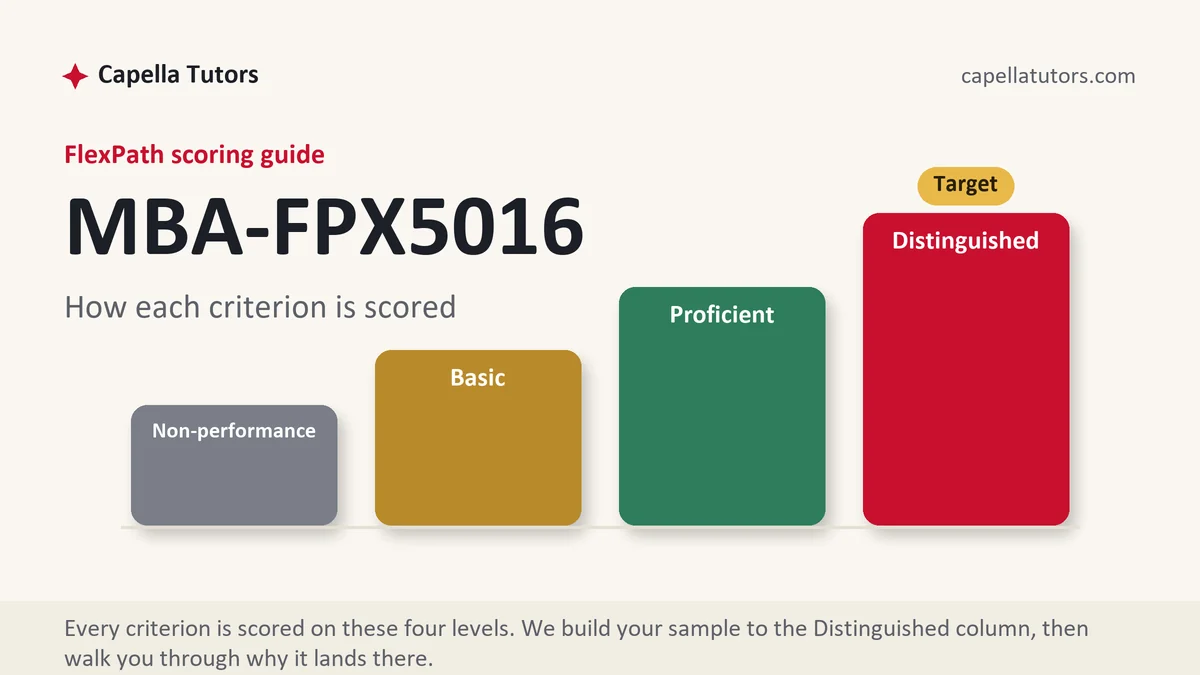
Every deliverable in the course follows our standard promise: a premium original draft in 24 to 48 hours, written to the Distinguished column on FlexPath or the A rubric row on GuidedPath, through the eight-person pipeline with both QA passes, revised free until it meets target.
Assessment manuals for this course
Every assessment in MBA FPX 5016 has its own manual now: the walkthrough, the structure that maps to the criteria, an annotated sample excerpt, and the done-for-you door. Open Assessment 1, Assessment 2, Assessment 3, or start from the list in the sidebar.
In MBA FPX 5016 right now?
Send the assessment number and the scoring guide from your courseroom. First premium sample free, back in 24 to 48 hours.
Quantified improvement or it does not count
Operations scoring guides pay for arithmetic: cycle time computed, the bottleneck identified by the numbers, the fix costed and sequenced. Adjectives about efficiency, however experienced they sound, sit in the Basic column because they describe where the criteria demand measurement. Managers who live operations often under-formalize exactly the analysis the rubric weighs, and our 5016 drafts exist to formalize it, the process mapped, the constraint shown mathematically, the improvement stated in throughput, cost, or time with the Distinguished extras where the columns call for them.
From hand-off to evaluated, on desk time
The working loop for this course: send the assessment number, scoring guide, and any process data the case supplies; a premium draft returns within 24 to 48 hours through scoring-guide QA and the separate APA and originality pass; you submit, the evaluation lands, the next assessment starts. That rhythm is what keeps a 2-point FlexPath course inside the flat-rate session instead of spilling across it.
What if my case is my own workplace's operation?
Even better, where the assessment allows it: real process numbers hit the specificity the top column rewards, and identifying details are stripped to professional standard. Where the data is thin, the scope reply says what the analysis can and cannot claim before drafting starts.
Is the first improvement-case draft free like the nursing courses?
Identical policy across the catalog: first premium draft free, criterion map included, judge the genre before you fund it. Most operations clients decide off that single draft.
The assessments, one by one
Assessment 1
The process analysis with the bottleneck computed. Read the full Assessment 1 manual.
Assessment 2: Demand Management Plan
Analyze how advertising affects demand, forecast demand from the scenario data, evaluate inventory management approaches, and recommend a plan. Read the full Assessment 2 manual.
Assessment 3: Supply Chain Management Plan
Inputs, operations and outputs in the supply chain, compare supply chain models such as fast and continuous flow, and recommend a plan. Read the full Assessment 3 manual.
How to actually write MBA FPX 5016: where to begin
Open the scoring guide before the case. Copy each criterion into your document as a heading, paste the Distinguished description under it, and treat that outline as the deliverable. A typical 5016 assessment gives you an operation, cased or your own workplace where permitted, and asks for a process analysis and an improvement case: the flow mapped, the constraint found, quality examined with a real tool, and a fix proposed with numbers attached.
Then collect the operational data before writing: step times, capacities, demand rates, defect counts, staffing, whatever the case supplies. Lay the process out as a map, one box per step with its time and capacity, because every later section reads off that map. Where the case leaves a number out, estimate it transparently and log the assumption; an operations paper with stated assumptions outscores one that quietly works around missing data.
Do the arithmetic before the prose. Compute each step's capacity, find the bottleneck by the numbers, measure the gap between demand and throughput, and run the quality data through whichever tool the criteria point to. Once the analysis is done, the writing is mostly reporting decisions already made, which is why drafting goes fast when this order is respected and slowly when it is not.
| Section | What goes in it | What Distinguished looks like |
|---|---|---|
| Process description and map | The current state: steps, sequence, times, capacities. | A quantified flow the reader can compute from, not a narrative walkthrough of what the operation does. |
| Bottleneck and capacity analysis | Per-step capacity against demand, the constraint identified. | The bottleneck proven by arithmetic, utilization shown, and its effect on total throughput stated in units. |
| Quality analysis | Defect or performance data run through an appropriate tool. | The tool actually executed on the data, with the finding named: the two defect types driving most failures, the assignable cause behind the variation. |
| Improvement recommendation | The fix, its cost, and its implementation sequence. | Improvement quantified in throughput, cycle time, or cost, aimed at the constraint, with barriers acknowledged. |
| Metrics and verification | Baseline versus target, and how results get measured. | Named metrics with numeric targets and a measurement cadence, tied back to the problem the paper opened with. |
Developing the analysis
Operations grading runs on arithmetic, so show it. Station three slows everything down is Basic; Distinguished is the math: station three processes 12 units an hour against 20 arriving, so it runs at full utilization while every other station idles, throughput is capped at 12, and any investment upstream is wasted until station three gains capacity. That one computed paragraph does more scoring work than a page of efficiency vocabulary. The same discipline applies to the fix: a recommendation is not add cross-training, it is cross-training two operators at a stated cost to lift station three to 16 units an hour, which raises weekly output by a computed amount that pays back the cost in a stated number of weeks. Argue from the numbers to the recommendation, never the reverse, and end each section with a sentence that answers its criterion in the criterion's own verbs so the evaluator finds it without hunting.
Citations that survive faculty review
Operations papers cite in three places. The data: case exhibits or workplace records, cited where each number appears so the analysis stays traceable. The methods: current peer-reviewed operations management sources for the tools you run, integrated in author-date form inside the argument; a citation that grounds why the bottleneck governs throughput is doing work, a citation decorating a definition is not. The benchmarks: industry or quality-body publications whenever you claim a performance standard. The Capella library's ABI/INFORM and Business Source databases carry the scholarship and the trade press. Keep sources inside roughly five years, match citations and references both ways in current APA, and give every source a criterion it serves. A reference list where each entry has a job reads as research; one padded for length reads as its opposite.
The mistakes that land Basic instead of Distinguished
- Adjectives where the guide wants arithmetic. Inefficient and streamlined are opinions; cycle time and throughput are evidence.
- Improving a non-bottleneck. A fix anywhere but the constraint changes nothing, and evaluators check for exactly this.
- Tool name-dropping. Mentioning Pareto analysis is Basic; running it on the defect data and naming the finding is Distinguished.
- An uncosted recommendation. A fix with no cost and no payback is a wish, not an improvement case.
- Describing the process instead of measuring it. A narrative of what the operation does, with no times or capacities, leaves the analysis criteria unanswered.
MBA FPX 5016 questions students actually ask
Can I analyze a process from my own workplace?
Where the assessment permits it, yes, and it usually helps: real step times and defect counts hit the specificity the top column rewards without invention. Strip identifying details to a professional standard, and if you cannot access real numbers, a well-documented case beats a vaguely remembered workplace.
What do I do when the case does not give me complete data?
Estimate transparently. State the assumption, give the basis for it, and where a single number is pivotal, run the analysis at a high and a low value to show the conclusion holds either way. Evaluators accept stated assumptions; what they mark down is analysis that silently pretends the gap is not there.
Which quality tools does the course expect me to use?
The ones your criteria name, and where the choice is open, the one the data supports. Defect counts by category call for Pareto analysis, a recurring failure calls for root-cause work, performance over time calls for basic control thinking. One tool run completely, with its finding stated and used in the recommendation, outscores three tools mentioned and abandoned.