How to write MBA-FPX5016 Assessment 3

The short answer

Assessment 3 of MBA-FPX5016 closes the course: the analysis and the improvement case pulled into one operating argument, with the numbers rebuilt rather than quoted. It asks what the operation looks like after the change, whether it now meets demand at takt, what quality costs alongside speed, and which trade-off management should accept. It is graded criterion by criterion against a FlexPath scoring guide, and recap is what keeps most drafts at Basic. What follows is our tutors' method, a criterion-mapped structure, and an annotated excerpt at the register that scores. Prefer it handled? A premium original synthesis written to this exact deliverable comes back in 24 to 48 hours, with free revisions until your guide is satisfied.

One honesty note before the manual: Capella revises courses and scoring guides over time, so always write to the exact scoring guide attached to your assessment in the courseroom. The course identity above is verified on capella.edu; the method and structure below are our tutors' approach to it, not Capella's official rubric text.
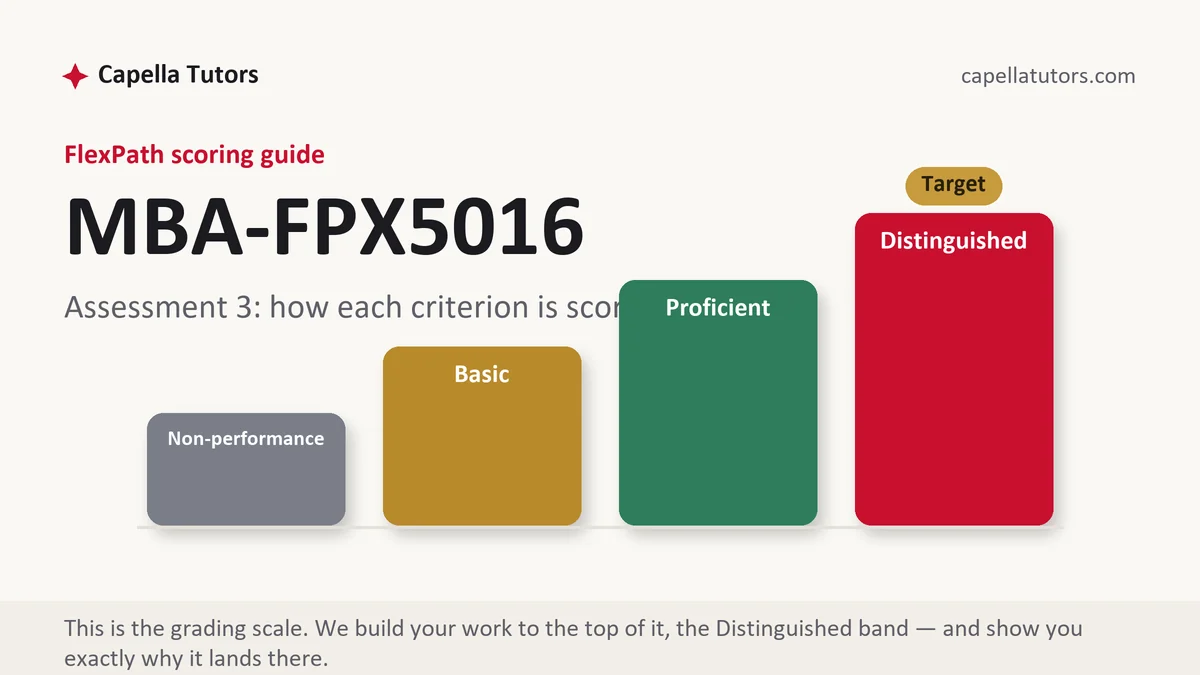
How Assessment 3 is scored

Every criterion resolves to one of four levels, and on a closing synthesis the levels separate on whether the paper rebuilds the operation or reports on it:

LevelWhat it means on an operations synthesis
DistinguishedThe whole operation is recomputed after the change, takt and cycle times are reconciled with demand, quality cost sits beside throughput cost, and the trade-off between them is decided on the page. Each criterion's top cell names its own additional demand; do what it names.
ProficientThe pieces assemble correctly and the figures agree, but the paper reports the trade-off rather than resolving it.
BasicA summary of the two earlier assessments with the arithmetic quoted instead of rerun. Recap is the default failure mode of a closing paper.
Non-performanceAn element the criterion required is simply absent, commonly the measurement plan or the revised rates. Evaluators score absence, not weakness.

Your scoring guide decides the exact deliverable, but the pattern across 5016 is that this paper answers to the two before it. The rates from the process analysis and the costed fix from the improvement case are inputs here, not citations, so any figure that was soft earlier gets exposed now. Rebuild them, do not paste them, and expect the binding step to have moved once the original constraint was relieved.

The method, step by step

  1. Treat the closing criteria as an audit

    Copy the guide's criteria into an empty document and read them as the questions an operations director asks after a project closes: what changed, what does the operation do now, what did it cost, what are we watching. Every paragraph you write answers one of those four. A closing paper without that framing drifts into narrative inside two pages, and narrative is exactly what the middle columns describe.

  2. Rebuild the rates from scratch

    Recompute every step under the new configuration rather than carrying forward figures from earlier submissions. Staffing moves, cycle times shift with the fix, and constraints relocate the moment the first one is relieved. Name the new binding step explicitly. A synthesis still pointing at the old bottleneck tells the evaluator the arithmetic was inherited rather than done.

  3. Set takt against the line you now have

    Takt is available production time divided by demand for that period, and it is the cleanest test of whether an operation fits its market. Compute it, then hold every step's cycle time against it. Steps above takt cap the system, steps far below it hold idle labor, and both facts belong on the page. This single division is what separates a closing argument from a status update.

  4. Price quality beside throughput

    Speed gains are easy to celebrate and easy to overstate, so put a number on defects: the error rate, the cost of each escape in rework, freight, refunds, or lost margin, and the annual total. Set that figure next to the throughput gain you claimed. The two are usually the same order of magnitude, and a paper reporting only the faster number has answered half its question.

  5. Decide the trade-off, do not describe it

    Almost every closing criterion is asking for a judgment: run faster or run cleaner, add labor or add equipment, serve the peak or serve the average. Lay the competing costs side by side, choose, and state what you are giving up. Recommendations that keep both options alive read as hedging, and hedging lands in the middle column however thorough the analysis behind it was.

  6. Sweep for contradictions, then self-score

    Read the finished draft once for numbers only: any figure appearing twice must be identical in both places, and anything inherited from an earlier assessment must match what you now claim. Then grade each criterion against its own top cell honestly. Submit early enough that a revision request still fits inside your session, since evaluations can take two business days.

A structure that maps to the criteria

These word targets come out of our tutoring files rather than from Capella; coverage is set by the guide in your courseroom, and a section runs long wherever its criterion needs the room.

SectionWhat it must doGuide
Introduction and scopeThe operation, what changed, and the question this synthesis settles, with the headline figures already in view.~130 words
The operation after the changeEvery step recomputed under the new configuration, the relocated constraint named, rates laid out so the reader can rerun them.~280 words
Takt time and demand fitAvailable time divided by demand, each cycle time compared against takt, capped steps and idle steps both identified.~280 words
Quality and its costError rate, cost per escape, annual total, set beside the throughput gain the improvement was sold on.~250 words
Trade-off and the operating recommendationThe competing costs compared, one course chosen, the surrendered option named rather than left open.~300 words
Measurement and limitsThe metrics that would confirm or refute this, their check cadence, and what the available data could not settle.~160 words
ReferencesCase data cited at the point of use, methods anchored in current operations scholarship, APA matched in both directions.as needed

Annotated sample excerpt

A short original passage from our files, picked because it performs the three moves this deliverable is graded on inside one paragraph. Read the moves, then run them on your own operation.

Sample excerpt: takt, quality cost, and the trade-off Original model · Capella Tutors

Halloway Apparel receives 1,150 returned garments a day against 7.5 productive hours, a takt of 23 seconds per unit, and the inspect-and-grade station that ran at 31 seconds now runs at 22 with the second grader added.1 The backlog therefore stops growing but does not drain, because one second of slack per unit recovers only 19 minutes across a full shift while the receiving dock, at 14 seconds, stands idle a third of the day.2 Grading errors run 6 percent, and each misgraded garment costs 11.40 dollars in return freight and rehandling, 787 dollars daily and roughly 205,000 dollars a year, which is larger than the throughput the second grader bought; the operation should therefore slow the station to 26 seconds, hold takt with a third shift hour rather than a faster cycle, and accept 340 dollars a day of overtime to remove most of that error cost.3

  • 1Takt computed from stated inputs, then the post-change cycle time placed against it. Both numbers are rebuilt here rather than carried over, which is what the synthesis criteria are checking.
  • 2The gain is sized honestly and the idle step is named. Reporting only the improvement, without the 19 minutes and the idle dock, is the Proficient version of this sentence.
  • 3Quality is priced in dollars, compared with the speed gain, and the trade-off is then decided with a stated cost accepted. Describing the tension and stopping there is where most drafts end.

The full premium sample for your exact assessment, written fresh to your scoring guide and issue, is free to request. Study it, revise it into your own voice, and submit work you understand.

Get the full sample free

The five mistakes that cost Distinguished

  • Recap with a new title. Summarizing the first two assessments, however accurately, answers a synthesis criterion at Basic and no higher.
  • Stale rates. Capacity figures computed before the change are the most common arithmetic failure here, and they usually leave the constraint in the wrong place.
  • Takt mentioned, never computed. The term appears in most drafts; the division appears in few, and the criterion is watching for the division.
  • Quality treated as a paragraph. Defects described in prose while every other claim carries a number tells the evaluator which analysis you skipped.
  • A recommendation with two answers. Presenting alternatives and declining to choose leaves the decision criterion unanswered; pick one and pay for it in writing.

Pre-submission checklist

  • Every step's rate recomputed under the post-change configuration
  • The binding step re-identified, including where it has moved
  • Takt computed from available time and demand, every cycle time compared against it
  • Defect rate, cost per escape, and annual quality cost stated in dollars
  • One trade-off decided on the page, with the surrendered option named
  • Figures reconciled across the document and each criterion self-scored before submission

Want the closing paper built to the top column?

Send the scoring guide plus whatever you submitted for the first two assessments. An eight-person team, including a research analyst and two QA reviewers, returns a premium original synthesis with the rates rebuilt, quality priced, and the trade-off decided, in 24 to 48 hours and revised free until it lands. This is the paper that sets how 5016 reads in your transcript; do not close the course on borrowed arithmetic.

Keep going

Online now