This manual is for MBA FPX 5016 Assessment 1, start to submission. Assessment 1 of MBA FPX 5016 is the course's process analysis: an operation mapped step by step, capacity computed at every stage, and the bottleneck identified by arithmetic rather than instinct. It is graded criterion by criterion against a FlexPath scoring guide, and the guide pays for computed rates, not efficiency vocabulary. Below you will find the method our tutors run for it, a structure that maps to the criteria, and an annotated excerpt showing the register that scores. Want it handled instead? A premium original sample for this exact assessment returns in 24 to 48 hours, revised free until it meets the guide. Capella's catalog lists the course as MBA-FPX5016, and some courserooms print MBA5016; both point to this same Assessment 1. In current courserooms this assessment typically appears as "Process Improvement Plan".
One honesty note before the manual: Capella revises courses and scoring guides over time, so always write to the exact scoring guide attached to your assessment in the courseroom. The course identity above is verified on capella.edu; the method and structure below are our tutors' approach to it, not Capella's official rubric text.
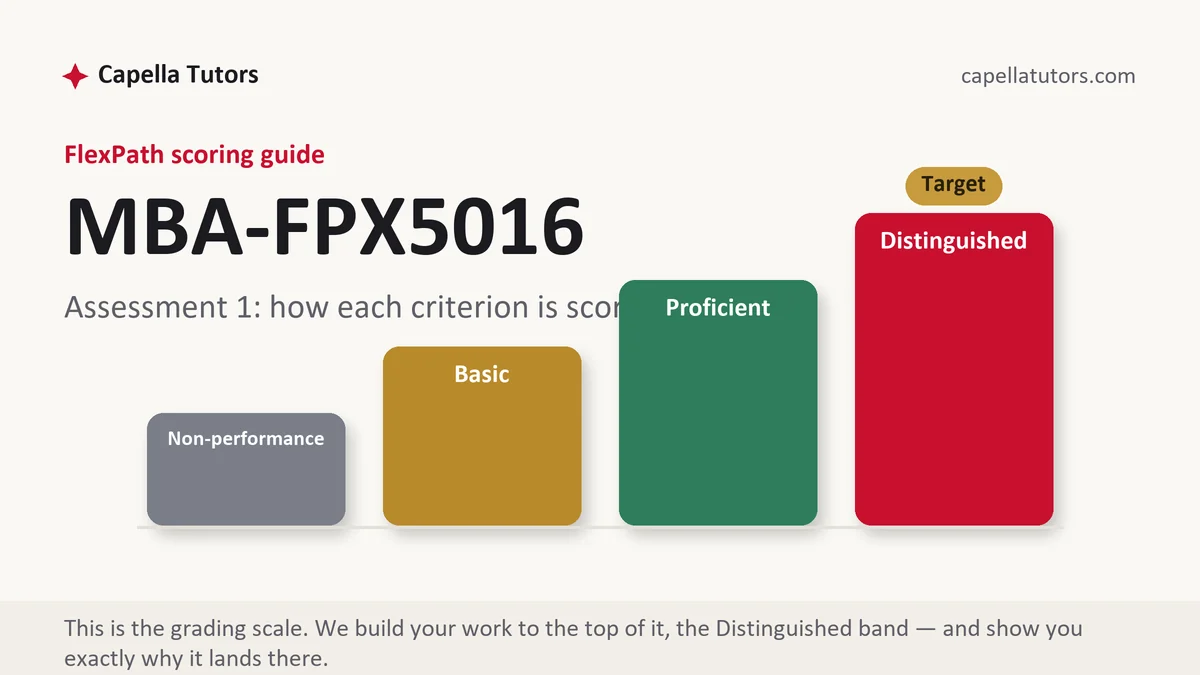
How MBA FPX 5016 Assessment 1 is scored
FlexPath never issues a letter grade; every criterion lands on one of four levels, and the distance between the levels is where this manual lives:
| Level | What it means on a process analysis |
|---|---|
| Distinguished | The flow is quantified end to end, the bottleneck is proven with utilization math against demand, and the paper states what the numbers still cannot show. Each criterion hides its own extra move in the Distinguished wording; find it and perform it. |
| Proficient | Every step carries a rate and the constraint is correctly named. Sound work that stops one computation short of proof. |
| Basic | A guided tour of the operation with numbers mentioned but never compared. This is where most first submissions in 5016 land. |
| Non-performance | A required computation is absent, most often per-step capacity. Evaluators drop a criterion to the floor for missing math, not weak math. |
Assessment 1 also carries the rest of the course on its back: your scoring guide decides the exact deliverable, but the pattern across 5016 is that the improvement case in Assessment 2 fixes whatever constraint you prove here, and the closing synthesis stands on both. Sloppy capacity math in the first paper becomes a mispriced recommendation in the second.
The MBA FPX 5016 Assessment 1 method, step by step
-
Pull the criteria out before you read the case
Copy each scoring-guide criterion into a blank document as a heading and paste its Distinguished description underneath. Only then open the case. The case is scenery; the criteria are the assignment, and every paragraph you eventually write should be traceable to one of those headings.
-
Walk the operation one step at a time
List every step in sequence, and for each one record three things: who staffs it, how long one unit takes, and what the step can therefore handle per hour. If the assessment lets you use your own workplace, real observed times beat remembered ones. Where the case omits a number, estimate it in the open and log the assumption; silent workarounds read as gaps.
-
Turn the map into rates
Capacity is arithmetic, not judgment: staff at a step divided by time per unit gives units per hour, and that computation must appear on the page for every step. A flowchart of boxes without rates is decoration. A table of rates the reader can recompute is analysis, and it is the single strongest signal of a Distinguished paper in this course.
-
Prove the bottleneck against demand
Set each step's capacity beside the arrival rate, in the same units, at the period that matters. The constraint is the step whose utilization crosses 100 percent while its neighbors idle, and you show it with a comparison, never a feeling. Be suspicious of the step that looks busiest; frantic and constraining are different properties, and only the numbers can tell them apart.
-
Charge the constraint to the whole system
A bottleneck matters because it caps everything downstream, so state its cost in system terms: throughput held to the constraint's rate, the queue growing by the difference each hour, idle capacity stranded behind the jam. This is the move that converts a correct identification into an argument a manager would fund, and it is usually where the top column's language points.
-
Mark your own guide before submission
Go criterion by criterion through the finished draft and assign each one a level, honestly, using the guide's own wording. Anything sitting at Proficient gets one more pass aimed at the exact phrase the Distinguished cell adds. Then submit with days to spare; evaluations can take two business days, and a resubmission needs room to happen inside your session.
A structure that maps to the criteria
These word targets are planning numbers from our tutoring files, not Capella requirements; your scoring guide decides coverage, and any section grows until its criterion is answered.
| Section | What it must do | Guide |
|---|---|---|
| Introduction | Name the operation, the demand it faces, and the question the analysis will answer, with the first numbers already present. | ~120 words |
| Process map and step data | Every step in sequence with staffing, time per unit, and hourly capacity, laid out so the reader can recompute it. | ~250 words |
| Capacity versus demand | Per-step rates set against the arrival rate at the period that matters, utilization computed for each stage. | ~350 words |
| The bottleneck and its system cost | The constraint proven by comparison, then charged to the operation: capped throughput, queue growth, stranded capacity. | ~300 words |
| Findings and implications | What the arithmetic means for management, plus what the data could not show and what a fuller study would measure. | ~150 words |
| References | Case exhibits cited where their numbers appear, methods grounded in current operations scholarship, APA matched both ways. | as needed |
Annotated sample excerpt
Here is a short original passage from our files, written to show what computed analysis sounds like on the page. Study the moves, then make them with your own case's numbers.
Bridgewater Urgent Care staffs one registration clerk whose intake takes five minutes per patient, a capacity of 12 patients per hour.1 Weekday evening arrivals average 14 per hour, so registration runs at 117 percent utilization while triage, at 16 per hour, and the four exam rooms, at a combined 18, wait on it at 88 and 67 percent respectively.2 The clinic's throughput is therefore capped at 12 patients per hour by a desk rather than a clinician, and each four-hour evening peak deposits eight unregistered patients into the waiting room that no downstream capacity can recover.3
- 1The first sentence converts an observed step into a rate. Every later claim computes from this number, which is why it appears before any judgment does.
- 2The bottleneck is proven by comparison: one step over 100 percent utilization, its neighbors idling, all in the same units. This is the exact arithmetic the top column pays for.
- 3The constraint gets charged to the system, capped throughput plus queue growth, stated as cost a manager can feel. Identification alone would have scored Proficient.
The full premium sample for your exact assessment, written fresh to your scoring guide and issue, is free to request. Study it, revise it into your own voice, and submit work you understand.
The five mistakes that cost Distinguished
- The guided tour. A narrative of what the operation does, warm and observant and containing no computed rate, answers none of the analysis criteria.
- Blaming the busy step. The station that looks frantic is often not the constraint; evaluators check whether your bottleneck came from arithmetic or from optics.
- Averages that hide the peak. Demand averaged across a full day can bury the rush hour where the actual problem lives; analyze the period your case is really about.
- Rates without a comparison. A capacity for every step, never set against demand, identifies nothing; the bottleneck exists only in the comparison.
- A map nobody can compute from. Boxes and arrows with no times attached force the evaluator to take your word, and the guide does not pay for taken words.
Pre-submission checklist
- Each scoring-guide criterion owns a labeled section written to its Distinguished wording
- Every process step shows staffing, time per unit, and computed hourly capacity
- Per-step capacity compared against demand in the same units, at the peak period
- The bottleneck proven by utilization and its system cost stated in throughput terms
- Every assumption logged where the case left a number out
- Draft self-scored level by level, submitted early enough for a revision cycle
Want this analysis done with backup?
Send the scoring guide and whatever process data your case supplies. An eight-person team, including a research analyst and two QA reviewers, returns a premium original sample computed to the Distinguished column in 24 to 48 hours, revised free until it gets there. The constraint math you hand in here prices the recommendation you write next; start the course on solid arithmetic.