Core Marketing Management runs as MBA FPX 5012 at Capella, 2 pts / 4 qcr, available in FlexPath in the MBA path. In Capella's catalog the course code is written MBA-FPX5012.
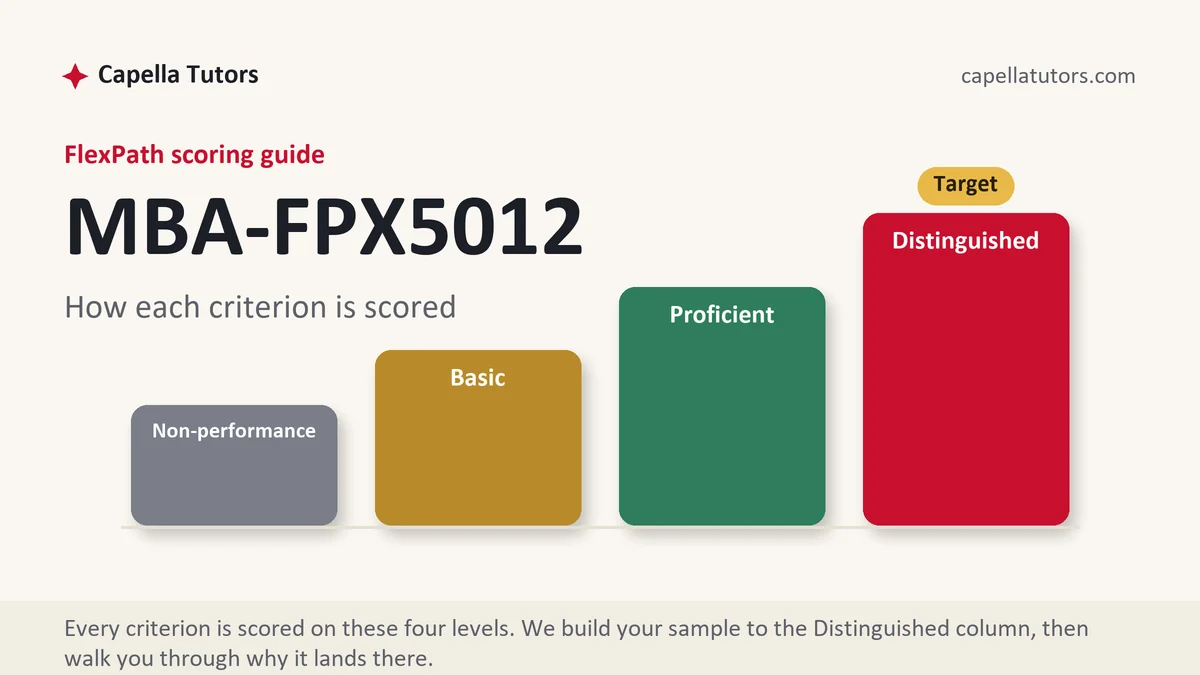
What MBA FPX 5012 actually grades
Marketing management graded as strategy, not slogans: segmentation, positioning, and marketing-mix decisions defended with evidence about a real offering. Distinguished work names a target customer narrowly and accepts the trade-offs of excluding everyone else; Basic work markets to everyone and therefore to no one, which the criteria are written to catch.
How we help in this course
We draft positioning that commits, segments sized with real market data where it exists, mixes that follow from the strategy instead of decorating it. Marketing is where confident vagueness feels most natural and grades worst; the sample shows the alternative.
The service terms are the same ones the whole site runs on: 24 to 48 hour delivery per deliverable, Distinguished or A targets matched to your format, two independent QA passes before anything reaches you, and free revisions until the target is met.
Assessment manuals for this course
Every assessment in MBA FPX 5012 has its own manual now: the walkthrough, the structure that maps to the criteria, an annotated sample excerpt, and the done-for-you door. Open Assessment 1, Assessment 2, Assessment 3, or start from the list in the sidebar.
In MBA FPX 5012 right now?
Send the assessment number and the scoring guide from your courseroom. First premium sample free, back in 24 to 48 hours.
The criteria are written to catch confident vagueness
Marketing is where plausible-sounding generality feels most natural and grades worst, and the 5012 scoring guides are constructed accordingly: they reward a target customer named narrowly, positioning that accepts the trade-offs of excluding everyone else, and mix decisions that follow from the strategy. Marketing to everyone reads as Basic because it commits to nothing the criteria can credit. Our drafts choose, segments sized with real market data where it exists, positioning that would survive a competitor's rebuttal, and the Distinguished extras placed where each column names them. The guides here filter for commitment, and drafts that commit clear the filter.
Momentum math for a 2-point course
On the FlexPath loop, 5012 closes the way the pathway intends when each assessment returns fast and lands in the top column the first time: submit, take the evaluation, move. The desk holds its 24 to 48 hour window for every deliverable, folds evaluator feedback into free revisions when asked, and keeps the course from stretching across billing-session weeks that the flat rate makes valuable.
Can I bring my own company as the subject?
If the assessment permits it, yes, and drafts built on an offering you actually know tend to hit the specificity the top column pays for with less effort. Identifying details get stripped wherever your employer's situation calls for it.
What proves the method before I pay?
The free first sample: a complete positioning deliverable with its criterion map, readable against your own scoring guide the day it arrives.
The assessments, one by one
Assessment 1: Marketing Plan
Business context, situation analysis with SWOT and PESTLE, marketing strategy, tactics and expected results, revenue goals and annual plan controls. Read the full Assessment 1 manual.
Assessment 2: Marketing Analysis Report with Metrics
Analyze a business's industry, customers, offerings, competitors and market characteristics, and evaluate its marketing using metrics such as social media data. Read the full Assessment 2 manual.
Assessment 3: Digital Marketing Plan
Digital marketing objectives, target audience, channels such as search, social, email and content, budget, and the metrics used to evaluate results. Read the full Assessment 3 manual.
How to actually write MBA FPX 5012: where to begin
Start in the courseroom, not in a blank document. Open the assessment's scoring guide, copy every criterion into your draft as a section heading, and paste its Distinguished description underneath. That outline is the actual assignment; the instructions above it supply scenario and context. A typical 5012 deliverable is a marketing plan or a campaign analysis for one named offering, so the criteria usually walk some version of the classic chain: market and customer analyzed, segments defined and one targeted, a positioning claim staked, and mix decisions that carry the positioning into product, price, place, and promotion.
With the skeleton set, gather raw material before writing a sentence. You need the offering itself, real or cased, and the numbers that describe its market: segment sizes, growth rates, competitor prices, share data where it exists. Then make the one decision the whole paper hangs on: who exactly the target customer is, described narrowly enough that most buyers are excluded. Every later section either defends that choice or spends it.
Draft in analysis order, not document order. Market analysis first, because segmentation depends on it; segmentation before targeting; targeting before positioning; positioning before any mix decision. If the format wants an executive summary, write it last and put the recommendation in its first sentence.
| Section | What goes in it | What Distinguished looks like |
|---|---|---|
| Market and customer analysis | Market size, growth, trends, and buyer behavior for this offering, built from data. | Every number sourced, and each finding ends with what it implies for the strategy, not just what it is. |
| Segmentation and targeting | Three or four segments defined on variables that predict buying, one selected. | Segments sized in dollars or units, the winner chosen on economics, the rejected segments named with reasons. |
| Positioning | A statement naming the target, the frame of reference, and the point of difference. | The claim defended against the strongest competitor's counter, with the trade-offs of excluding other buyers accepted in writing. |
| Marketing mix | Product, price, place, and promotion decisions for the chosen segment. | Each of the four traceable to the positioning in one sentence, price justified against the segment's willingness to pay. |
| Metrics and budget | Objectives, spending logic, and how success gets measured. | Specific KPIs with numeric targets and a review cadence, each tied to an objective stated earlier. |
Developing the analysis
The difference between Basic and Distinguished in 5012 is whether you run the frameworks or describe them. A paragraph explaining what segmentation is scores Basic; a paragraph that actually segments this market, names the variables used, and sizes the result scores Distinguished. The same rule governs positioning: do not assert that the offering is differentiated, argue it from segment economics. If the target segment is 400,000 buyers who pay a premium for convenience and the nearest competitor serves them through a channel they distrust, the positioning writes itself and the evaluator can follow every step. Then close the loop: end each section with a sentence that answers its criterion in the criterion's own verbs, because the evaluator is reading with the guide open and rewarding exactly that visibility.
Citations that survive faculty review
MBA evaluators read citations as evidence of research behavior, so every source should be doing named work for a specific criterion: an industry report sizing the market, a peer-reviewed article grounding the segmentation logic, competitor pricing pulled from public materials. Aim for current sources, mostly inside five years, and integrate them into argument sentences rather than parking them at paragraph ends: the segment grew 11 percent annually through 2025 (author, year), which is what makes the premium positioning affordable, beats a bare statistic with a citation attached. Find sources through the Capella library first, ABI/INFORM and Business Source Ultimate for scholarship and trade press, the report databases for market sizing, and competitor annual reports for pricing and channel facts. Match every in-text citation to the reference list both ways in current APA before submitting, because citation mismatch is the most common revision trigger in otherwise strong work.
The mistakes that land Basic instead of Distinguished
- Targeting everyone. A broad target reads as no decision made, and the criteria are written to catch it.
- Describing the four Ps instead of deciding them. Definitions of price strategy are textbook recital; a price with a defense is analysis.
- Positioning in a competitive vacuum. A point of difference means nothing until the paper names who it differs from.
- Unquantified market claims. A large and growing market is filler; a sized market with a source is evidence.
- Theory paragraphs with no application. Every framework mentioned must be run on this offering or cut.
MBA FPX 5012 questions students actually ask
Can I write about a famous company like Nike or Starbucks?
Where the prompt allows a free choice, you can, but giants make weak papers: their positioning is already settled and public, which leaves you summarizing rather than deciding. A mid-size firm, a regional brand, or your own employer gives you open decisions to make and defend, which is where the Distinguished column lives. If you use your employer, strip identifying details to a professional standard.
Where do I find market data without paying for industry reports?
The Capella library covers most of it: ABI/INFORM and Business Source Ultimate carry trade press and market coverage, and the library's report databases carry sizing data. Beyond that, census and government statistics, trade association publications, and the 10-K filings of public competitors are free and citable. When a number simply does not exist, estimate it transparently, state the assumption, and note what better data would change.
How many sources does a 5012 assessment need?
Scoring guides rarely fix a number, they ask for relevant, credible, current evidence. The working floor our tutors use is five to seven sources with each one doing a distinct job: two carrying market data, two or three peer-reviewed pieces grounding the strategy logic, and competitor materials for pricing and channel facts. Ten sources that each earn a sentence beat twenty that decorate the reference list.