This manual is for MBA FPX 5012 Assessment 2, start to submission. The Marketing Analysis Report with Metrics asks you to analyze the marketing of a business, often a local company: its industry, whether it sells to businesses or consumers, its offerings, its competitive environment, the characteristics of its market, and its marketing performance measured with metrics such as social media engagement, customer costs and other data. The grade turns on metrics. A report that uses numbers to judge the marketing, and explains what they mean, scores above a description of the business. Below is the method our tutors use, a structure that maps to the criteria, and an annotated sample excerpt. Prefer to hand it off? A premium original sample for this exact assessment comes back in 24 to 48 hours, revised free until it meets the guide. Capella's catalog lists the course as MBA-FPX5012, and some courserooms print MBA5012; both point to this same Assessment 2. In current courserooms this assessment typically appears as "Marketing Analysis Report with Metrics".
One honesty note before the manual: Capella revises courses and scoring guides over time, so always write to the exact scoring guide attached to your assessment in the courseroom. The course identity above is verified on capella.edu; the method and structure below are our tutors' approach to it, not Capella's official rubric text.
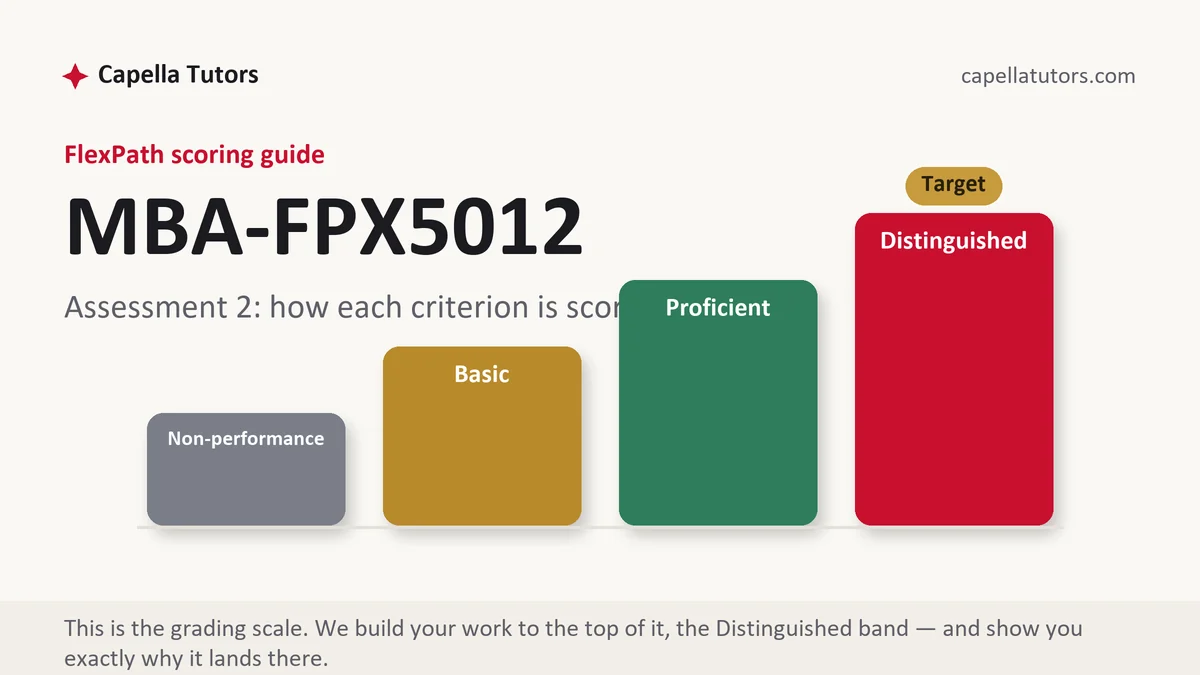
How MBA FPX 5012 Assessment 2 is scored
FlexPath does not use letter grades. Each criterion in the scoring guide lands on one of four levels, and the level descriptions are the real writing brief:
| Level | What it means on a marketing analysis report |
|---|---|
| Distinguished | The marketing analysis report is specific to the organization or case, applies course concepts accurately with credible sources, and ends in justified conclusions or recommendations. |
| Proficient | The marketing analysis report is accurate, but the application or recommendations are general. |
| Basic | The marketing analysis report describes concepts with little application. |
| Non-performance | A required part of the marketing analysis report is missing. |
Gather real metrics where you can, such as follower counts, engagement rates and review scores.
The MBA FPX 5012 Assessment 2 method, step by step
-
Describe the business
Industry, B2B or B2C, and offerings.
-
Analyze competitors
Top competitors and how the business compares.
-
Describe the market
Customers, size and trends.
-
Collect metrics
Social media, reviews, costs.
-
Interpret the metrics
What they say about marketing performance.
-
Recommend
Changes supported by the metrics.
A structure that maps to the criteria
Word counts are planning targets our tutors use, not Capella rules; follow the length and format your scoring guide states.
| Section | What it must do | Guide |
|---|---|---|
| Business, industry and offerings | Context. | ~150 words |
| Competitive environment | Competitors compared. | ~150 words |
| Market characteristics | Customers and trends. | ~100 words |
| Metrics and recommendations | Data and changes. | ~200 words |
| References | Sources. | as needed |
Annotated sample excerpt
An original model excerpt from our team, written to show the register that reaches the top of the guide. Learn the moves, then write your own version.
The restaurant has more Instagram followers than three of its four main competitors, but its engagement rate, likes and comments per post divided by followers, is under 1 percent, compared with about 3 percent for the busiest competitor.1 Its posts are mostly menu photos, while the competitor's most engaged posts show staff and regular customers.2 The metrics suggest the problem is not reach but relevance, so the recommendation is to shift content toward people and events and measure engagement monthly.3
- 1Uses a defined metric with a comparison.
- 2Finds the likely cause.
- 3Recommends a change with a measure.
The full premium sample for your exact assessment, written fresh to your scoring guide and topic, is free to request. Study it, revise it into your own voice, and submit work you understand.
The five mistakes that cost Distinguished
- Definitions without application. Apply each concept to the organization or case.
- No sources. Cite credible business sources.
- Vague recommendations. Make them specific and justified.
- Description without metrics. Use numbers to judge performance.
Pre-submission checklist
- Business described
- Competitors analyzed
- Market described
- Metrics collected
- Metrics interpreted
- Recommendations and references
Want the marketing analysis report written?
Send the scoring guide and any materials from your courseroom. Our team returns a premium original marketing analysis report in 24 to 48 hours, revised free until it meets the guide.