How to write MBA-FPX5012 Assessment 3

The short answer

The final deliverable in MBA-FPX5012 pulls the course into one document: a market read, a target, a position, a mix, and a budget that has to answer for itself. Your scoring guide fixes the format, but a closing synthesis is graded on whether the chain holds and whether the plan can be defended in money. The habit that costs students the top column is arguing enthusiasm, a program described as engaging rather than as profitable at a stated lift. Want it handled instead? A premium original sample comes back in 24 to 48 hours with free revisions until the guide is met.

One honesty note before the manual: Capella revises courses and scoring guides over time, so always write to the exact scoring guide attached to your assessment in the courseroom. The course identity above is verified on capella.edu; the method and structure below are our tutors' approach to it, not Capella's official rubric text.
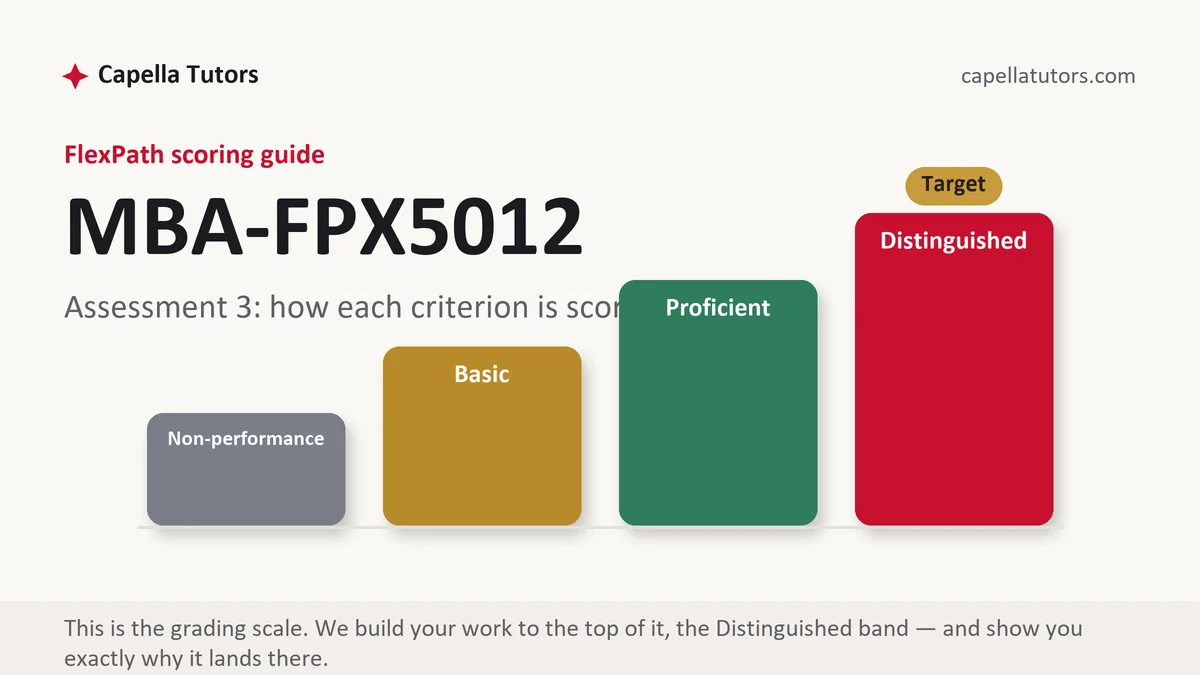
How Assessment 3 is scored

The four-column ladder applies to every criterion, and on the closing deliverable the columns divide like this:

LevelWhat it means on the closing marketing synthesis
DistinguishedThe chain holds end to end, segment through position through mix, and the plan answers in money: what it costs, what it returns, and what has to be true for the return to appear. Measurement is designed in rather than promised at the end.
ProficientA complete plan, each part present and internally consistent, with the economics left qualitative. Complete and accountable are different standards, and the guide is written for the second.
BasicCourse frameworks applied in sequence over a case with a budget appended at the end. Coverage without an argument, which is what the synthesis criterion refuses to credit.
Non-performanceA required element of the plan, or the evaluation of it, is absent. Nothing else in the paper compensates for a section that is not there.

Treat the earlier assessments as inputs rather than as material to summarize. What is new here is the argument connecting them to a spending decision, so give the plan and its economics the space and let the recap run short.

The method, step by step

  1. Name the one marketing decision the synthesis answers

    A plan is not a topic. Decide what leadership is being asked to approve, a launch, a campaign, a program, a repositioned line, and write it at the top with the money attached. Everything then has a job: establish the opportunity, choose the buyer, stake the claim, spend the budget, prove the return. Papers without that spine read as a course review with headings.

  2. Rebuild the chain on a single page before you draft

    One page, five lines: the segment, its size, the position, the three mix decisions that carry it, and the objective in a number. If any line does not follow from the one above it, the plan has a break, and a break that survives to the draft becomes a criterion the evaluator marks down.

  3. Convert the objective into a number someone owns

    Increase awareness is not an objective. Move trial among the target segment from 4 percent to 7 percent by the end of the second quarter, owned by the brand manager, is. Attach the metric to a source you could actually pull, panel data, point-of-sale, subscription records, and state the baseline. Objective and evaluation criteria are graded on that specificity.

  4. Test the economics rather than the enthusiasm

    Every program has a cost and a claimed effect. Put both in the same units per customer or per period, subtract, and see whether what is left is positive. Discounts, loyalty credits, and free trials are the usual traps, because their cost is paid on all buyers while the benefit lands only on the ones whose behavior changed.

  5. Design the measurement before you spend the budget

    Say how you will know it worked, in a way that could produce a bad answer. A holdout group, a matched-store comparison, a pre-period baseline, whatever the case supports. Measurement written after the spend is a promise; measurement written into the plan is a control, and only one of the two reads as management.

  6. Read the plan as the budget owner, then self-score

    Reread asking what the person paying will ask: what does this cost, what do I get, when do I know, what if it misses. If any answer is missing, the criteria on implications and evaluation are already short. Then self-score against the guide, revise below-target sections, and submit early in the week.

A structure that maps to the criteria

The targets below are our tutors' planning ranges for a typical closing plan, not Capella rules; your own scoring guide decides the real length.

SectionWhat it must doGuide
Executive summaryThe decision, the money, and the expected result in the first three sentences.~130 words
Situation and the decisionThe market, the competitive position today, and what leadership is being asked to approve.~200 words
Strategy: segment, target, positionThe chain restated tightly, each link carrying the evidence that supports the next.~300 words
The plan: mix and budgetThe program itself, the mix decisions behind it, and what each line of the budget buys.~320 words
Economics and measurementCost against expected return in the same units, the break-even, and how results get verified.~300 words
ReferencesMarket and trade sources, competitor materials, and marketing literature in current APA.as needed

Annotated sample excerpt

Below is original model work from our team, chosen to show a marketing program put through arithmetic instead of adjectives.

Sample excerpt: program economics Original model · Capella Tutors

Calderwood Markets' loyalty proposal is a 4 percent basket discount for enrolled households, and it pays only if it changes behavior rather than subsidizing it. Enrolled households in the pilot spent $1,860 a year against $1,410 for comparable non-enrolled households, but roughly two thirds of that gap was already present before enrollment, so the defensible incremental lift is about $150 a household, not $450.1 At the chain's 26 percent gross margin, $150 of lift returns $39, while the discount costs 4 percent of $1,860, or $74, leaving the program $35 a household under water before a dollar of platform cost.2 It turns positive only where enrollment is restricted to the two segments whose pre-enrollment spend sat below the chain median, where the same arithmetic yields $18 a household, so the recommendation is a targeted program with a hard eligibility rule rather than a chainwide rollout.3

  • 1Self-selection is stripped out before any lift is claimed. Enrolled shoppers spend more because heavy shoppers enroll, and a plan that misses this overstates its case threefold.
  • 2Cost and return are computed in the same unit and period, and the program is shown losing money at face value. Reporting an unflattering result you then fix is a Distinguished move.
  • 3The recommendation narrows the program instead of abandoning it, and the course's segmentation work reappears as the mechanism. That is the chain holding.

The full premium sample for your exact assessment, written fresh to your scoring guide and issue, is free to request. Study it, revise it into your own voice, and submit work you understand.

Get the full sample free

The five mistakes that cost Distinguished

  • Engagement reported as return. Sign-ups, impressions, and app opens are activity; unless the paper converts them into margin, the economics criterion has nothing to score.
  • Self-selection left in the numbers. Comparing participants with non-participants and calling the gap a lift is the commonest analytical error in loyalty work.
  • A chain that breaks in the middle. A tight segment followed by a mass-market campaign tells the evaluator the strategy sections were written for their own sake.
  • A budget with no economics. Line items answer what it costs and leave what it returns unanswered, which is the half the closing criteria weigh most.
  • Measurement promised, never designed. We will track results could have been written before the plan existed, and evaluators read it as a placeholder.

Pre-submission checklist

  • The decision leadership is being asked to approve, stated with its money in the opening
  • The chain from segment to position to mix visible on one page before drafting
  • An objective with a baseline, a target, a date, and a named owner
  • Program cost and expected return computed in the same units, with the break-even stated
  • A measurement design that could return a negative result, not just a promise to track
  • Every criterion answered in a locatable section, draft self-scored, submitted early in the week

Want the closing plan built with you?

Send the scoring guide, the case, and your earlier submissions so the plan builds on the segment and position you already argued. The desk runs research, drafting, and two independent QA passes against your guide, delivers a premium original sample in 24 to 48 hours, and revises free until the target column is met.

Keep going

Online now