Send the system description and the criteria that came with it, and a premium original sample lands inside 24 to 48 hours with every security claim carrying the evidence that would satisfy an assessor, traced from requirement to control to test to result, reviewed by a second reader before delivery. The catalog lists this as IT FPX 4803, System Assurance Security, worth 3 program points, a core course inside the General Information Technology FlexPath specialization that also counts toward the Information Assurance and Cybersecurity specialization, taught in FlexPath within a BS in Information Technology built on at least 90 program points including a minimum of 27 at the 3000 level or above. Your program evaluation is the place to confirm which of those two roles it is playing on your plan. In Capella's catalog the course code is written IT-FPX4803.
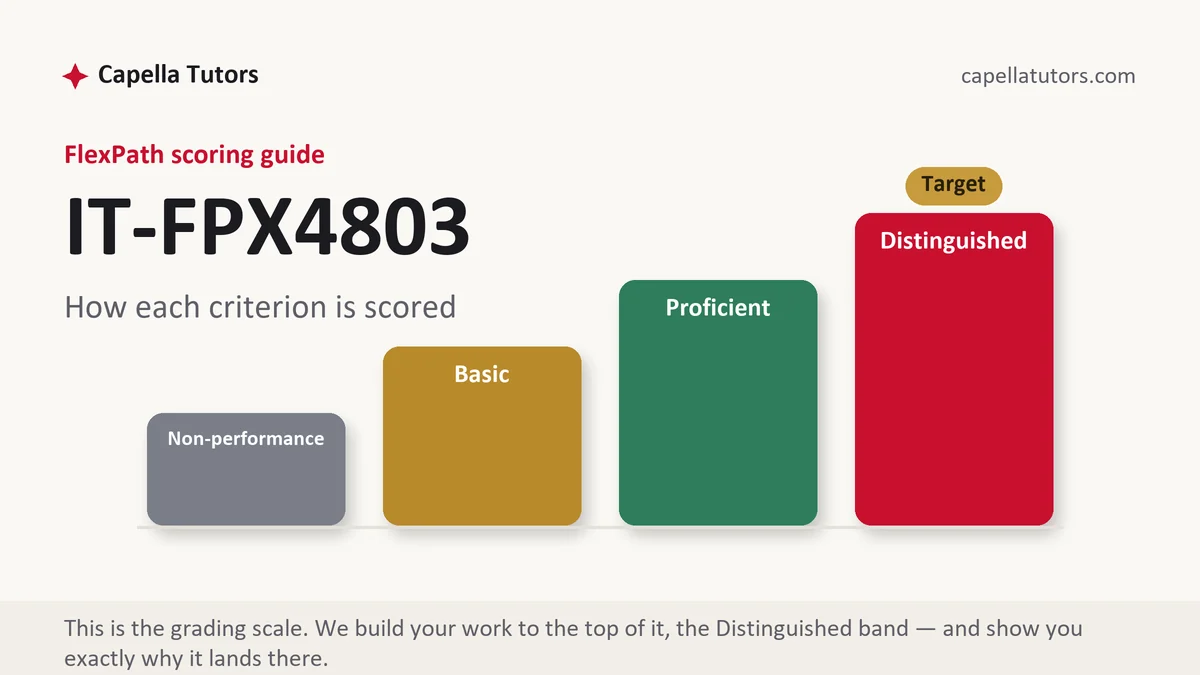
What IT FPX 4803 actually grades
Assurance is the evidence half of security, and the criteria in this course are built around a single question: not whether a control exists, but whether you can prove it does what it claims and keeps doing it. That starts with requirements, and the distinction between a requirement and an intention is the first place marks move. A sentence saying the system will be secure cannot be tested, cannot be assessed, and cannot be traced, while a sentence saying that an idle session is invalidated within fifteen minutes and that the invalidation is logged can be verified by anyone with an account and a stopwatch. Build the whole document on that difference. Every requirement gets an identifier, every control names the requirement it implements, every test names the control it exercises, and every result names the test. That chain is what an assessor follows, and a paper that cannot be walked in that direction is graded as description rather than assurance no matter how much technical content it holds.
The middle of the course is where assurance is actually built, which is inside the development and configuration lifecycle rather than after it. Threat modeling comes first and works best against a data-flow view with trust boundaries drawn on it, using a structured prompt set so the exercise is repeatable: spoofing an identity, tampering with data, repudiating an action, disclosing information, denying service, and elevating privilege, applied to each element and each crossing. Design review follows, then coding standards, then verification split into complementary techniques, since analysis of source code finds different defects than exercising a running instance, and neither finds what a careful review of the authentication and authorization paths finds. Components you did not write are part of your attack surface, so dependency analysis and an inventory of what is actually inside the build belong in the same section. Configuration assurance runs alongside it: a hardened baseline taken from a published benchmark rather than invented, a record of every deliberate deviation with its justification, drift detection so the baseline is a live state rather than a memory, and change control so a fix does not quietly undo a control.
The closing strand is the decision layer, and it is the part IT students most often leave out. Assessment produces evidence, an authorizing official reads that evidence and accepts the residual risk in writing, and continuous monitoring keeps the decision honest in the months afterwards, which is the whole argument for the categorize, select, implement, assess, authorize, and monitor cycle that most course material uses as its spine. Independence matters inside that cycle: the person who implemented a control should not be the only person who says it works, and where a course project makes you both, say so and describe how you compensated. Logging deserves its own paragraph, because a log that can be edited by the account whose misuse it would record is not evidence, which makes integrity protection and separation of the log store part of the control set rather than an operational detail. Vulnerability handling closes it out, and the discipline is priority rather than volume: a published severity number describes a defect in the abstract, and your environment decides what it means here.
How we help in this course
Assurance work from us is built as an evidence plan first and prose second. Requirements come back numbered and testable, the threat model is worked element by element against the boundaries you drew, controls are mapped to the catalog reference and the requirement they satisfy, test procedures state the steps and the expected outcome before the result, findings carry an environment-adjusted priority rather than a copied severity, and the authorization section states residual risk in words a decision maker could sign next to. Tell us the system, its data, its exposure, and the framework your faculty named, and the document will hold together end to end.
Studio terms apply without change. The deliverable arrives inside 24 to 48 hours, written to the Distinguished descriptors, after eight people have handled it: research pulls the guide and the current revisions of every standard involved, a subject writer builds the requirement chain and the test procedures, a scoring-guide reviewer scores the draft the way your evaluator will, an APA and originality pass reconciles the references, and an editor reads it last. Revision is free until the guide is met, faculty comments return to the queue at no charge, and since an evaluated attempt can take two business days to come back, a draft that goes in early leaves room for the one criterion that always needs another pass.
The assessments, one by one
Assessment 1
The opening deliverable in IT FPX 4803, System Assurance Security, generally asks you to draw a boundary and then write security requirements inside it that somebody could actually test: what is in scope, what connects to it, what data it holds and at what sensitivity, who uses it, and what is deliberately excluded. Read the full Assessment 1 manual.
Assessment 2
The middle deliverable in IT FPX 4803, System Assurance Security, usually asks you to model the threats against a data-flow view and then produce verification evidence for the controls you claim: a structured enumeration per element and per boundary crossing, complementary analysis techniques chosen. Read the full Assessment 2 manual.
Assessment 3
The closing deliverable in IT FPX 4803, System Assurance Security, is usually where evidence turns into a decision: findings prioritized on exposure in your environment rather than on a published base score, remediation with owners and dates, a residual risk statement somebody accepts in writing,. Read the full Assessment 3 manual.
How to actually write IT FPX 4803: where to begin
Convert the criteria into an evidence plan before you write a paragraph. Each claim the guide asks for gets a row: the claim, the artifact that supports it, and where that artifact comes from, whether that is a configuration excerpt, a scan output, a test transcript, a policy clause, or a log entry. Rows with no artifact are the honest map of what you still have to do, and they also tell you which claims to soften. Then write the system description tightly, since assurance is scoped work and a boundary that drifts makes every later statement ambiguous. Name what is inside the boundary, what connects to it, what data it holds and at what sensitivity, who the users are, and what is explicitly excluded and why.
Then write one requirement all the way through, because that single worked chain teaches the pattern for the rest of the document. Take a lockout requirement: accounts lock after five failed authentication attempts inside fifteen minutes and remain locked for thirty. The weak version of this paragraph says the system enforces account lockout. The version that reaches the top column names the setting and the value it is set to, cites the benchmark item that recommends it with the benchmark version attached, states the test procedure as six deliberate failures from a disposable test account, records that the sixth attempt was refused and that a subsequent correct password was also refused inside the lock window while access returned after the interval elapsed, quotes the log entries generated at each step as the evidence that the event is auditable, and then names the residual exposure, which is that a lockout policy converts a password-guessing attack into a denial-of-service against real accounts, mitigated by rate limiting per source address rather than by the per-account counter alone. That is requirement, control, test, result, and residual risk in one paragraph, and it is the shape every other requirement in your document should take.
Then show that you can triage rather than transcribe. A scan that returns forty findings with six marked at the top severity is not a work plan. Sort them by exposure, by the data behind the affected service, by whether working exploit code is publicly available, and by what compensating controls already sit in front of them, then write the sort criteria down. If four of those six critical findings sit on a segment with no inbound route and no user access, and a mid-severity finding sits on the internet-facing login, the two remaining criticals and that one middling finding are the week's work, and saying so with the reasoning attached demonstrates the judgment the analysis criterion is looking for. Close the document with the monitoring plan, meaning what is watched, at what interval, by whom, and what change would trigger a reassessment before the next scheduled review.
| Section | What goes in it | What Distinguished looks like |
|---|---|---|
| Scope and categorization | System boundary, components, data types and sensitivity, users, interfaces, and stated exclusions. | An impact level argued from the data and the mission rather than assigned by habit. |
| Security requirements | Numbered, testable requirements derived from the categorization, the framework, and any regulation in play. | Each requirement phrased so a pass or fail is observable, with its source cited. |
| Threat model | A data-flow view with trust boundaries, threats enumerated per element, and the ones ruled out explained. | A structured method applied consistently, with dismissed threats justified rather than ignored. |
| Verification activities | Static and dynamic analysis, code review, dependency inventory, configuration benchmark, and scanning. | Techniques chosen for what each finds, with coverage and blind spots both stated. |
| Findings and remediation | Findings with environment-adjusted priority, remediation actions, owners, dates, and retest results. | Priority defended on exposure and impact rather than copied from a base severity score. |
| Authorization and monitoring | Residual risk statement, the accepting authority, monitoring measures and cadence, and current APA references. | Residual risk quantified or bounded, with a trigger that forces reassessment before the next cycle. |
Developing the analysis
The argument worth taking a position on is whether compliance produces assurance, and a paper that resolves it in its own words gains a criterion outright. The case for the checklist is stronger than skeptics allow: a published benchmark encodes what a community of practitioners agreed on, it makes two systems comparable, it gives an auditor something repeatable to test, and it stops a junior administrator from inventing a security posture from scratch on a Tuesday afternoon. The case against is the one every practitioner has watched happen: a control catalog rewards the production of documents, an assessment window can be survived by preparation rather than by practice, and organizations with clean audit results appear in breach reporting often enough that the correlation between paperwork and defense is visibly loose. The graded move is to name the specific place where the two disagree for your system. Say which benchmark items your threat model considers irrelevant to this deployment and why, which threats your model raises that no benchmark item covers, and what you would test anyway despite a passing checklist. Then state the cost, because independent testing outside the compliance scope is time somebody has to fund, and an argument for it that ignores the budget is not an argument a manager can act on.
Citations that survive faculty review
Assurance writing lives or dies on whether its sources can be checked, so version numbers are not optional. The national standards institute publications are the backbone: the risk management framework document for the lifecycle, the security and privacy control catalog for control text, the assessment procedures companion for how a control is tested, and the secure software development framework for the development side, each cited with the revision because control identifiers and wording move between revisions and an unversioned citation tells the evaluator you took it secondhand. Configuration claims cite the benchmark or the technical implementation guide by version and by the item number you applied. A severity claim cites the vulnerability record itself plus the version of the scoring specification you used, since the same defect can carry different arithmetic under different specification versions. Application-level requirements map cleanly to the open application security project verification standard, which numbers its requirements for exactly this purpose. Where the frame is a management system rather than a federal one, the international information security management standards supply the structure and the control annex. Vendor advisories are primary for what a defect is and never authoritative for what it means in your environment. Peer-reviewed work through the Capella library carries any claim about how effective a control actually is, and industry breach reporting carries scale figures only when the publication year appears in your sentence. Reconcile the reference list in both directions in current APA before you submit.
The mistakes that land Basic instead of Distinguished
- Requirements written as adjectives. A system described as robust or hardened gives an assessor nothing to test and a grader nothing to reward.
- Evidence asserted rather than shown. Saying a control was verified is a claim, while a procedure, a transcript, and a log entry are evidence.
- Base severity scores used as the work order. A published number describes the defect in the abstract and says nothing about reachability in your network.
- The builder assessing their own control with no comment. Independence is part of the method, and a project that cannot provide it has to say so and compensate.
- Monitoring defined as an annual review. A control state that is only checked once a year is a control state that is unknown for eleven months.
IT FPX 4803 questions students actually ask
What is the real difference between a scan and a penetration test in my write-up?
They answer different questions and the criteria expect you to know which one you performed. A scan compares what it can see against a database of known defects and returns a list with severities attached, which makes it broad, repeatable, cheap enough to run weekly, and blind to anything that requires chaining two small weaknesses into one real path. A penetration test starts from an objective, uses judgment, and tries to reach it, which makes it narrow, expensive, dependent on the skill of whoever ran it, and the only method that tells you whether a finding is reachable in practice. Write both into the document with their limits stated: the scan gives you coverage and a baseline you can trend over time, the test gives you a demonstrated path and a story a manager will act on, and neither is a substitute for the other. Then say which one your evidence actually came from.
Do I need real tool output for the evidence sections?
Your scoring guide decides, and where output is expected the safe way to produce it is a virtual machine on hardware you own, built for the purpose and disposable afterwards. Install the deliberately vulnerable target or a stock server image, run the tooling against that, and capture the results with the date and the tool version visible in the screenshot. Never point a scanner, a fuzzer, or any testing tool at a network you do not own and administer, and that includes your employer's, because written authorization scoped in advance is the only thing distinguishing an academic exercise from an offence under computer misuse law. If an assessment appears to invite live testing against a real environment, get the scope, the window, and the approval in writing from your faculty member and the system owner before anything runs.
How do I write about residual risk without making the project look like a failure?
Frame it as the outcome of the method rather than as an apology, because a residual risk statement is what an authorization decision is made of. No control set reduces risk to zero, so a document claiming otherwise is read as inexperience rather than as success. Write each residual item in three parts: what remains after the controls you applied, why the remaining exposure is acceptable given the impact level and the cost of eliminating it, and who has the authority to accept it. Add the condition that would change the answer, such as a rise in the sensitivity of the data or the appearance of public exploit code for a component you compensated around. That sentence turns residual risk into a managed position with a review trigger, which is exactly what the top of the scoring guide describes.
Assessment evidence due and nothing traced?
Send the system description and the criteria beside it. Requirements come back numbered, controls mapped, tests written, residual risk stated. We charge nothing for your opening premium sample.