This manual is for IT FPX 4803 Assessment 1, start to submission. The opening deliverable in IT FPX 4803, System Assurance Security, generally asks you to draw a boundary and then write security requirements inside it that somebody could actually test: what is in scope, what connects to it, what data it holds and at what sensitivity, who uses it, and what is deliberately excluded. Verdicts are recorded criterion by criterion against the guide your courseroom issued with the assessment. Our tutors' working order is written out under this, beside an outline built from the criteria and a passage with notes. Prefer to hand it off? A premium original sample for this exact assessment returns in 24 to 48 hours with every requirement phrased so a pass or a fail is observable, revised free until the guide is met. Capella's catalog lists the course as IT-FPX4803, and some courserooms print IT4803; both point to this same Assessment 1.
One honesty note before the manual: Capella revises courses and scoring guides over time, so always write to the exact scoring guide attached to your assessment in the courseroom. The course identity above is verified on capella.edu; the method and structure below are our tutors' approach to it, not Capella's official rubric text.
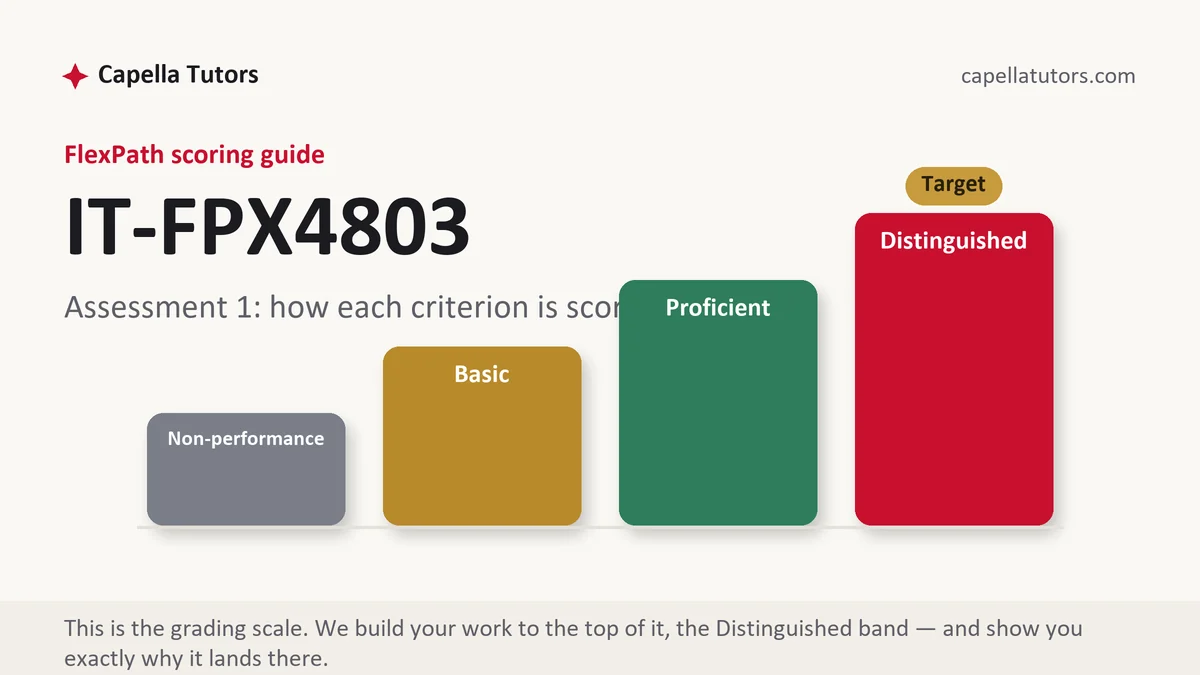
How IT FPX 4803 Assessment 1 is scored
Assurance work collects the same treatment as everything else here, one verdict per criterion at one of four levels, with nothing averaged. The level text is the most literal instruction available:
| Level | What it means on a scope and requirements deliverable |
|---|---|
| Distinguished | The boundary is drawn so that no later sentence is ambiguous, the impact level is argued from the data and the mission rather than assigned by habit, and every requirement is written so a stranger with an account could pass or fail it. The criterion names one move past a complete list, and it is printed there. |
| Proficient | Scope and requirements are present and coherent. Complete work sitting one column below the top because the requirements describe intentions instead of observable states. |
| Basic | A system described in general terms with requirements written as adjectives. A document that sounds like security and cannot be tested lands here regularly. |
| Non-performance | A required element is absent, most often the exclusions or any statement of data sensitivity. What is missing costs the whole criterion. |
Everything the course grades afterwards is traced back to the identifiers you assign here. A requirement written vaguely now becomes a test you cannot design and a result you cannot report, which is why this deliverable is worth more time than its length suggests.
The IT FPX 4803 Assessment 1 method, step by step
-
Turn each criterion into an evidence row before writing prose
The claim the guide asks for, the artifact that will support it, and where that artifact comes from, whether a configuration excerpt, a tool output, a test transcript, a policy clause or a log entry. Rows with no artifact are the honest map of what you have left to do.
-
Draw the boundary and defend it
Name what is inside, what connects from outside, what data crosses each interface, and what is explicitly excluded with a reason. Assurance is scoped work, so a boundary that drifts halfway through the document makes every statement after it arguable.
-
Categorize from the data and the mission, not from habit
Say what kinds of information the system holds, what the consequence of losing confidentiality, integrity or availability would be for each, and let the impact level follow from the worst of them. Then write the sentence that explains why it is not the level above or below.
-
Write requirements as observable states with identifiers
Every requirement gets a number, a source, and a phrasing somebody could verify without asking you what you meant. A system that will be hardened cannot be tested. A system where administrative access requires a second factor and the enforcement is logged can be checked by anybody with an account.
-
Trace each requirement to where it came from
A control catalog item, a regulation, a contractual clause or your own categorization, cited with its revision. Requirements with no parent look invented, and the criterion asking for derivation has nothing to reward if the lineage is missing.
-
Prune the list until the priorities mean something
A requirement set with no internal ranking tells a reader the hard part was skipped. Order the items, name the basis for that order, and accept that at this impact level some of them belong in a recommended column rather than a required one.
A structure that maps to the criteria
Internal planning lengths for an opening assurance document, not Capella rules; expand whichever criterion your own guide leans on hardest.
| Section | What it must do | Guide |
|---|---|---|
| System description and boundary | What the system does, its components, the interfaces that cross the boundary, and what is deliberately outside it. | ~300 words |
| Data types and categorization | The information the system holds, the consequence of a loss for each property, and the impact level argued rather than assigned. | ~250 words |
| Users, roles and access | Who uses the system, what each role can do, and which roles hold administrative or audit capability. | ~200 words |
| Security requirements | Numbered, testable requirements with a source and a priority each, phrased so a pass or a fail is observable. | ~400 words |
| Assumptions and exclusions | What you assumed because you could not verify it, what is out of scope, and who would have to confirm each item. | ~150 words |
| Sources | Control catalogs, benchmarks and regulation cited by revision, current APA reconciled in both directions. | as needed |
Annotated sample excerpt
A paragraph our team wrote as a model for a deliverable of this kind. Read it for the moves rather than the details, then write the version your own system needs.
The system assessed here is the payroll file transfer service operated for a 900-employee manufacturer, which means one hardened transfer host, the scheduled job that assembles the weekly file, the two service accounts that move it, and the encrypted store the file sits in for its fourteen-day retention window.1 Three things cross the boundary and are therefore in scope as interfaces rather than as systems: the human resources database that the job reads from, the outbound link to the payroll processor, and the identity provider that authenticates the two administrators, and each is described by what data moves, in which direction, and on whose authority.2 Explicitly outside the boundary are the human resources application itself, the processor's own environment, and the corporate wireless network, excluded because no assessment authority was granted over them and because inventing findings about a system nobody let me examine would be worse than declaring the gap.3
- 1Enumerates the components rather than naming the system in the abstract. A boundary a reader can count is a boundary that cannot drift later.
- 2Distinguishes an interface from a system and says what each carries. That distinction is what stops the scope from quietly doubling in the findings section.
- 3States the exclusions and the reason, including the honest one about authority. Declaring a limit is graded well; discovering it in the marker's comments is not.
The full premium sample for your exact assessment, written fresh to your scoring guide and issue, is free to request. Study it, revise it into your own voice, and submit work you understand.
The five mistakes that cost Distinguished
- Requirements written as adjectives. A system described as robust or secure gives an assessor nothing to test and a marker nothing to credit.
- An impact level assigned with no argument. The categorization is a conclusion drawn from the data and the mission, and stating it without the reasoning skips the part being graded.
- A boundary that grows through the document. Systems that appear for the first time in the findings section were never scoped, and every earlier statement becomes ambiguous.
- Every requirement marked mandatory. A list with no differentiation tells a reader the prioritization step was skipped rather than completed.
- Control text quoted without a revision. Identifiers and wording move between revisions of a catalog, so an unversioned citation reads as secondhand.
Pre-submission checklist
- Each criterion in your guide addressed under its own heading
- Boundary stated as a countable list of components and interfaces
- Data types named with the consequence of losing each property
- Impact level argued, including why it is not the level above
- Every requirement numbered, sourced, prioritized and observably testable
- Exclusions and assumptions declared, catalogs cited by revision, current APA both ways
Scope and requirements due this week?
Send the system description your faculty supplied and the criteria attached to it. The boundary comes back countable, the categorization comes back argued from the data, and every requirement comes back phrased so a pass or a fail is something a person can observe. Your opening premium sample is free.