This manual is for IT FPX 4803 Assessment 3, start to submission. The closing deliverable in IT FPX 4803, System Assurance Security, is usually where evidence turns into a decision: findings prioritized on exposure in your environment rather than on a published base score, remediation with owners and dates, a residual risk statement somebody accepts in writing, and a monitoring plan with measures, thresholds and a cadence. Verdicts arrive criterion by criterion against whatever guide your courseroom supplied. The working order our tutors follow comes next, with an outline mapped criterion by criterion and a passage carrying notes. Prefer to hand it off? A premium original sample for this exact assessment comes back in 24 to 48 hours with the triage reasoning written down, revised free until the guide is satisfied. Capella's catalog lists the course as IT-FPX4803, and some courserooms print IT4803; both point to this same Assessment 3.
One honesty note before the manual: Capella revises courses and scoring guides over time, so always write to the exact scoring guide attached to your assessment in the courseroom. The course identity above is verified on capella.edu; the method and structure below are our tutors' approach to it, not Capella's official rubric text.
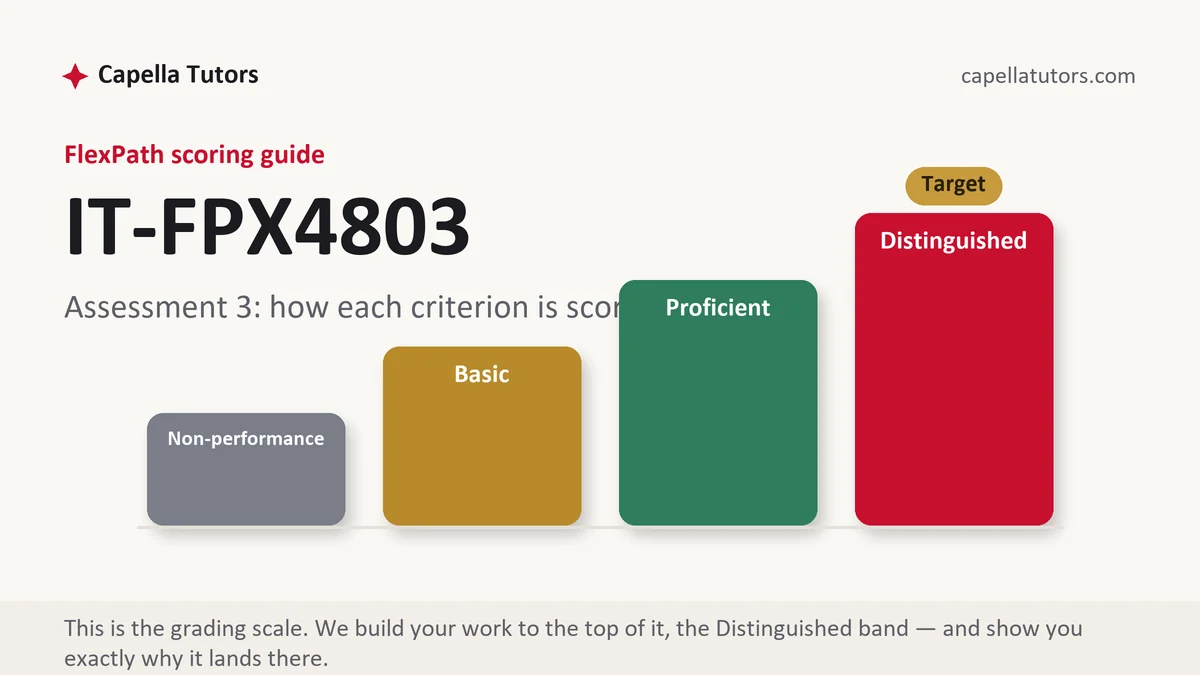
How IT FPX 4803 Assessment 3 is scored
The guide fixes each criterion at one of four levels and stops there, so a thin monitoring section is not carried by a strong findings section. The highest level is the target:
| Level | What it means on a findings and monitoring deliverable |
|---|---|
| Distinguished | Priority is defended on reachability and impact in this environment, residual risk is bounded and owned by a named role, and the monitoring plan carries measures, thresholds, intervals and a trigger that forces reassessment early. The criterion asks for one thing past a finding list, and it names it. |
| Proficient | Findings are complete, remediation is planned and monitoring exists. Full work one column below the top, usually because the priority order was inherited rather than argued. |
| Basic | A scanner report reformatted into a table, with monitoring defined as an annual review. Volume presented as analysis lands here more often than a short honest list does. |
| Non-performance | A required element is not present, most often the residual risk statement or the accepting authority. The floor belongs to absence. |
One more thing worth writing plainly: on a course project you are usually both the person who implemented the controls and the person assessing them. Independence is part of the method, so say that the roles were combined and describe how you compensated, whether by an external benchmark, a peer review, or a test somebody else could repeat.
The IT FPX 4803 Assessment 3 method, step by step
-
Sort the findings before you format them
A report with forty rows and six at the top severity is not a work plan. Order them by whether the affected service is reachable, by what data sits behind it, by whether working exploit code is public, and by what already stands in front of it, then write the sort criteria down so the order can be checked.
-
Adjust severity to your own environment and say so
A published score describes a defect in the abstract. A high-severity item on a segment with no inbound route and no user access may reasonably sit behind a middling item on the internet-facing login, and stating that reasoning is the analysis the criterion is looking for.
-
Give every remediation an owner, a date and a retest
An action with no role attached is a suggestion, and a fix with no retest is a claim. Record what changed, who changed it, when, and the result of running the same check again afterwards.
-
Write the residual risk in three parts
What remains after the controls you applied, why the remainder is acceptable given the impact level and the cost of closing it, and which role has the authority to accept it. A document claiming risk was eliminated reads as inexperience rather than as success.
-
Set thresholds that somebody could act on
A measure, a value, an interval, a recipient and a response. Monitoring described as ongoing vigilance produces no behavior, while a stated threshold with a named recipient produces a ticket, and only the second one can be graded.
-
Name the trigger that forces an early reassessment
A rise in the sensitivity of the data, a change to the boundary, or the appearance of public exploit code for a component you compensated around. One sentence turns a residual position into a managed one with a review condition attached.
A structure that maps to the criteria
Internal planning lengths for a closing assurance document, not Capella instructions; expand the criterion your own guide leans on.
| Section | What it must do | Guide |
|---|---|---|
| Findings and environment-adjusted priority | Each finding with what it affects, its published severity, its reachability here, and the priority you assigned with the reason. | ~350 words |
| Remediation plan | Actions with owners by role, dates, dependencies, and the retest that will confirm each one. | ~250 words |
| Compensating controls | Where a defect cannot be removed, what stands in front of it, and how much of the exposure that actually removes. | ~200 words |
| Residual risk and authorization | What remains, why it is acceptable at this impact level, which role accepts it, and what the acceptance is conditional on. | ~250 words |
| Monitoring plan | Measures, thresholds, intervals, recipients, responses, and how a control state is confirmed rather than assumed between reviews. | ~300 words |
| Independence, limitations and sources | Where you assessed your own work and how you compensated, what you could not test, and catalogs cited by revision in current APA. | ~200 words |
Annotated sample excerpt
A short model paragraph our team wrote where a guide's strongest column sits. Learn the structure, then set thresholds your own system could actually meet.
Four measures carry the monitoring plan for the customer portal, each with a value rather than an intention: failed authentication attempts per source address above twenty in ten minutes, a configuration drift check against the hardened baseline run nightly with any deviation raised the same morning, certificate expiry flagged at thirty days, and log delivery from the portal host confirmed hourly so a silent logging pipeline is noticed within one hour rather than at the next review.1 Each threshold has a recipient and a response: the first three go to the platform administrator as a ticket with a four-hour acknowledgment target, while a logging gap goes to the security lead directly, because a monitoring failure is the one condition that makes every other measure meaningless.2 The plan is deliberately small, and the honest note is that twenty attempts in ten minutes will produce occasional noise from a shared corporate address, which is accepted for the first quarter and reviewed against the actual alert volume rather than tuned in advance on a guess.3
- 1Gives four measures with numbers and intervals attached. A threshold is a value, and a plan without values cannot be operated or graded.
- 2Routes each threshold to a role with a response time, and singles out the failure that disables the rest. Monitoring the monitor is the move most submissions omit.
- 3Admits the false-positive cost and schedules the tuning instead of pretending the first number is right. Owning the noise is what lifts this above a control list.
The full premium sample for your exact assessment, written fresh to your scoring guide and issue, is free to request. Study it, revise it into your own voice, and submit work you understand.
The five mistakes that cost Distinguished
- A vendor severity column treated as the schedule. A published rating describes the defect in the abstract and says nothing about whether anything in your network can reach it.
- Remediation with no owner. Actions and dates without a role attached are a schedule nobody has agreed to and nobody will execute.
- Residual risk written as an apology. No control set reaches zero, so the remainder is the outcome of the method and should be stated as a position somebody accepts.
- Monitoring reduced to a yearly look. Between two annual checks the state of every control is simply unknown, and the criteria mark that as the gap it is.
- The implementer assessing their own control in silence. Independence is part of assurance, and a project that cannot supply it has to say so and describe the compensation.
Pre-submission checklist
- Each criterion in your guide addressed under its own heading
- Findings prioritized with the sort criteria written down
- Published severity separated from reachability in this environment
- Every remediation carrying an owner by role, a date and a retest
- Residual risk stated in three parts, with the accepting role named
- Thresholds with values, intervals, recipients and a reassessment trigger, current APA both ways
Findings and monitoring sections due?
Send the evidence you gathered, the system description and the criteria for this stage. Findings come back triaged with the reasoning on the page, residual risk comes back bounded and owned by a role, and the monitoring plan comes back with values, intervals and recipients. The first premium sample is free.