Send the platform, the scenario, and the criteria, and a premium original sample returns inside 24 to 48 hours with every configuration change traced to a published baseline recommendation, evidence captured on both sides of the change, and a rollback written for each one. The catalog records this course as IT FPX 4080, Operating Systems and Application Security, three program points within the Information Assurance and Cybersecurity specialization, taught in FlexPath inside a BS in Information Technology that requires at least 90 program points including a minimum of 27 at the 3000 level or above. In Capella's catalog the course code is written IT-FPX4080.
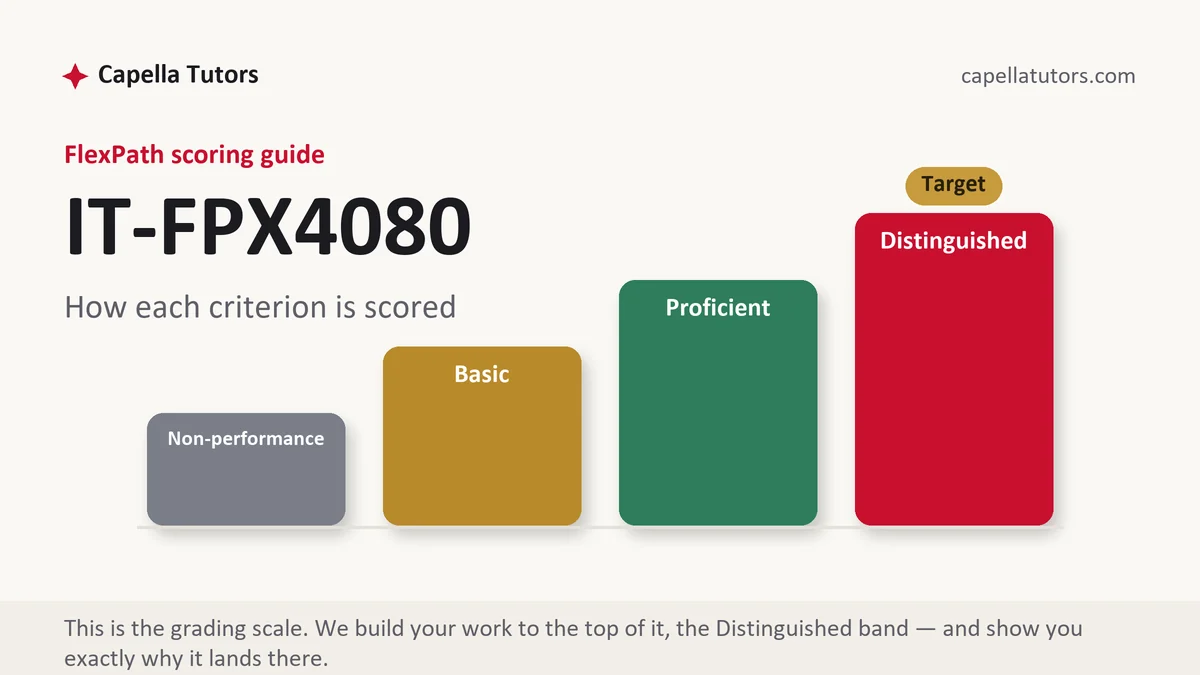
What IT FPX 4080 actually grades
Hardening is graded as a decision process, and the first decision is which published baseline you are working from. A submission that lists settings from memory has no way to prove those settings were the right ones, while a submission that names a benchmark, cites the recommendation numbers, and then departs from three of them with reasons has demonstrated the professional judgment the criteria describe. Attack surface reduction is the organizing idea underneath: every service running, every port listening, every account enabled, and every feature installed is something that can be attacked, so the default answer is removal and the interesting work is arguing for the exceptions. Configuration drift belongs in the same section, since a machine hardened once and never checked again is compliant only on the day it was built, and the deliverable should say how the state gets re-verified and on what cycle.
Privilege and permissions carry the technical marks. On the Windows side that means understanding how policy applied at the domain reaches the machine, why local administrator rights on a workstation defeat most of what you built above it, and how a privileged account that logs in interactively to an ordinary desktop leaves credentials behind for the next intruder to collect. On the Linux side it means owner, group, and other permission bits read correctly, the default mask that decides what new files inherit, and the elevation policy that grants specific commands rather than a general escape into the root account. One example is worth working through in any paper: a script owned by root but writable by everyone, running from a scheduled job, hands full control of the machine to anyone who can edit that file, and nothing else in the configuration matters after that. Mandatory access frameworks on Linux distributions add a second layer that confines a compromised service to what its profile permits, and turning that layer off because an application misbehaved is the shortcut evaluators look for.
The application half of the course asks what the software does with what it is given. Input that arrives from outside is untrusted until it has been validated against what you expect, and the validation belongs on the server rather than in the browser where anyone can bypass it. Data placed into a query, a command line, a page, or a file path needs the treatment appropriate to that destination, which is why parameterized statements are the answer for databases and contextual encoding is the answer for output. Authentication, session handling, and authorization are three separate problems that submissions routinely merge, since proving who you are, keeping that proof alive safely, and deciding what you may do are different mechanisms that fail in different ways. Dependencies deserve a paragraph, because most application code in a modern project came from somewhere else and the vulnerability will arrive through a package rather than through your logic. Where the criteria reference a published list of common web risks, map your findings to it by name so the evaluator can follow.
How we help in this course
Hardening and application deliverables from us are built around evidence. Every recommended change cites the benchmark item it comes from, states the security purpose in one line, names the systems and users it will affect, and carries a rollback. Where the criteria expect hands-on work, the document is structured for before and after captures with the setting visible in each, and the narrative explains what changed rather than leaving a reader to compare two pictures. Application findings arrive mapped to a named risk category with a code-level or configuration-level fix attached. Tell us the operating system and version, whether you have a lab, and any application the scenario supplies, and the work will fit that platform rather than describing a generic system.
Terms are identical to the rest of the studio. Twenty four to 48 hours per deliverable, written to the Distinguished descriptor, with eight people handling it: research retrieves your guide and the current benchmark revisions, a subject writer builds the configuration argument and the review, a scoring-guide reviewer marks it row by row before delivery, an APA and originality pass verifies every reference, and an editor closes the document. Free revision until the guide is satisfied, free handling of returned faculty comments, and a schedule that assumes an evaluator may take two business days, which matters here because a rejected hardening deliverable usually needs new screen captures rather than new prose.
The assessments, one by one
Assessment 1
The opening deliverable in Operating Systems and Application Security is normally a measurement rather than a recommendation: you name a published baseline, compare a system against it item by item, and report the gaps with evidence taken from the system itself. Read the full Assessment 1 manual.
Assessment 2
The middle deliverable in this course usually turns from the operating system to the software running on it, and it is analysis rather than development: you review a supplied design or code sample, identify weaknesses, map each one to a named risk category, and describe a remediation precisely. Read the full Assessment 2 manual.
Assessment 3
The final deliverable in this course is usually a recommendation with a program behind it: you evaluate options against stated requirements, pick one, and then say how the estate stays hardened after the project team goes away. Read the full Assessment 3 manual.
How to actually write IT FPX 4080: where to begin
Read the criteria, then choose the platform and freeze it, because a paper that drifts between two operating systems ends up shallow in both. Once the platform is fixed, download the benchmark for that exact version and use its numbering as the skeleton of your document. Group the recommendations you will apply, the ones that do not apply to your environment, and the ones you are deliberately declining, and treat that third group as the most valuable section in the deliverable. Anyone can apply a benchmark, and the person who can explain why recommendation twelve would break the line of business application and what compensating measure covers the gap is the one being described in the top column.
Then be honest about scale, because it is what turns a settings list into an analysis. A benchmark for a current server operating system runs to a few hundred numbered recommendations. Suppose yours contains 214 items, that 38 do not apply because the roles they govern are not installed, and that 41 conflict with an application the business depends on. You are left with 135 you will apply directly, and the deliverable's real content is the 41, each with the conflict described, a compensating measure named, and an owner for the exception. Add sequencing, since some changes must land together to avoid locking yourself out, and any change to remote access configuration belongs in a maintenance window with console access available. State the test plan for the application after the change, because a hardening project that breaks production teaches an organization to stop hardening.
Finish with the parts a checklist cannot supply: measurement and maintenance. Say how you will confirm each change actually took effect, using the setting query rather than the fact that you clicked something, and keep that output as evidence. Define the patch cadence with tiers, so that a vulnerability already known to be exploited in the wild gets an emergency path measured in days while routine updates follow the normal monthly cycle behind a small test group. Describe how the baseline is re-verified on a schedule and what happens when a machine has drifted. Then close with the rollback for the riskiest change and the criteria you would use to invoke it, since a competent engineer plans the retreat before advancing.
| Section | What goes in it | What Distinguished looks like |
|---|---|---|
| Scope and baseline | Platform and version, the systems in scope, and the published benchmark being followed. | Benchmark cited by name and revision, with the profile level chosen and justified. |
| Findings | Current configuration measured against the baseline, with each gap identified by item. | Gaps evidenced by actual output from the system rather than assumed from the documentation. |
| Changes and exceptions | Applied settings, non-applicable items, and declined items with compensating measures. | Declined items carry a business reason, a compensating control, an owner, and a review date. |
| Privilege model | Administrative rights, elevation policy, service accounts, and file permission model. | Least privilege demonstrated with a concrete permission example rather than asserted. |
| Application security | Input handling, data access, authentication and session design, and dependency status. | Findings mapped to a named risk category with a fix specific enough to implement. |
| Verification and sources | Post-change evidence, patch cadence, drift checks, rollback, and current APA. | Each change verified by querying the system, with the query and its output shown. |
Developing the analysis
The tension this course keeps generating is between hardening thoroughly and keeping the business running, and the criteria reward a candidate who resolves it rather than pretending it does not exist. The maximalist position says apply the benchmark, because every declined item is an attack path left open and organizations that negotiate with their own baseline end up with no baseline at all. The pragmatic position says a hardening program that breaks a revenue system once will never be allowed to touch production again, so the sustainable path is staged application with testing, exceptions recorded openly, and a slow reduction of the exception list over time. The same argument runs through patching, where the case for immediate deployment rests on the short interval between a fix being published and an exploit appearing, while the case for testing rests on the update that takes a fleet offline. Resolve it with tiering rather than a single policy: emergency handling for anything on a published catalog of vulnerabilities known to be actively exploited, a normal cycle with a pilot group for everything else, and an explicit maximum age for outstanding patches. Then say what your recommendation costs in downtime, because a plan that never mentions disruption has not been costed.
Citations that survive faculty review
Configuration guidance should be cited to the body that publishes it, and the two that carry weight are the benchmark series from the Center for Internet Security and the checklist program and server hardening guidance issued by the National Institute of Standards and Technology. Cite them with the platform version and the document revision, because a benchmark for one release recommends settings that do not exist in another and an undated reference tells the evaluator you did not open it. Vendor baselines are primary sources for their own products and should be labeled as vendor documents, which is a strength rather than a weakness when the subject is how that product behaves. Application security claims belong to the Open Worldwide Application Security Project, whose ranked list of common web application risks and whose verification standard give you a shared vocabulary, and to the secure software development framework published by the same national standards body when your criteria reach into process. Vulnerability specifics come from the national vulnerability database by identifier, and urgency claims come from the catalog of known exploited vulnerabilities maintained by the national cyber defense agency, cited with the date you retrieved it. Peer-reviewed work through the Capella library supports anything you assert about patch timing or the practical effect of a control class. Keep news reporting of an incident separate from the technical analysis of the flaw behind it.
The mistakes that land Basic instead of Distinguished
- A hardening paper with no baseline named. Settings offered with no published source behind them cannot be checked or defended.
- Screen captures with no before state. An image of a configured setting proves nothing about what it was or who changed it.
- Every declined recommendation left unexplained. The exception list is the analysis, and leaving it blank removes the part being graded.
- Application security reduced to a network control. A firewall in front of an injectable query does not fix the query.
- No rollback for a change that can lock you out. Remote access hardening without a documented retreat is how a lab becomes unreachable.
IT FPX 4080 questions students actually ask
Which operating system should I use for the hands-on sections?
Use the one your criteria name, and where the choice is yours, pick the platform you can run comfortably in a virtual machine on hardware you own. A current server release of Windows and a mainstream Linux distribution both have published benchmarks, both give you enough surface to demonstrate real hardening, and both let you show privilege and permission work that a desktop install would not. Take a snapshot before you begin so that a change locking you out costs you a restore rather than a rebuild, and keep the virtual network isolated so nothing you configure reaches anything you do not own. Whatever you choose, state the exact edition and build in the document, since a recommendation that applies to one release may be absent from the next.
How do I show a configuration change actually took effect?
Query the system rather than trusting the interface you used to make the change. Every setting worth hardening has a way to be read back, whether that is a policy result report, a registry value, a configuration file, or a command that prints the effective state, and the output of that query is your evidence. Capture it once before the change and once after, paste both as text where the tool allows it, and write a sentence naming what differs so the reader is not comparing blocks by eye. Where a change needs a restart or a policy refresh before it applies, do that first and then capture, because a great many submissions show a setting that had been entered and not yet applied. Keep a short table of item, expected value, observed value, and verification method, which answers the verification criterion in one place.
Do I have to write code for the application security part?
Usually not, and the criteria are the arbiter. Most application security work at this level is analysis and specification rather than development, so the expected artifacts are a review that identifies weaknesses in a supplied design or code sample, a mapping of those weaknesses to a named risk category, and a remediation described precisely enough that a developer could act on it. Where a fix is best shown as a snippet, a few lines contrasting the unsafe pattern with the safe one is more persuasive than a page of prose, and a parameterized query set beside a concatenated one makes the point in four lines. If your assessment does ask for working code, treat it as a scripting deliverable and bring the same discipline: readable structure, handled errors, and evidence that you ran it.
Hardening deliverable due?
Send the scenario and the criteria. Baseline named, exceptions justified, evidence captured before and after, rollback written. First premium sample free.