This manual is for IT FPX 4080 Assessment 3, start to submission. The final deliverable in this course is usually a recommendation with a program behind it: you evaluate options against stated requirements, pick one, and then say how the estate stays hardened after the project team goes away. Two things decide the grade. The evaluation has to be against criteria written before you looked at any product, and the program has to include patch tiering, drift checking, and a rollback for the change that could lock you out. A recommendation that never mentions disruption has not been costed. Below is the method our tutors use for it, a structure that maps to the criteria, and an annotated sample excerpt. Prefer to hand it off? A premium original sample for this exact assessment comes back in 24 to 48 hours, revised free until it meets the guide. Capella's catalog lists the course as IT-FPX4080, and some courserooms print IT4080; both point to this same Assessment 3.
One honesty note before the manual: Capella revises courses and scoring guides over time, so always write to the exact scoring guide attached to your assessment in the courseroom. The course identity above is verified on capella.edu; the method and structure below are our tutors' approach to it, not Capella's official rubric text.
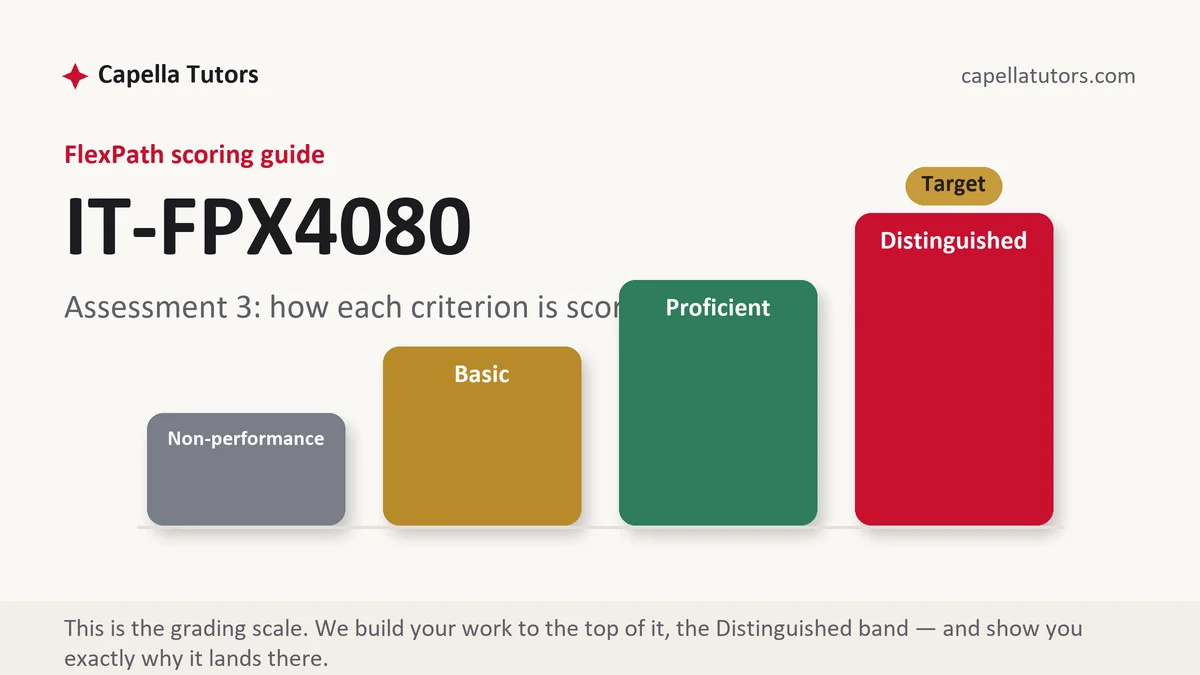
How IT FPX 4080 Assessment 3 is scored
Levels replace grades here. Each criterion is placed at one of four descriptions by an evaluator working the guide, and the description you are aiming at is the clearest brief you will get:
| Level | What it means on an evaluation and program |
|---|---|
| Distinguished | Requirements are written before any option is named, the recommendation states what it costs in downtime, and every risky change carries a rollback with a trigger. There is an extra move in each row; take it. |
| Proficient | A defensible recommendation with a maintenance plan attached. Sound work that has not yet been priced in disruption or tested against a failure. |
| Basic | A comparison of products by feature list, with a preference at the end and a monthly patch cycle described in a sentence. |
| Non-performance | A required element is missing, most often the rollback or the verification approach. An empty section decides its row on its own. |
The tension the criteria are testing is between hardening thoroughly and keeping the business running, and the way to resolve it is tiering rather than a single policy. Say which failures your plan survives and which it does not, because a program nobody can operate on a bad night is available only during office hours.
The IT FPX 4080 Assessment 3 method, step by step
-
Write the evaluation criteria before you name a product
Take a tire and service chain with 612 endpoints across 40 locations and a two-person technology team. Requirements first, weighted: management from one console, behavior that survives an unreliable branch connection, a rollback path, an evidence trail for compliance, and an operational load two people can carry. A comparison built after the preference is formed reads as a justification and grades that way.
-
Specify by capability, and treat any named product as an example
Say what the software must do rather than which logo does it, then, where a criterion wants concreteness, name one current option that meets the specification and cite the vendor documentation with its date. That structure keeps your recommendation valid when a product is discontinued and protects the paper from the objection that the design was built around something somebody liked.
-
Tier the patch policy instead of stating one cycle
Anything on a published catalog of vulnerabilities known to be actively exploited gets an emergency path measured in days, everything else follows a normal monthly cycle behind a pilot group of 30 machines drawn from more than one branch, and every outstanding patch has a maximum age after which it escalates. Name the interval, name the pilot, name the escalation.
-
Design the drift check as a query on a schedule
Confirm the state by reading it back, not by trusting that the console reported success, and say what happens when a machine has drifted: who is told, what the remediation is, and how a machine that keeps drifting gets escalated rather than quietly re-fixed each month. A baseline with no drift check is a baseline that was true once.
-
Write the rollback for the change that can lock you out
Remote access hardening on a machine 200 miles away needs a documented retreat and a criterion for invoking it, plus a maintenance window and a way in that does not depend on the thing you are changing. Sequence changes that must land together, and say plainly what the recommendation costs in downtime, because that number is the one an operations reader will look for first.
-
Cost it, phase it, then self-score
Give the licensing shape, the deployment effort, and the ongoing operational hours, then phase the rollout with what each phase buys. Say what you would defer if the budget shrank. Then mark every criterion D, P, B, or N and revise anything below the top before uploading early in the week.
A structure that maps to the criteria
The counts below are how our tutors plan a recommendation of this kind rather than a Capella limit; expand whichever section your guide weights.
| Section | What it must do | Guide |
|---|---|---|
| Requirements | Weighted needs written before any option is considered, each one testable after deployment. | ~250 words |
| Evaluation | Options compared against those requirements by capability, with the rejected option named and the reason given. | ~300 words |
| Recommendation | The choice, what it costs in money and downtime, and the risk it leaves behind. | ~250 words |
| Patch policy | The emergency path, the normal cycle, the pilot group, and the maximum age before escalation. | ~250 words |
| Drift and verification | The query, the schedule, the owner, and what happens when a machine has drifted twice. | ~250 words |
| Rollback and sources | The retreat for the riskiest change, its trigger, the maintenance window, and references in current APA. | ~200 words |
Annotated sample excerpt
A short original model passage from our team, written at the register the guide rewards. Take the way it prices a decision and price your own.
Option B is recommended because it satisfies all five weighted requirements including offline enforcement at branches with unreliable connectivity, where Option A depends on a console callback that would leave a disconnected store unprotected for the duration of the outage.1 Deployment is phased across 40 locations in four waves, beginning with a pilot of 30 machines drawn from three branches with different connection quality, and the recommendation carries an expected 15 minutes of downtime per machine for the reboot that the sensor installation requires.2 The remote access hardening in wave two is the change that can strand a store, so it is applied inside a Tuesday overnight window with the previous configuration exported first, and it is rolled back if a branch fails to check in within 30 minutes of the change.3
- 1Ties the choice to a requirement written earlier and names the specific way the alternative fails it. A comparison that reaches a conclusion this way was not written backward.
- 2Puts the cost in downtime per machine and phases the rollout with a pilot that varies deliberately. An operations reader trusts a number and distrusts an adjective.
- 3Gives the rollback a trigger and a time limit rather than promising one. A retreat with no condition attached is a paragraph, not a plan.
The full premium sample for your exact assessment, written fresh to your scoring guide and issue, is free to request. Study it, revise it into your own voice, and submit work you understand.
The five mistakes that cost Distinguished
- Products compared before requirements exist. An evaluation written after the preference reads as advocacy and the criterion notices.
- One patch cycle for every severity. A single monthly rule treats an actively exploited flaw and a cosmetic update as the same problem.
- Console success taken as verification. A management report saying a policy applied is not the same as reading the value back from the machine.
- No rollback on a change that can strand a site. Remote hardening with no documented retreat is how a branch becomes unreachable at midnight.
- Disruption never mentioned. A recommendation with no downtime figure has not been costed and will not survive its first operations review.
Pre-submission checklist
- Weighted requirements appear before any option is named
- Options are compared by capability, with the rejected one named and the reason stated
- The patch policy has an emergency path, a normal cycle, a pilot group, and a maximum age
- Drift is checked by querying the system on a schedule, with an owner and an escalation
- The riskiest change has a rollback, a trigger, and a maintenance window
- Downtime and ongoing operational hours are quantified, then every criterion self-scored
Recommendation due and the program half is missing?
Send the estate size, the scenario, and the criteria. A premium original comes back inside 24 to 48 hours with weighted requirements, a comparison by capability, tiered patching, drift checks, and a rollback that has a trigger on it. First sample free.