This manual is for IT FPX 4080 Assessment 1, start to submission. The opening deliverable in Operating Systems and Application Security is normally a measurement rather than a recommendation: you name a published baseline, compare a system against it item by item, and report the gaps with evidence taken from the system itself. Students lose the top of the guide by supplying settings from memory, because a setting with no published source behind it cannot be checked or defended. Marks live in the baseline you cite, the evidence you captured, and the items you decline to apply with a reason attached. Below is the method our tutors use for it, a structure that maps to the criteria, and an annotated sample excerpt. Prefer to hand it off? A premium original sample for this exact assessment comes back in 24 to 48 hours, revised free until it meets the guide. Capella's catalog lists the course as IT-FPX4080, and some courserooms print IT4080; both point to this same Assessment 1.
One honesty note before the manual: Capella revises courses and scoring guides over time, so always write to the exact scoring guide attached to your assessment in the courseroom. The course identity above is verified on capella.edu; the method and structure below are our tutors' approach to it, not Capella's official rubric text.
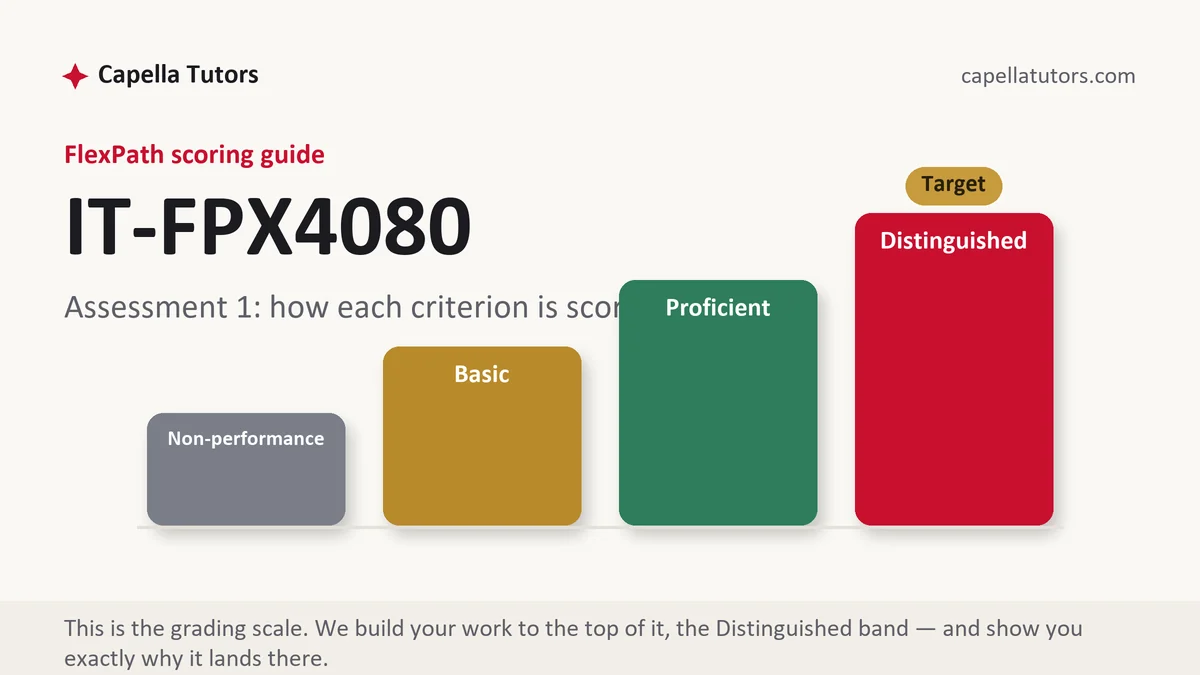
How IT FPX 4080 Assessment 1 is scored
FlexPath reports levels rather than scores. Each criterion on the guide is placed at one of four positions, and the wording at each position is the specification for your document:
| Level | What it means on a gap assessment |
|---|---|
| Distinguished | The baseline is cited by name and revision, every gap is evidenced by output from the system, and declined items carry a business reason and a compensating measure. One extra move hides in each criterion; go and find it. |
| Proficient | The comparison is accurate and complete against a named baseline. Correct work that has not yet said what should happen about the items it cannot apply. |
| Basic | A list of recommended settings assembled from experience, with the current state assumed rather than measured. |
| Non-performance | A required element is absent, most often the evidence or the baseline reference. An unsupported section takes its own row to the bottom. |
The organizing idea underneath every criterion here is attack surface. Each running service, listening port, enabled account, and installed feature is something that can be attacked, so removal is the default answer and the interesting work is arguing for the exceptions.
The IT FPX 4080 Assessment 1 method, step by step
-
Choose the platform and freeze it
A document that drifts between two operating systems ends up shallow in both. Take an accounting practice running a single Linux application server for its client portal, name the distribution and the release, and hold that choice through every section. State the edition and build in writing, since a recommendation that exists in one release may be absent from the next.
-
Download the benchmark for that exact version and borrow its numbering
Use the published recommendation numbers as the skeleton of your document so a reader can follow you item by item. Cite the benchmark by name and revision, because a benchmark for one release recommends settings that do not exist in another and an undated reference tells your evaluator you never opened the document.
-
Measure the current state by querying the system
Read the value back rather than trusting the interface you would use to change it. A configuration file, a command that prints the effective state, a permission listing: the output of that query is your evidence, pasted as text. Assumed current state is the most common reason a gap assessment reads as a settings list.
-
Sort every item into three buckets and count them
Applicable, not applicable, and declined. Suppose the benchmark carries 167 recommendations, 22 of which govern roles this server does not run, and 19 of which conflict with the practice's tax software. That leaves 126 you apply directly, and the 19 are the most valuable pages in the deliverable because anyone can apply a benchmark and only judgment can defend an exception.
-
Work one permission example all the way through
Read owner, group, and other bits correctly, check the default mask that decides what new files inherit, and look at what the elevation policy actually grants. A script owned by the root account but writable by everyone, launched from a scheduled job, hands the machine to anybody who can edit that file, and nothing else in the configuration matters afterward. One worked example proves the privilege criterion; a definition of least privilege does not.
-
Say how the state gets re-verified, then self-score
A machine hardened once and never checked again was compliant on the day it was built. Name the query, the cycle, and who looks at the result. Then mark each criterion D, P, B, or N against the guide, rewrite anything below the top, and upload early because an evaluation can take two business days.
A structure that maps to the criteria
The word counts are our tutors' planning shape for an assessment of this kind rather than a Capella rule; captured output sits outside the count.
| Section | What it must do | Guide |
|---|---|---|
| Scope and platform | The exact edition and build, the systems in scope, the role the server performs, and what is excluded. | ~200 words |
| Baseline reference | The benchmark by name and revision, the profile level chosen, and why that level suits this server. | ~200 words |
| Measured state | How each value was read back, with the query named and its output preserved as text. | ~300 words |
| Gap table | Item by item: recommendation, expected value, observed value, and applicable or not applicable or declined. | ~350 words |
| Privilege and permissions | The account model, the elevation policy, the default mask, and one permission fault worked through fully. | ~300 words |
| Re-verification and sources | The drift check, its cycle and owner, and benchmark and vendor references in current APA. | ~200 words |
Annotated sample excerpt
A short passage of original model text from our team, written where the top column of the guide sits. Read it for the method, then measure your own machine that way.
Recommendation 3.2.4 of the benchmark revision in use requires that no world-writable files exist outside the temporary directories, and a filesystem query returned two: the nightly export script in the application directory and its configuration file, both mode 666.
- 1Cites the recommendation number and the benchmark revision, then reports what the system actually returned. Measured beats assumed in every row of a gap assessment.
- 2Explains the consequence in one sentence rather than restating the rule. A finding that says why it matters is arguing for the analysis criterion.
- 3States the remediation, the resulting value, and how the change will be proved, so verification is designed in rather than promised at the end.
The full premium sample for your exact assessment, written fresh to your scoring guide and issue, is free to request. Study it, revise it into your own voice, and submit work you understand.
The five mistakes that cost Distinguished
- No baseline named anywhere. Settings offered with no published source cannot be checked by a reader or defended by the author.
- Current state assumed from the documentation. The benchmark says what a default should be, and only the machine says what it is.
- Two operating systems half covered. A document that switches platform mid-section is thin in both and cites benchmarks for neither.
- Declined items left blank. The exception list is where the judgment is, and leaving it empty removes the part being graded.
- Least privilege asserted rather than demonstrated. A definition earns nothing; one permission fault traced to its consequence earns the row.
Pre-submission checklist
- The exact platform edition and build appear in the scope section
- The benchmark is cited by name and revision, with the profile level justified
- Every observed value was read back from the system, with the query and output preserved
- Items are sorted into applicable, not applicable, and declined, and counted
- One permission or privilege fault is traced through to its consequence
- A re-verification query, cycle, and owner are named, then every criterion self-scored
Gap assessment due and the evidence is thin?
Send the platform, the scenario, and the criteria. A premium original returns inside 24 to 48 hours with the benchmark cited by revision, each gap evidenced from the system, and the declined items argued rather than skipped. The first sample is free.