Send the prompt, the criteria, and any starter data your faculty supplied, and a premium original sample comes back inside 24 to 48 hours as a working script plus the written explanation that earns most of the marks, with comments pitched at a reader who will grade the code without executing it. Your program evaluation shows this course as IT FPX 4079, Python Scripting, three program points inside the Information Assurance and Cybersecurity specialization, taught in FlexPath as part of a BS in Information Technology that requires at least 90 program points with a minimum of 27 at the 3000 level or above. In Capella's catalog the course code is written IT-FPX4079.
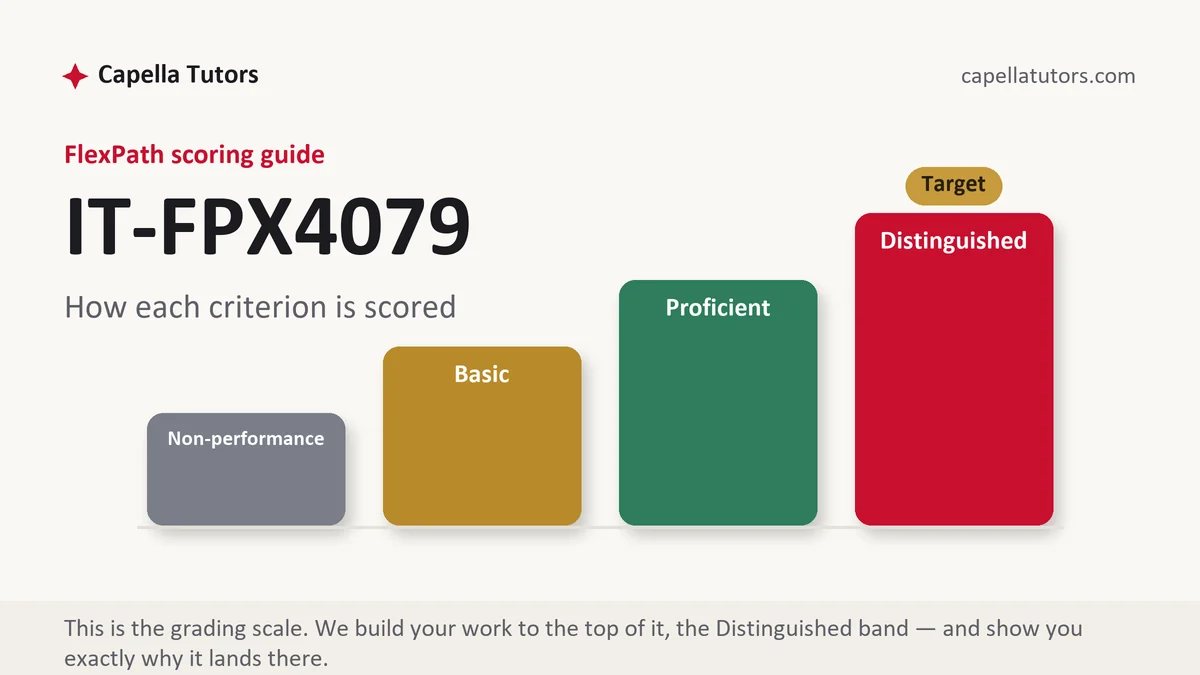
What IT FPX 4079 actually grades
Two artifacts get graded in this course and students routinely prepare only one. The script has to run, and the document has to explain it to someone who may never execute a line. That second requirement is where the marks concentrate, because criteria at this level ask you to justify design decisions, describe how the program handles bad input, and connect the output to the problem the prompt described. A script that solves the task and arrives with no walkthrough tends to sit in the Proficient column wondering what went wrong. Write the explanation as a guided tour: what the program takes in, what it produces, how it is organized, which decision points exist and why you chose the branch you chose, and what happens when the input is missing, malformed, or enormous.
Readability is graded whether the guide says so or not, since the evaluator's experience of your code is the evidence they have. Names carry meaning, so a variable holding failed authentication attempts per address is named for that and not called d. Functions do one job each and are short enough to see whole, which also makes the walkthrough easy to write because each function becomes a paragraph. The language has a published style convention covering indentation, line length, naming, and import order, and following it is free marks that most submissions leave on the table. Comments explain intent rather than restating syntax, so a line saying that a counter increases is noise while a line saying that the threshold is set to twenty five because the security team treats that as a brute force signal is content. Docstrings at the top of each function state what goes in, what comes out, and what raises an error.
Correct handling of the unexpected is the third graded strand and the one that separates a working script from a usable tool. Files are missing, permissions are refused, encodings surprise you, and a user types a word where a number belonged. Wrap the risky operation, catch the specific exception rather than everything, tell the user what happened in language that suggests a fix, and exit with a status that tells an automated caller whether the run succeeded. Validate input at the boundary so the rest of the program can assume clean data. Never hard-code a path, a hostname, or a credential, since the first two make the script unusable on another machine and the third is a finding in a security course. Since this course sits inside the cybersecurity specialization, expect the problems to be security shaped: parsing authentication logs, hashing files to detect change, summarizing scan output, checking configuration against an expected baseline.
How we help in this course
Scripting orders come back as a package rather than a file. The code arrives organized into functions with docstrings, style-checked, commented where intent needs stating, and free of hard-coded paths and secrets. Alongside it comes a sample data file so the grader can run it without hunting, a captured sample of the output, and a written walkthrough that maps each criterion in your guide to the specific function and lines that satisfy it. Tell us which libraries the course permits, whether the standard library alone is required, how the work is submitted, and what Python version your instructor expects, and we will build inside those limits rather than reaching for whatever is fastest.
The studio terms hold for code exactly as they do for essays. One premium original inside 24 to 48 hours, aimed at the Distinguished descriptor, with eight people involved before it reaches you, including a subject writer who builds and tests the program, a reviewer who reads the draft against every row of your scoring guide, a check that any cited documentation is real and current, and a final editorial read of the explanatory document. Revisions cost nothing until the guide is met, faculty comments return to the same queue free, and because an evaluated attempt can take two business days, we would rather ship a version early and refine it than have you wait on a perfect first pass.
The assessments, one by one
Assessment 1
The opening deliverable in Python Scripting normally asks for two artifacts and most students prepare one: a program that runs, and a document that explains the program to somebody who may never execute a line of it. Read the full Assessment 1 manual.
Assessment 2
The middle deliverable in this course usually raises the difficulty in one specific direction: the program now has to survive contact with a real filesystem, which means missing files, refused permissions, encodings you did not expect, and a run that takes long enough for somebody to wonder whether it hung. Read the full Assessment 2 manual.
Assessment 3
The final deliverable in Python Scripting usually asks the program to do something a person would otherwise do by eye: take two exports that should agree, work out where they do not, and produce a report somebody can act on. Read the full Assessment 3 manual.
How to actually write IT FPX 4079: where to begin
Write the program on paper before you write it in an editor. Three lines will do: what comes in, what goes out, and the transformation between them. Then decompose the transformation into steps and turn each step into a function name, which gives you both the structure of the script and the outline of the document at the same time. Pseudocode is worth including in the submission when the criteria mention design, because it shows the thinking that finished code hides. Decide your data structures early too, since choosing a dictionary keyed by address rather than a list of pairs is the difference between a counting loop that is obvious and one that needs a paragraph of apology.
Then learn the one performance habit this course rewards, which is not loading a file you do not need to hold. A script that calls a read-all-lines method on a 2 gigabyte log pulls the entire file into memory and will fail on the machine of anyone who runs it with less headroom than you have. Iterating over the file object instead processes one line at a time and holds a few kilobytes regardless of file size, which turns an impossible job into a routine one. The same principle applies to pattern matching: compile the expression once above the loop rather than rebuilding it on every one of 1.4 million iterations, and accumulate counts in a dictionary instead of scanning a growing list for each new entry, because the second approach turns a linear job into a quadratic one and gets noticeably slower as the file grows. State that reasoning in your walkthrough, since an evaluator can only grade the efficiency criterion on the explanation you gave.
Finish by proving the script works, which means evidence rather than a claim. Include a small sample input file that exercises the interesting cases, a normal record, an edge case, and a deliberately malformed line, then capture the output for each and paste it as text rather than as a picture. Say what the program does when the input file is absent and show that message too. If the criteria mention testing, add a short section listing what you checked and what result you expected, since even three manual test cases documented properly beat an assertion that everything was verified. Then read your own code once as a stranger would, renaming anything you had to pause over.
| Section | What goes in it | What Distinguished looks like |
|---|---|---|
| Problem statement | The task in plain language, the inputs, the outputs, and any constraint the prompt imposed. | Constraints restated in your own terms with edge cases identified before any code appears. |
| Design | Decomposition into functions, chosen data structures, and the reason for each choice. | Alternatives named and rejected with a reason, and pseudocode that matches the finished script. |
| Implementation | The code itself, organized, styled to convention, with docstrings and intent comments. | Short single-purpose functions, no hard-coded paths or secrets, and names that need no glossary. |
| Robustness | Input validation, specific exception handling, user-facing messages, and exit behavior. | Failures handled by type with a message that tells the user how to fix the run. |
| Evidence | Sample input, captured output for normal and abnormal cases, and any tests performed. | Output pasted as text, with an abnormal case shown rather than merely described. |
| Documentation | The walkthrough mapping criteria to functions, plus cited references in current APA. | Each criterion answered by pointing at named functions and lines the grader can find. |
Developing the analysis
The design argument worth putting in writing is whether to reach for a third-party package or to stay inside the standard library, and it comes up in nearly every task this course sets. The argument for the package is that a maintained library has handled the encoding problems, the malformed records, and the awkward edge cases that your afternoon of coding will not, and that reimplementing a solved problem wastes effort you could spend on the part that is specific to your task. The argument against is dependency weight: every package you add is code you did not review running with your privileges, an install step for anyone who wants to run your script, and a version that will eventually break. For coursework the balance tips further toward the standard library than it would at work, because a grader may run your file on a plain interpreter with nothing installed, and a submission that fails on an import error is scored on the traceback. State your rule in the document, which might be that anything in the standard library wins by default, that a dependency has to be pinned and justified in one sentence, and that a task the course exists to teach gets written rather than imported. Then note the exception you allowed and why.
Citations that survive faculty review
Programming courses have a citation problem that essay courses do not, which is that the most useful answers live on forums nobody wants in a reference list. The rule that keeps you safe is to cite the primary documentation for anything the language or the library does. The official Python documentation is the authority for behavior of the interpreter, the standard library modules, and the exception hierarchy, and the style guide published as an enhancement proposal is the authority for formatting and naming conventions, both of which can be cited in current format with a retrieval date. Third-party libraries are cited to their own official documentation at the version you used, and the version matters because behavior changes between releases. For the security-shaped tasks in this course, the analytical content usually needs a second source type: guidance on what belongs in a log record and how long to keep it comes from the log management publication issued by the National Institute of Standards and Technology, secure coding advice comes from the Open Worldwide Application Security Project, and any claim about attacker behavior your script is meant to detect needs a dated reference. Peer-reviewed computing education research retrieved through the Capella library is the right support for claims about readability or maintainability. Where a forum answer genuinely helped, credit it and then verify the behavior against the documentation before you rely on it.
The mistakes that land Basic instead of Distinguished
- Code submitted as an image. A grader who cannot copy a line cannot test it, and screenshots of source lose every mark for readability.
- A bare exception clause around the whole program. Catching everything hides the bug you needed to see and turns a crash into silent wrong output.
- Credentials or absolute paths written into the file. A script that only runs on your desktop is not a deliverable, and a hard-coded secret is a finding.
- Comments that repeat the code. Restating a line in English adds length and no information, and the criterion wants intent.
- No output shown anywhere. A claim that the script works is not evidence that it did.
IT FPX 4079 questions students actually ask
Can I use libraries the course has not taught?
Check the prompt and the announcements first, since some assessments restrict you to the standard library precisely to make you write the logic being graded. Where nothing forbids it, the deciding question is whether the package does the thing the criterion is testing. Importing a module to read a comma separated file is fine when the task is analysis, and importing one that performs the whole analysis when the task was to write the analysis removes the evidence your evaluator needs. If you do add a dependency, name it and its version in the document, say in one sentence why the standard library was insufficient, and include the install command so a grader can reproduce your environment. Keep the count low, because every addition is another way for your submission to fail on someone else's machine.
How do I document a script for a grader who will not run it?
Write for a reader who is competent but has no context and no time. Open with a paragraph saying what the program does and what it needs to run, then show the input and the output side by side so the transformation is visible before any code appears. Walk the functions in the order the program calls them, one short paragraph each, saying what it receives, what it returns, and the one decision inside it worth explaining. Where a criterion mentions something specific, quote the criterion and point at the function and line numbers that satisfy it, since an evaluator marking twenty submissions should not have to search. Close with the limits: what the script does not handle, what would break it, and what you would build next.
What do I do when the script runs but the numbers look wrong?
Stop editing and start narrowing, because guessing at fixes is how a small bug becomes a rewrite. Cut the input down to a handful of records you can verify by hand, work out the correct answer manually, then print the intermediate values at each stage until you find the first point where the program and your arithmetic diverge. Most defects in this kind of script live in three places: an off-by-one in a range or a slice, a string that was never converted to a number so comparisons behave alphabetically, and a counter reset in the wrong scope so it clears on every iteration. Once you find it, keep the small test file and mention it in the document, since a submission that shows how correctness was checked is arguing for the criterion rather than hoping for it.
Script due and the write-up is missing?
Send the prompt and the criteria. Commented code, sample output, and a walkthrough that maps to each row of the guide. The first premium sample is free.