This manual is for IT FPX 4079 Assessment 2, start to submission. The middle deliverable in this course usually raises the difficulty in one specific direction: the program now has to survive contact with a real filesystem, which means missing files, refused permissions, encodings you did not expect, and a run that takes long enough for somebody to wonder whether it hung. Correct output on a clean sample is Proficient work. What separates the top of the guide is a program that behaves predictably when the inputs misbehave and a document that shows it doing so. Below is the method our tutors use for it, a structure that maps to the criteria, and an annotated sample excerpt. Prefer to hand it off? A premium original sample for this exact assessment comes back in 24 to 48 hours, revised free until it meets the guide. Capella's catalog lists the course as IT-FPX4079, and some courserooms print IT4079; both point to this same Assessment 2.
One honesty note before the manual: Capella revises courses and scoring guides over time, so always write to the exact scoring guide attached to your assessment in the courseroom. The course identity above is verified on capella.edu; the method and structure below are our tutors' approach to it, not Capella's official rubric text.
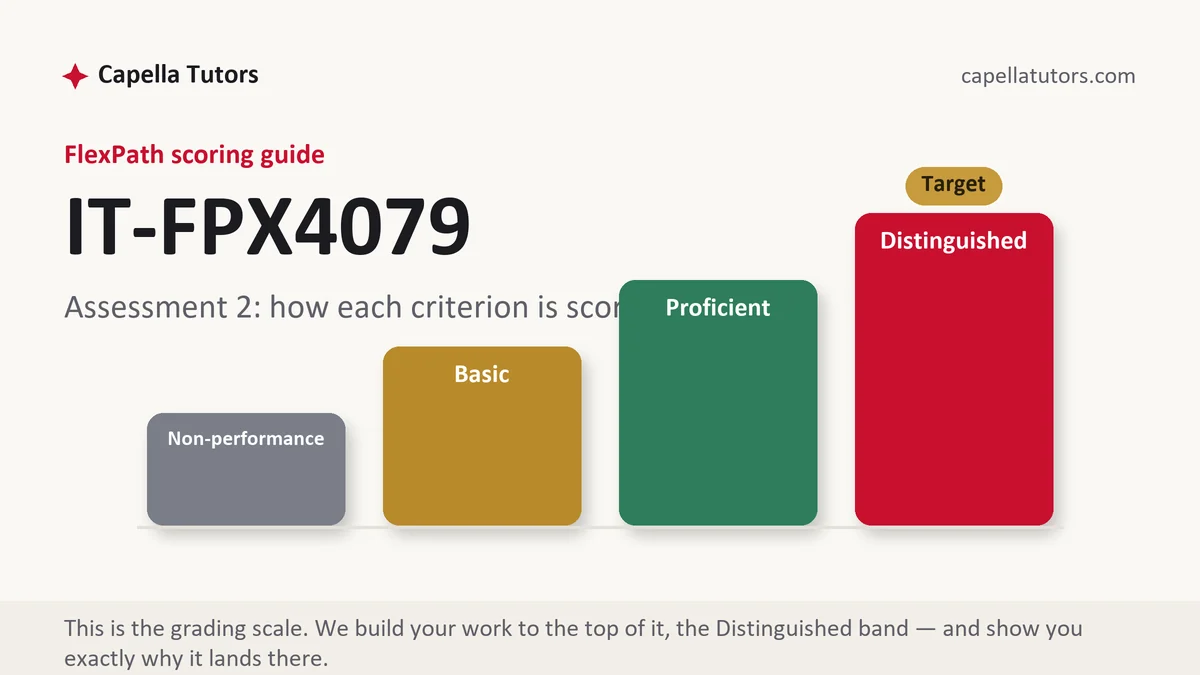
How IT FPX 4079 Assessment 2 is scored
Nothing converts to a percentage in FlexPath. Each criterion is placed at one of four levels by an evaluator working through the guide, and those levels describe the deliverable you should be building:
| Level | What it means on a verification script |
|---|---|
| Distinguished | Every failure mode is handled by type with a message that suggests a fix, the exit status is usable by an automated caller, and the document shows an abnormal run rather than describing one. Each row carries an extra move; take it. |
| Proficient | A program that verifies correctly and reports clearly on well-formed input. Solid engineering that has not yet been shown misbehaving on purpose. |
| Basic | A script that works on the sample provided and stops with a traceback on anything else, documented as though the traceback will not happen. |
| Non-performance | A required element is not present, commonly the error handling or the captured evidence. An empty section grades itself. |
One habit carries most of the difference here: decide in advance what the program should do about every input it cannot process, then make the document show it happening. Predictable failure is a feature, and it is a graded one.
The IT FPX 4079 Assessment 2 method, step by step
-
Define correct behavior for the bad cases before you write the good one
List what the program meets in the wild and what it does about each: file listed but absent, file present but unreadable, digest mismatch, manifest line malformed, directory empty. That list becomes both your handling code and the evidence section, and writing it first stops the handling being bolted on at the end where it always looks like it was.
-
Read the manifest and the files as separate concerns
Take a public radio station verifying its archive against a stored manifest of digests. One function parses the manifest into a mapping, another computes a digest for a file, and a third compares and classifies the result. Separated that way, each becomes a paragraph in the walkthrough and each can be checked on its own, which is exactly what the design row is asking for.
-
Stream the bytes and budget the clock
Hash in fixed-size chunks rather than reading a whole file into memory, since the archive holds files far larger than anything you want resident. Then do the arithmetic for the document: 9,400 files totaling about 780 gigabytes, verified at roughly 180 megabytes per second, is close to 72 minutes of work, which is why the program prints progress rather than sitting silent.
-
Classify results instead of printing them as they come
Four outcomes, counted and reported separately: verified, mismatched, missing, and unreadable. A run that prints one line per file gives a reader 9,400 lines and no summary, while a run that reports totals with the exceptions listed underneath gives them a decision. Return a non-zero exit status when anything failed so a scheduled caller can tell.
-
Catch by type, and never swallow the mismatch
A file not found, a permission error, and a decoding failure are different problems with different remedies, so handle each and say which in the message. A digest that does not match is not an error to be caught, it is the finding the program exists to produce, and a program that hides it inside a general handler has defeated its own purpose.
-
Show the abnormal run, then self-score
Build a small test tree where one file is altered, one is deleted, and one manifest line is malformed, then paste the output for that run as text beside the clean run. Say what you checked and what you expected. Then mark each criterion D, P, B, or N and revise any row you cannot defend before uploading early in the week.
A structure that maps to the criteria
These are planning proportions our tutors use for the written half of a verification submission rather than Capella limits; the code is additional.
| Section | What it must do | Guide |
|---|---|---|
| Purpose and inputs | What the program verifies, what the manifest looks like, what it produces, and what it needs to run. | ~200 words |
| Design | The separation into parsing, hashing, and comparison, with the reason each is its own function. | ~300 words |
| Handling and messages | Each failure mode, the exception type caught, the message issued, and the exit status returned. | ~300 words |
| Performance | Chunked reading, the volume involved, the time it implies, and how progress is reported to the user. | ~250 words |
| Evidence | Output from a clean run and from a run with an altered file, a deleted file, and a bad manifest line. | ~250 words |
| Criterion map and sources | The function satisfying each criterion, plus documentation cited with a retrieval date in current APA. | ~150 words |
Annotated sample excerpt
A short original model passage written by our team at the register the guide rewards. Take the reasoning pattern and apply it to your own program.
verify_file catches FileNotFoundError and PermissionError separately, because the first means the manifest and the archive disagree about what exists and the second means the archive is intact but the account running the check lacks rights, and those two findings send an operator to entirely different places.1 Neither is allowed to become a bare except clause, since a general handler here would also swallow a digest mismatch, which is not an error but the exact result the program was written to report.2 The run therefore ends with counts for verified, mismatched, missing, and unreadable files, prints the exceptions under each heading, and returns exit status 1 whenever any count other than verified is non-zero so the nightly scheduler records a failure.3
- 1Distinguishes two exception types by what they mean operationally rather than by what they are called. That is the sentence a robustness criterion is written to reward.
- 2Names the specific harm a broad handler would cause in this program. General advice about bare handlers earns nothing; this earns the row.
- 3Turns handling into reportable output and a usable exit status, which is what makes the difference between a script and a tool somebody can schedule.
The full premium sample for your exact assessment, written fresh to your scoring guide and issue, is free to request. Study it, revise it into your own voice, and submit work you understand.
The five mistakes that cost Distinguished
- Whole files read into memory to hash them. The approach works on the sample and dies on the archive, and the size of the input was in the prompt.
- A general handler that also hides mismatches. Catching everything means the one result you were asked to detect disappears with the errors.
- Output as one line per file. Thousands of rows with no totals leaves the reader doing the summarizing the program should have done.
- Exit status always zero. A verification tool that reports success to its caller after finding a mismatch cannot be scheduled by anyone.
- Failure modes described but never demonstrated. A paragraph promising graceful handling is not evidence, and the evidence row wants the captured run.
Pre-submission checklist
- Every failure mode is listed with the exception type caught and the message issued
- Files are hashed in chunks, with the volume and expected duration stated
- Results are classified and totaled, with exceptions listed under each heading
- A non-zero exit status is returned whenever anything other than verification succeeds
- Output is captured as text for both a clean run and a deliberately broken run
- Each criterion is tied to a named function, and every row self-scored before upload
Verification script due and the failure paths are untested?
Send the prompt, the manifest format, and the criteria. A premium original comes back inside 24 to 48 hours with chunked hashing, handling by exception type, a usable exit status, and captured output from a run that was broken on purpose. First sample free.