This manual is for IT FPX 4079 Assessment 1, start to submission. The opening deliverable in Python Scripting normally asks for two artifacts and most students prepare one: a program that runs, and a document that explains the program to somebody who may never execute a line of it. The second is where the marks concentrate, because the criteria ask you to justify design decisions, describe what happens when the input is wrong, and connect the output to the problem the prompt described. A working script with no walkthrough tends to sit in the Proficient column wondering what happened. Below is the method our tutors use for it, a structure that maps to the criteria, and an annotated sample excerpt. Prefer to hand it off? A premium original sample for this exact assessment comes back in 24 to 48 hours, revised free until it meets the guide. Capella's catalog lists the course as IT-FPX4079, and some courserooms print IT4079; both point to this same Assessment 1.
One honesty note before the manual: Capella revises courses and scoring guides over time, so always write to the exact scoring guide attached to your assessment in the courseroom. The course identity above is verified on capella.edu; the method and structure below are our tutors' approach to it, not Capella's official rubric text.
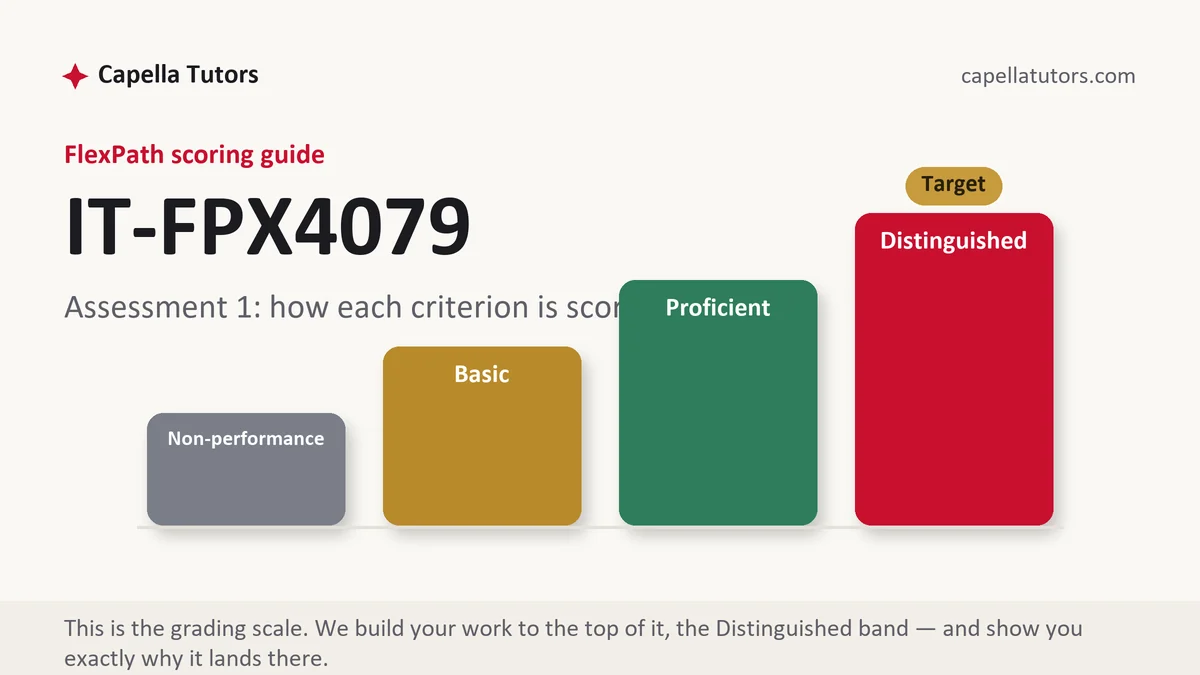
How IT FPX 4079 Assessment 1 is scored
There are no letter grades to chase. Your evaluator places each criterion at one of four levels against the guide, and the level wording is your specification:
| Level | What it means on a script and its write-up |
|---|---|
| Distinguished | The design is justified with an alternative named and rejected, the code needs no glossary to read, and the document points at the function that satisfies each criterion. Every row hides one extra move; go and find it. |
| Proficient | A correct program, cleanly organized, documented adequately. Good work that has not yet explained why it was built this way rather than another way. |
| Basic | A script that produces the right answer with commentary that restates the syntax. It is the usual first attempt, and the repair is a document rather than more code. |
| Non-performance | A required element is absent, most often the evidence that the program ran. Nothing to show is worse than something imperfect to show. |
Readability is graded whether the guide mentions it or not, because your evaluator's experience of the code is the only evidence they have. Names that carry meaning and functions short enough to see whole also make the write-up easy, since each function becomes a paragraph.
The IT FPX 4079 Assessment 1 method, step by step
-
Write the program on paper first
Three sentences are enough: the input the program receives, the output it has to produce, and what must happen in between. Then break that middle sentence into steps and turn each step into a function name, which gives you the structure of the script and the outline of the document at the same time. Where a criterion mentions design, include the pseudocode, because finished code hides the thinking that earned the row.
-
Choose the data structure before the loop
Take a school district service desk that wants a summary of failed remote-access authentications from its own logs. A dictionary keyed by source address with a count as the value makes the counting obvious; a list of pairs makes it a paragraph of apology. State the choice and the reason in the document, since a criterion about design is asking for exactly that sentence.
-
Read the file the way that scales
The district log is around 640 megabytes with roughly 2.3 million lines. Calling a read-all-lines method pulls the whole file into memory and fails on any machine with less headroom than yours, while iterating over the file object holds a few kilobytes no matter how large the file grows. Compile any pattern once above the loop rather than rebuilding it 2.3 million times, and say so in the write-up because the efficiency row can only be graded on your explanation.
-
Validate at the boundary and catch by type
Check the input where it arrives so the rest of the program can assume clean data, then wrap only the risky operation and catch the specific exception rather than everything. A missing file, a refused permission, and a line that does not parse each deserve their own message, phrased so the user can tell what to fix. Never write a path, a hostname, or a credential into the file.
-
Prove it ran
Include a small sample input covering a normal record, an edge case, and a deliberately malformed line, then paste the output as text rather than as a picture. Show what the program prints when the input file is absent. Three documented manual checks beat a claim that everything was verified, and the claim earns nothing on its own.
-
Map the criteria to functions, then self-score
Quote each criterion in the document and name the function and the lines that satisfy it, so an evaluator marking a stack of submissions is not searching. Then mark yourself D, P, B, or N row by row, rewrite anything short of the top, and upload early because an evaluation can take two business days.
A structure that maps to the criteria
The word counts are how our tutors plan the written half of a scripting submission, not a Capella rule; the code itself is additional to them.
| Section | What it must do | Guide |
|---|---|---|
| Problem statement | The task in plain language, the inputs, the outputs, and any constraint the prompt imposed on you. | ~200 words |
| Design | Decomposition into functions, the data structures chosen, and one alternative named and rejected with a reason. | ~300 words |
| Implementation notes | How the code is organized, what each function receives and returns, and the one decision inside it worth explaining. | ~350 words |
| Robustness | Where input is validated, which exceptions are caught by type, the messages produced, and the exit behavior. | ~250 words |
| Evidence | Sample input, captured output for the normal and the abnormal case, and the checks actually performed. | ~200 words |
| Criterion map and sources | Each criterion answered by naming a function and its lines, plus any documentation cited in current APA. | ~150 words |
Annotated sample excerpt
A short piece of original model writing from our team, at the level the top of the guide describes. Study how it argues, then explain your own program the same way.
The parser accumulates counts in a dictionary keyed by source address rather than appending to a list and counting afterward, because the list approach rescans a growing collection for every new record and slows noticeably as the file grows, while the dictionary lookup does not.1 The log is read by iterating over the file object one line at a time, so memory use stays near constant on the 640 megabyte sample instead of scaling with the file, and the regular expression is compiled once above the loop rather than rebuilt on each of roughly 2.3 million iterations.2 A named tuple was considered for each parsed record and rejected, since nothing downstream needs the extra fields and the plain count keeps summarize_by_source short enough to read in one screen.3
- 1States the choice and the cost of the alternative in the same sentence. A design criterion is asking for a comparison, and this gives it one without a paragraph of theory.
- 2Ties two efficiency decisions to the actual size of the input. Numbers from the data in front of you argue better than a general claim about performance.
- 3Names something rejected and why, which is the move that separates the top column from a correct answer. Rejections show judgment; only choices show taste.
The full premium sample for your exact assessment, written fresh to your scoring guide and issue, is free to request. Study it, revise it into your own voice, and submit work you understand.
The five mistakes that cost Distinguished
- Code submitted as an image. A grader who cannot copy a line cannot test it, and a screenshot of source forfeits the readability row.
- One exception handler wrapped around everything. Catching every failure hides the defect you needed to see and turns a crash into quietly wrong output.
- Paths or credentials written into the file. A script that only runs on your desktop is not a deliverable, and a stored secret is a finding in a security specialization.
- Comments that translate the code into English. Restating a line adds length and no information, and the criterion is asking for intent.
- A design section that describes the finished code. Explaining what you built is not the same as explaining why, and only the second earns the row.
Pre-submission checklist
- The document opens with the inputs, the outputs, and the transformation between them
- One alternative design is named and rejected with a stated reason
- The file is read without loading it whole, and any pattern is compiled outside the loop
- Exceptions are caught by type, with messages that tell the user what to fix
- Sample input and captured output appear as text, including an abnormal case
- Each criterion is answered by pointing at a named function, then self-scored before upload
Script due and the write-up is missing?
Send the prompt, the criteria, and any starter data your faculty supplied. A premium original returns inside 24 to 48 hours as commented code, sample output, and a walkthrough that names the function behind every criterion. The first one is free.