Give us the organization in your case, the criteria, and anything you know about how it is staffed, and a premium original sample lands inside 24 to 48 hours with every recommendation carrying an owner, a cadence, and a way to tell whether it is working. Your program listing shows this course as IT FPX 4073, Organizational Security, three program points inside the Information Assurance and Cybersecurity specialization, taught in FlexPath as part of a BS in Information Technology that asks for a minimum of 90 program points and at least 27 of them above the 3000 level. In Capella's catalog the course code is written IT-FPX4073.
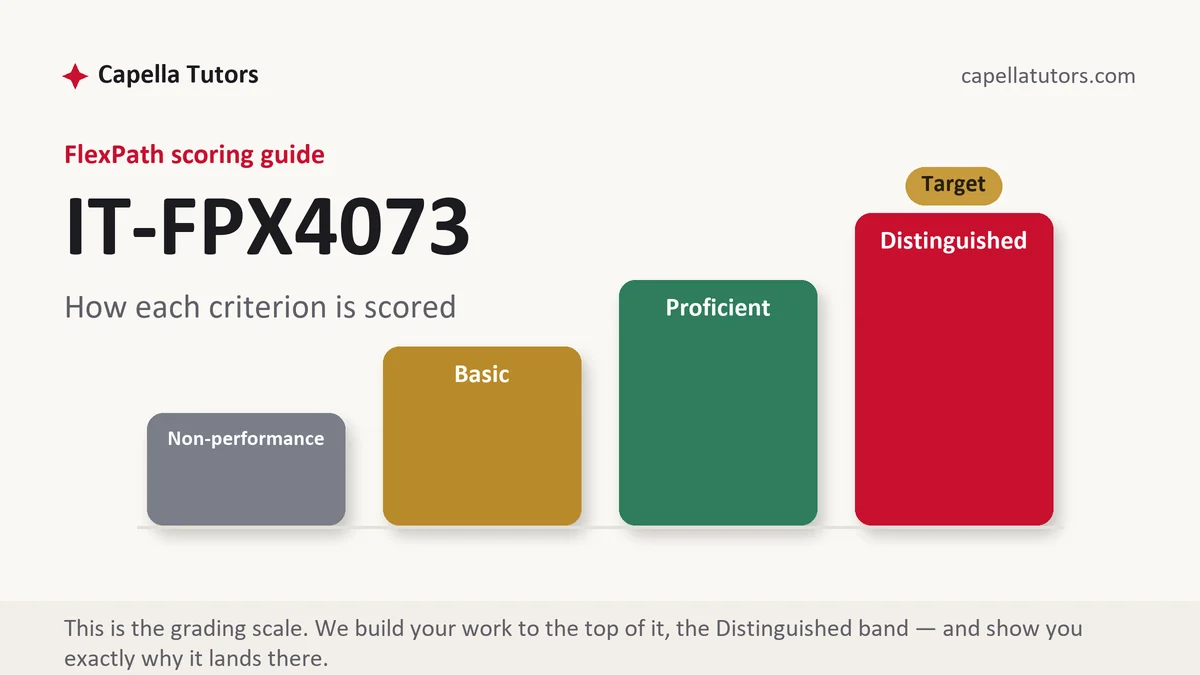
What IT FPX 4073 actually grades
The subject of this course is an organization, not a network, and that shift is what the criteria test. A technically strong student can lose the top column here by writing about firewalls when the question was about who decides, who pays, and who is accountable when nobody does. Governance comes first: an executive sponsor with budget authority, a security function with a reporting line that does not run through the people it audits, a steering group that meets on a schedule, and a documented set of roles that distinguishes the person accountable for a decision from the person who performs the work. Data ownership deserves particular care in writing, since the business owner who classifies information and approves access is a different role from the custodian who runs the system that stores it, and a paper that merges them cannot describe an approval process that works.
People and buildings carry more of the risk than most IT students expect, and the criteria reward candidates who write about both without embarrassment. Personnel security runs the length of employment: background screening proportionate to the role, an acceptable use agreement signed before access exists, provisioning driven by job function rather than by copying a colleague's permissions, periodic recertification of what people can reach, and a departure process that closes accounts on the last day rather than in the following month. Separation of duties and rotation of duties are the two controls that address the trusted insider, and they belong in any paper that mentions fraud. Physical and environmental measures then protect what logical controls assume, since a server room with a propped door, an unlogged visitor, or an unmonitored delivery entrance undoes an access control policy without touching a keyboard.
The outward-facing sections are third-party risk and continuity, and both are graded on process rather than on intention. Vendors inherit your data and export their weaknesses, so the deliverable should describe tiering suppliers by the sensitivity of what they hold, obtaining evidence proportionate to that tier, writing security obligations into the contract with a right to audit and a breach notification window measured in hours, and reassessing on a cycle. Continuity planning starts from a business impact analysis that establishes which processes cannot stop and for how long, and only then produces recovery objectives, alternate arrangements, and a test schedule with results recorded. Finish with measurement, because a security program that cannot report on itself gets cut in the first budget round. Choose a small set of indicators that describe risk rather than effort, state the target and the tolerance for each, and name the person who presents them.
How we help in this course
Program-level deliverables from us come back structured the way a real assessment is structured. Current state is described against a named framework, gaps are stated as findings with evidence, and every remediation carries an owner, an effort estimate, a sequence position, and the indicator that will show it worked. Policy language we supply is enforceable rather than aspirational, with a scope, a review date, and consequences. Roles are written using a responsibility model so a reader can see who decides and who executes. Tell us the sector, the approximate headcount, and any regulation your faculty attached to the scenario, and the program we describe will be the size of the organization in front of us.
Delivery follows the studio standard with nothing changed for this course. A premium original inside 24 to 48 hours, targeted at the Distinguished descriptor, moved through eight people so that research, subject writing, criterion-by-criterion review, citation and originality checking, and a final edit each happen before the file reaches you. Revisions are free until the scoring guide is met and returned faculty feedback re-enters the same cycle at no cost. Because Capella allows an evaluator two business days per attempt, and because FlexPath bills in flat 12-week sessions with up to two courses running at once, we plan submissions so a revision cycle does not push a course past the session boundary.
The assessments, one by one
Assessment 1
The opening deliverable in Organizational Security usually asks who decides rather than what to install: the sponsor with budget authority, the reporting line, the committee cadence, who owns which data, and where the current arrangement leaves a gap. Read the full Assessment 1 manual.
Assessment 2
The middle deliverable in this course usually covers the parts of a security program that have nothing to do with software: people through the length of their employment, buildings and who gets into them, and suppliers who inherit your data and export their weaknesses. Read the full Assessment 2 manual.
Assessment 3
The later work in this course usually asks the program to prove it works: which processes cannot stop and for how long, what recovery objectives follow, when the plan was last exercised, and which handful of numbers an executive would read. Read the full Assessment 3 manual.
How to actually write IT FPX 4073: where to begin
Open the scoring guide, then pick your organization before anything else, because every criterion in this course resolves to a specific place with a specific budget. If the assessment names one, mine the case for headcount, sector, regulation, and known incidents. If it lets you choose, take an employer you understand well enough to describe honestly, and where you cannot disclose real detail, build a composite and label it as one at the top of the document. A composite you declare is legitimate scholarship and an anonymized employer described in unverifiable detail is a problem for you rather than for the grader.
Then find one number that makes the argument for you, because a program paper full of adjectives reads as a brochure. Departure handling is the easiest place to look. Take an organization of 340 staff with annual turnover around 18 percent, which is roughly 61 people leaving in a year. If access removal currently takes an average of six days after the last working day, the organization is carrying about 366 account-days each year in which credentials exist for people who no longer work there. Put a single incident cost against that exposure and the case for automated deprovisioning tied to the payroll record writes itself. The same technique works on unmanaged devices, unreviewed privileged accounts, or vendors with data and no signed obligations. One quantified gap moves a submission out of the Basic column faster than three pages of general advice, because it shows measurement rather than opinion.
Finish with a plan that respects the money. Sort remediation into what can be done with existing staff this quarter, what needs a modest purchase, and what requires a budget request with a business case behind it. State the sequence and the reason for it, since some controls make others cheaper, and an identity cleanup performed before a privileged access purchase reduces what you have to buy. Name who accepts the risks you are not addressing this year and when that acceptance expires. A program roadmap with dates, owners, and an honest untreated column is what the top descriptor is describing, and it is rarer in submitted work than the guide's wording suggests.
| Section | What goes in it | What Distinguished looks like |
|---|---|---|
| Organization and scope | Sector, size, structure, the data held, the obligations that apply, and what is out of scope. | Context specific enough that a reader could not swap in another company without the paper breaking. |
| Governance and roles | Sponsor, reporting line, committee cadence, and a role model separating decision from execution. | Accountability placed on named positions, with the conflict of interest in the reporting line addressed. |
| People and premises | Screening, agreements, access recertification, departures, facility access, and visitor handling. | Controls tied to the employment lifecycle and to the building the scenario actually describes. |
| Third parties | Supplier tiering, evidence expected per tier, contract clauses, and reassessment cadence. | Obligations written as contract language with a notification window and an audit right. |
| Continuity | Impact analysis, recovery objectives, alternate arrangements, and the test record. | Objectives derived from process criticality and validated by an exercise with a date and a result. |
| Measurement and sources | Indicators with targets, reporting audience, framework references, and current APA. | Indicators that describe risk rather than activity, each with a threshold and an owner. |
Developing the analysis
Security awareness training is the argument to pick up in this course, because the evidence pulls in two directions and the criteria reward candidates who notice. The optimistic reading points to phishing simulation programs where reported click rates fall substantially over a year, and to the reporting culture that develops when staff are thanked rather than punished for raising a false alarm. The skeptical reading answers that measured click rates drift back once the campaign ends, that simulation performance measures familiarity with the simulation rather than resistance to a real attack, and that punitive programs teach people to hide mistakes, which costs an organization the early warning it most needs. Both readings are supported in the literature, so resolve them rather than reciting them. The defensible position is that training is a control with a small effect that must not be relied on alone, which is why phishing-resistant authentication and attachment handling belong in the same recommendation, and why the metric worth reporting is time to report an incident rather than percentage clicked. Say what you would do if the training budget were cut in half, and the analysis criterion has been answered.
Citations that survive faculty review
Management standards anchor this paper. The information security management system standard published jointly by the International Organization for Standardization and the International Electrotechnical Commission, together with its companion control guidance, gives you the vocabulary of scope, leadership, and continual improvement that a program assessment is graded against. The Cybersecurity Framework from the National Institute of Standards and Technology supplies functions to organize findings under, and its associated publications on contingency planning and on supply chain risk practices cover two sections that generic sources handle badly. Where the scenario is regulated, cite the obligation itself: the administrative safeguards in the health privacy security rule, the twelfth requirement family in the payment card standard, or the state privacy statute that applies, rather than a summary article about any of them. Annual incident reporting from the industry gives you the scale figures that make a business case credible, and each one needs its year named in your sentence. Peer-reviewed organizational research retrieved through the Capella library carries claims about culture, insider behavior, and training effect, and it is the source type that most distinguishes a strong paper here, since the questions in this course are about people as much as about systems.
The mistakes that land Basic instead of Distinguished
- A program with no named owner anywhere. Recommendations addressed to the organization in general get implemented by nobody.
- Physical and personnel controls left out. A program paper that covers only technology has answered a different question.
- Vendor risk that stops at a questionnaire. A returned form with no evidence and no contract clause changes nothing about the risk.
- Metrics that count activity. Tickets closed and courses completed measure effort, and the criterion wants exposure.
- Continuity objectives with no impact analysis behind them. A recovery time invented without asking the business is a number the business will not honor.
IT FPX 4073 questions students actually ask
What if I do not work somewhere I can write about?
Use a constructed organization and say so on the first page. Give it a sector, a headcount, a rough revenue, a geography, a technology estate, and the regulatory regime that follows from those choices, then keep every later section consistent with that profile. Public material makes this easy to do credibly, since annual reports, regulator enforcement notices, and sector breach reporting supply realistic numbers you can cite. What faculty penalize is not invention but inconsistency, so a fictional company that has 40 employees in one section and an internal security operations centre in the next will lose the criterion. Where you borrow from a former employer, change identifying detail and label the case as composite rather than presenting confidential material.
How do I write security metrics an executive would actually read?
Pick five at most, express each as a number with a target beside it, and make sure every one of them answers a question a board member would ask unprompted. How long does it take us to remove access when someone leaves. What share of our critical systems is patched inside the window we promised. How many suppliers hold our sensitive data without a signed obligation. How long between an incident starting and somebody noticing. How many risks are we formally accepting and who signed for them. Each of those describes exposure rather than effort, each has an owner, and each can move. Add a short trend arrow and one sentence of interpretation, then stop, because an executive report that runs to fifteen indicators gets read as none.
How much of this deliverable should be about technology?
Less than an IT student expects, and the ratio itself is a graded signal. Technology belongs in the paper where it implements a decision the organization made, so a section on privileged access should spend more words on who approves elevated rights and how often that approval is reviewed than on the product that stores the passwords. Read each of your criteria and ask whether the row is about a control, a process, or an accountability, then write to that. When a criterion is genuinely technical, be specific and brief. The organizing test is whether a reader could hand your recommendations to a manager with no security background and get them started, because that is who runs the program between the paragraphs you wrote.
Program assessment due?
Send the organization, the scenario, and the criteria. Owners, cadence, and metrics come back attached to every recommendation. The first premium sample is free.