This manual is for IT FPX 4073 Assessment 3, start to submission. The later work in this course usually asks the program to prove it works: which processes cannot stop and for how long, what recovery objectives follow, when the plan was last exercised, and which handful of numbers an executive would read. A program that cannot report on itself gets cut in the first budget round, which is why the metrics section carries more weight than students expect. Below: the method, a criterion-by-criterion structure, and one annotated model excerpt. Need support? Send the case and a premium original sample lands inside 24 to 48 hours, reworked free until the guide is clear. Capella's catalog lists the course as IT-FPX4073, and some courserooms print IT4073; both point to this same Assessment 3.
One honesty note before the manual: Capella revises courses and scoring guides over time, so always write to the exact scoring guide attached to your assessment in the courseroom. The course identity above is verified on capella.edu; the method and structure below are our tutors' approach to it, not Capella's official rubric text.
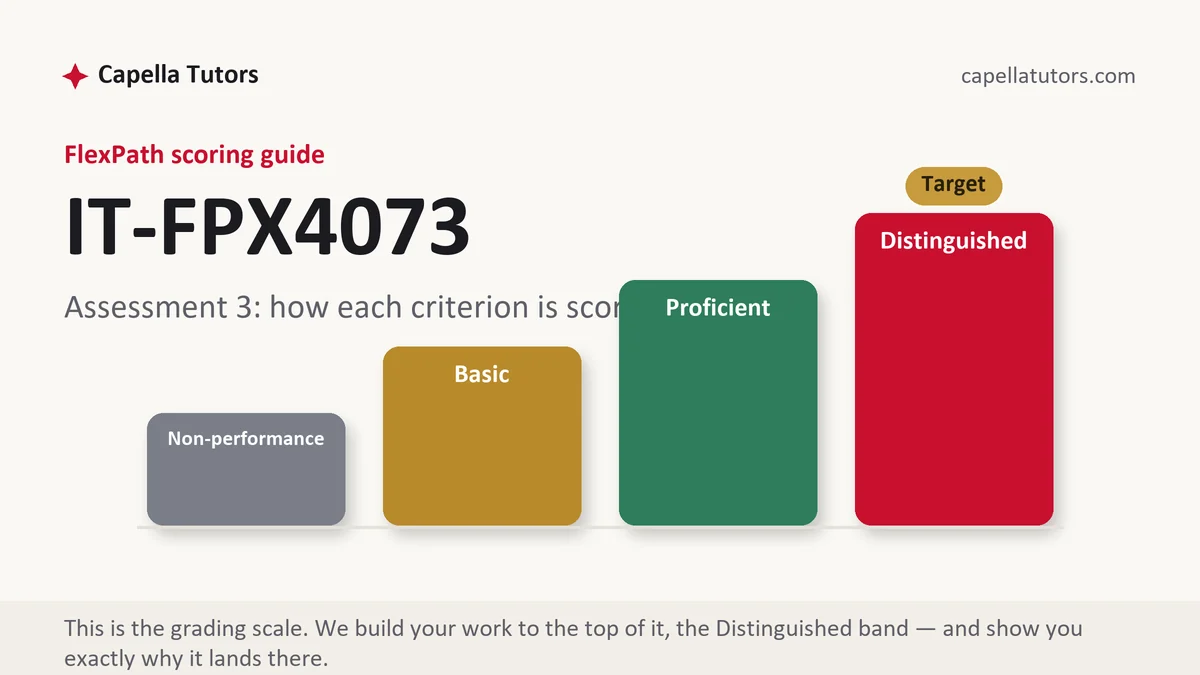
How IT FPX 4073 Assessment 3 is scored
Each criterion lands at one of four levels. The wording of the level is what your draft has to satisfy:
| Level | What it means on a continuity and metrics submission |
|---|---|
| Distinguished | Recovery objectives come from a business impact analysis rather than from preference, the plan has been exercised on a stated date with a stated result, and every indicator describes exposure with a target and an owner. Untreated risk is signed for and expires. |
| Proficient | Impact analysis, objectives, and indicators are all present and consistent. Solid, with the exercise and the ownership left vague. |
| Basic | Recovery times chosen because they sound responsible, plus a page of activity counts called metrics. The standard result when the business was never asked. |
| Non-performance | A required element is absent, most often the impact analysis or the test record, so the objectives resting on it cannot be defended. |
The line to hold in this deliverable is between exposure and effort. Tickets closed and courses completed measure how busy the team was. Time to remove access after a departure, and the share of critical systems patched inside the promised window, measure how exposed the business is. Only the second kind belongs in front of an owner.
The IT FPX 4073 Assessment 3 method, step by step
-
Map the criteria, then ask the business before writing a number
Impact analysis comes first and everything else is derived from it. List the processes, ask what stops if each one stops, and for how long that is survivable, then record who told you. A recovery time invented by the technology team is a number the business will not honor when it matters.
-
Establish criticality from the operating calendar
A distributor moving seed and garden stock through three warehouses is not equally fragile all year. Order intake and pick-and-pack during the spring rush cannot stop for more than a few hours without missing a delivery window that does not come back, while the same outage in November is an inconvenience. Say that, because criticality that ignores the calendar is criticality nobody in the business recognizes.
-
Derive recovery objectives and say what each one costs
Set a recovery time objective for how long a service may be down and a recovery point objective for how much data may be lost, then justify both from the analysis and price them. A four-hour recovery for order intake needs a warm standby that costs money every month, and a twenty-four hour recovery needs almost nothing, so the choice belongs to the business with the numbers in front of them.
-
Write alternate arrangements that somebody could follow
Say where the work happens when the primary site is unavailable, who declares that, who is called, and in what order. Then name the dependency people forget: a warehouse can pick on paper for a day only if a current stock list is printed somewhere, and a plan that assumes the system is available in order to recover the system is not a plan.
-
Record the exercise honestly, including what failed
Give the test a date, a type, a participant list, and a result. A tabletop exercise that revealed the offsite backup key was held by one person who had left is a stronger paragraph than an untested claim of readiness, because it shows the program working. State what was fixed afterwards and when it will next be exercised.
-
Pick five indicators and one roadmap, then self-score
Choose at most five numbers, each with a target, an owner, and a trend, and each answering a question an owner would ask unprompted. Then sort remediation into what existing staff can do this quarter, what needs a modest purchase, and what needs a business case, and name who signs for anything untreated and when that acceptance expires. Then mark yourself per row and submit with room to revise.
A structure that maps to the criteria
Word targets our tutors plan against for a continuity and measurement deliverable at this level, not Capella rules; your guide decides where the weight belongs.
| Section | What it must do | Guide |
|---|---|---|
| Business impact analysis | Processes, what stops when each stops, how long that is survivable, and who in the business said so. | ~300 words |
| Criticality and calendar | How the operating year changes the ranking, with the peak period named and quantified. | ~200 words |
| Recovery objectives | Recovery time and recovery point per service, derived from the analysis and priced. | ~250 words |
| Alternate arrangements | Where work happens, who declares, who is called, and the dependencies the plan must not assume. | ~250 words |
| Exercise record | Test date, type, participants, result, what failed, what was fixed, and the next date. | ~200 words |
| Indicators and roadmap | Five exposure measures with targets and owners, remediation sequenced, untreated risk signed and dated. | ~300 words |
Annotated sample excerpt
An excerpt from a model our team wrote, showing what an exercise record reads like when it reports a failure rather than a rehearsal.
On 14 February the operations director, the warehouse manager at the eastern site, and the technology manager ran a two-hour tabletop exercise on the loss of the order intake system during the first week of the spring rush.1 The exercise failed at forty minutes: the paper fallback assumed a printed stock list that nobody had produced since the previous year, and the offsite backup passphrase was held by one person who had left the business in November.2 Both were closed within three weeks, with the stock list now printed every Friday at each warehouse and the passphrase split between the operations director and the finance director, and the next exercise is scheduled for September so it lands outside the peak rather than during it.3
- 1Gives the exercise a date, a duration, named participants, and a scenario tied to the peak period. Specificity is what makes a test record credible.
- 2Reports two failures plainly. A test that found something is evidence the program works, and hiding it costs the criterion it would have earned.
- 3Closes the loop with fixes, owners, and the next date, and explains the scheduling choice. Continuity graded on process wants exactly this shape.
The full premium sample for your exact assessment, written fresh to your scoring guide and issue, is free to request. Study it, revise it into your own voice, and submit work you understand.
The five mistakes that cost Distinguished
- Recovery objectives with no impact analysis behind them. A number the business never agreed to is a number the business will not fund or honor.
- Metrics that count activity. Tickets closed and training completed measure effort, and the criterion is asking about exposure.
- A plan that assumes the failed system is available. Recovery instructions stored only in the system being recovered is the oldest gap in continuity planning.
- A test asserted rather than dated. An exercise with no date, participants, or result reads as a claim, and claims do not score.
- Untreated risk left unassigned. Acceptance belongs to a named position with an expiry, or nobody has actually accepted anything.
Pre-submission checklist
- Impact analysis built from what the business said, with sources named
- Criticality tied to the operating calendar, with the peak period quantified
- Recovery time and recovery point per service, each derived and priced
- Alternate arrangements written without assuming the failed system is available
- Exercise recorded with date, participants, result, failures, fixes, and next date
- Five exposure indicators with targets and owners, untreated risk signed and dated, then self-scored per row
Continuity plan due and nothing has been tested?
Send the organization, its calendar, and the criteria. You get an impact analysis with the business in it, recovery objectives derived and priced, an exercise record written honestly, and five indicators an owner would actually read, inside 24 to 48 hours. Revision runs free until the guide is met and the first premium sample is at no charge.