This manual is for IT FPX 4073 Assessment 1, start to submission. The opening deliverable in Organizational Security usually asks who decides rather than what to install: the sponsor with budget authority, the reporting line, the committee cadence, who owns which data, and where the current arrangement leaves a gap. A strong technical student can lose the top column by writing about firewalls when the criterion asked about accountability. Here you get the method, a structure keyed to the criteria, and an annotated model excerpt. Rather hand it over? Send the organization in your case and a premium original sample returns inside 24 to 48 hours, revised free until every row is met. Capella's catalog lists the course as IT-FPX4073, and some courserooms print IT4073; both point to this same Assessment 1.
One honesty note before the manual: Capella revises courses and scoring guides over time, so always write to the exact scoring guide attached to your assessment in the courseroom. The course identity above is verified on capella.edu; the method and structure below are our tutors' approach to it, not Capella's official rubric text.
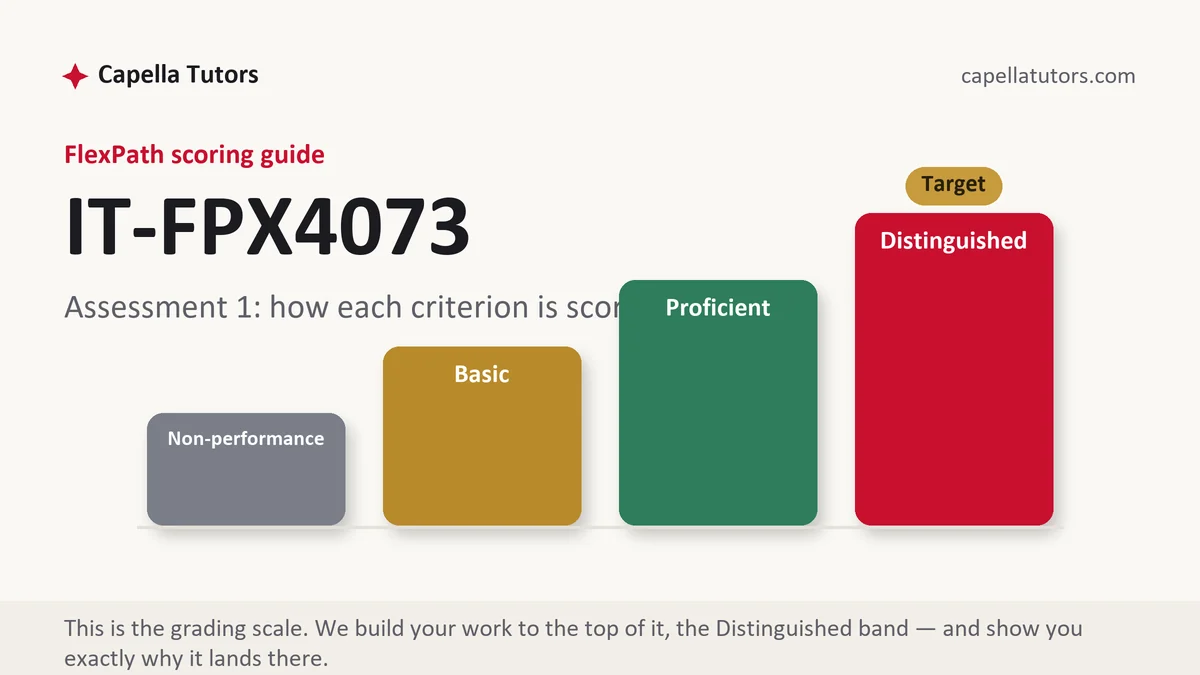
How IT FPX 4073 Assessment 1 is scored
FlexPath grades each criterion at one of four levels and issues no letter grade. The level text is the specification:
| Level | What it means on a governance and current-state submission |
|---|---|
| Distinguished | Accountability sits on named positions, the conflict in the reporting line is addressed rather than ignored, data owners are kept distinct from custodians, and at least one gap is quantified. The context is specific enough that no other company could be swapped in. |
| Proficient | Sponsor, roles, cadence, and gaps are all present and coherent. Sound, with the awkward accountability question left alone. |
| Basic | A description of good governance addressed to the organization in general. Where a submission lands when no position was ever named. |
| Non-performance | A required element is absent, most often the reporting line or the ownership model, so the criterion built on it has nothing to mark. |
One distinction earns marks in almost every draft: the business owner who classifies information and approves access is not the custodian who runs the system it sits on. A paper that merges the two cannot describe an approval process that works, and the approval process is what the accountability criterion is looking at.
The IT FPX 4073 Assessment 1 method, step by step
-
Set the criteria as headings, then pick the organization
Every criterion here resolves to a specific place with a specific budget, so decide the organization before writing a word. If the case names one, mine it for headcount, sector, and obligations. If you may choose, take an employer you can describe honestly, and where you cannot disclose real detail, build a composite and label it as one on the first page.
-
Describe the place tightly enough that it could not be another company
A regional heating and cooling contractor with 210 staff across four depots, sixty service vans running a dispatch application, and a single office server holding customer payment history is a specific organization. A mid-sized company with several locations is not, and the context criterion is graded on exactly that difference.
-
Name the sponsor and fix the reporting line
Say who holds budget authority for security, who the security function reports to, and why that line does not run through the people it audits. In a contractor of this size the honest answer is often that the technology manager reports to the finance director and audits their own work, and naming that conflict, then proposing a quarterly report straight to the owner, is worth more than pretending a governance structure exists.
-
Separate deciding from doing with a role model
Write the roles so a reader can see who is accountable for a decision, who performs the work, who must be consulted, and who is merely told. Then apply it to something real: who approves a new dispatch application user, who creates the account, and who reviews the list every quarter. Three names against one process beats a page of definitions.
-
Assess the current state against a named framework
Choose a framework, cite it by revision, and organize your gaps under its functions rather than under headings you invented. State each gap as a finding with the evidence behind it, because a gap asserted without evidence is an opinion and a gap with a count behind it is an assessment.
-
Quantify one gap, then self-score and submit
Find a single number that makes the argument for you. A contractor with 210 staff and turnover around 22 percent loses roughly 46 people a year, and at five working days to remove access it carries about 230 account-days annually in which credentials belong to former staff. One quantified gap lifts a submission out of Basic faster than three pages of general advice. Then mark yourself per row and submit inside the two business day window.
A structure that maps to the criteria
The word counts below are planning targets our tutors use for a governance assessment at this level, not Capella rules; expand whichever section your guide weights most.
| Section | What it must do | Guide |
|---|---|---|
| Organization and scope | Sector, size, structure, sites, the data held, the obligations that follow, and what is out of scope. | ~250 words |
| Sponsorship and reporting | Who holds budget authority, who security reports to, and how the conflict in that line is handled. | ~250 words |
| Roles and accountability | A role model separating decision from execution, applied to one real approval process. | ~250 words |
| Data ownership | Business owners who classify and approve, custodians who operate, and the boundary between them. | ~200 words |
| Current-state gaps | Findings organized under a cited framework's functions, each with the evidence behind it. | ~300 words |
| Sources | Management standards and framework revisions cited directly, organizational research for culture claims, current APA. | as needed |
Annotated sample excerpt
An excerpt from a model our team wrote, showing how a governance gap reads when a number is doing the arguing.
Departures are handled by an email from the depot supervisor to the technology manager, sent when the supervisor remembers, and eleven of the last thirty leavers still held an active dispatch account four weeks after their final shift.1 At 210 staff and turnover near 22 percent, the contractor loses about 46 people a year, and at an average removal delay of five working days it carries roughly 230 account-days annually in which live credentials belong to former employees, some of them fitters who left for a competitor.2 The gap is not a missing product; it is a missing trigger, so the recommendation is to drive deactivation from the payroll record rather than from a supervisor's memory, owned by the finance director because that is where the payroll record already lives.3
- 1States how the process actually works today and produces a count from the real record. Evidence before diagnosis is the order a findings criterion rewards.
- 2Turns the count into an annual exposure figure a non-technical owner can hold in their head, and adds the detail that makes it matter.
- 3Names the gap as a process failure and assigns the fix to the position that already owns the source of truth. Accountability placed on a named role is the top-column move.
The full premium sample for your exact assessment, written fresh to your scoring guide and issue, is free to request. Study it, revise it into your own voice, and submit work you understand.
The five mistakes that cost Distinguished
- Recommendations addressed to the organization in general. A control assigned to everybody gets implemented by nobody, and the criterion asks for a position.
- Business owner and system custodian merged. If the person who runs the system also approves access to it, no approval process exists to describe.
- A reporting line with an obvious conflict left unmentioned. Naming the conflict is worth more than describing a governance structure the case does not have.
- Gaps asserted with no evidence. An unsupported gap is an opinion, and the assessment row is graded on what you can show.
- A generic company that could be any company. If a reader could swap in another firm without the paper breaking, the context criterion is already lost.
Pre-submission checklist
- Organization chosen and labeled as real or composite on the first page
- Context specific enough that no other company could be substituted
- Sponsor named by position, with the reporting-line conflict addressed
- A role model applied to one real approval process with named positions
- Business owners kept distinct from custodians in writing
- At least one gap quantified from evidence, then self-scored per row
Governance assessment due and the case is thin?
Send the organization, the criteria, and any regulation your faculty attached. You get a context nobody could swap out, accountability placed on named positions, ownership separated from custody, and at least one gap quantified from the evidence, inside 24 to 48 hours. Revisions run free until the guide is met and the opening premium sample is free.