How to write BUS-FPX4012 Assessment 2

The short answer

This manual is for BUS-FPX4012 Assessment 2, start to submission. Assessment 2 of BUS-FPX4012, Leadership in Organizations, is the influence deliverable: an outcome has to be produced through people you cannot instruct, and you explain which sources of influence are available, which you would use on whom, and what each attempt costs. Your scoring guide decides whether that arrives as an analysis, a memo or a persuasion plan. Below is the sequence our tutors use here, a structure that answers the criteria one at a time, and an annotated excerpt. Want it taken off your desk? We return a premium original sample for your criteria in 24 to 48 hours and keep revising until the descriptors are met. Your courseroom may print this as BUS FPX 4012 Assessment 2 or BUS4012 Assessment 2; it is the same deliverable, and BUS-FPX4012 Assessment 2 is what this manual walks through.

One honesty note before the manual: Capella revises courses and scoring guides over time, so always write to the exact scoring guide attached to your assessment in the courseroom. The course identity above is verified on capella.edu; the method and structure below are our tutors' approach to it, not Capella's official rubric text.
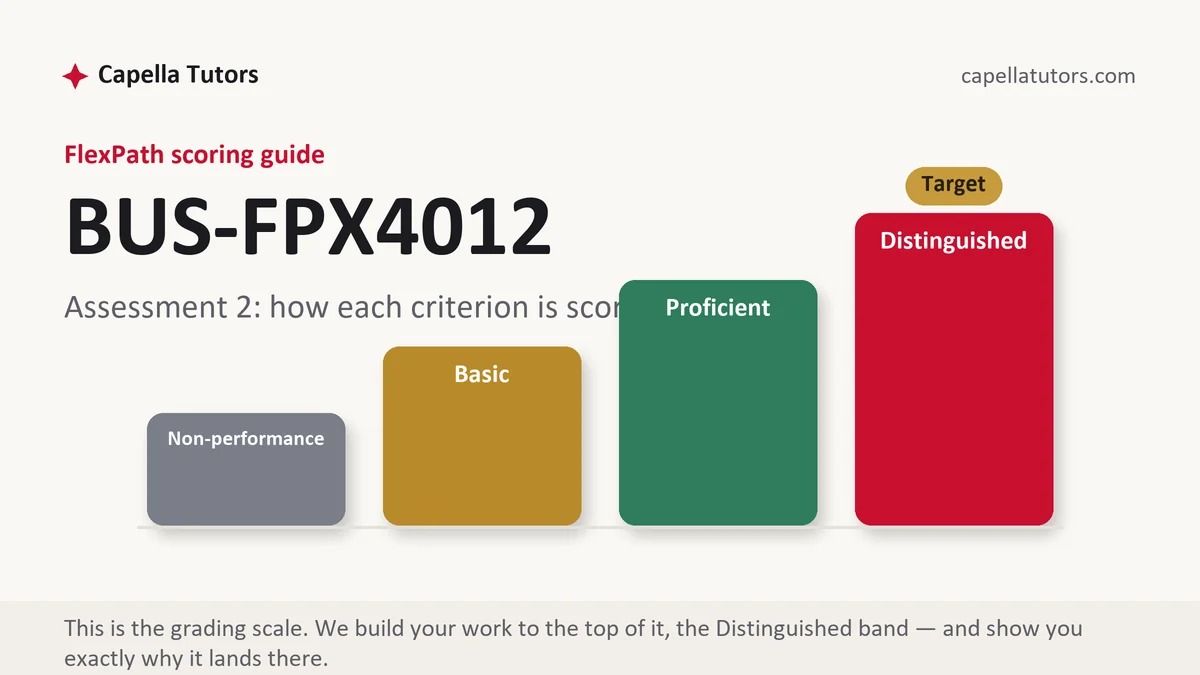
BUS-FPX4012 Assessment 2 grading scale at Capella FlexPath, the criterion levels this assessment is scored on, from Capella Tutors
How Capella FlexPath grades BUS-FPX4012 Assessment 2, visualized by Capella Tutors.

How BUS-FPX4012 Assessment 2 is scored

There are four levels per criterion in FlexPath and no letter grades anywhere, so the level descriptions are the specification you write to:

LevelWhat it means on a power and influence deliverable
DistinguishedEach influence attempt is traced to a named source, aimed at a named person or group, and priced, with the cheaper option considered and rejected. The extra move is always written into the criterion; find it and make it.
ProficientThe sources of influence are identified correctly and matched sensibly to the situation. Solid, and still one step below the top level.
BasicA general account of influence tactics with the target audience left unspecified. Where drafts land when the scenario is treated as background.
Non-performanceA required element never appears, commonly the cost or consequence of an influence attempt. Missing content cannot be graded generously.

Position authority is the weakest instrument in the set for anything requiring effort rather than mere presence, and most students overrate it because it is the one that appears on an organization chart. Expertise, reliability, framing and personal regard are all available to somebody with no direct reports, and a paper that shows one of them working on a named audience answers the criterion better than a paragraph about the limits of hierarchy.

The BUS-FPX4012 Assessment 2 method, step by step

  1. Turn the criteria into headings, then find your audience

    Outline from the guide first. Then name every person or group whose behaviour has to change for the outcome to happen, because an influence plan with no audience is a list of tactics. Three named audiences with different interests is the material this deliverable runs on.

  2. State the outcome as something observable

    Not better collaboration but four clinics using one recall protocol by the end of the quarter. An observable outcome lets you show progress and lets a reader judge whether your influence attempts are proportionate to it. Vague goals produce vague tactics, and vague tactics land at Basic.

  3. Put a number on the gap you are trying to close

    Measure the present state so the argument has weight. Across four sites with 2,400, 1,900, 3,100 and 1,600 patients and compliance of 74, 68, 51 and 79 percent, the weighted rate is 5,913 of 9,000, or 66 percent, and the largest site is the weakest performer. That arithmetic tells you where to spend your influence and gives the criterion something concrete to reward.

  4. Map each audience to a source of influence

    Work through the audiences one at a time and say what actually moves each. A clinical lead who trusts data responds to a comparison table. A long-serving receptionist who has seen three failed initiatives responds to a colleague she respects going first. A practice owner responds to a figure with a currency symbol in front of it. Name the source you are drawing on in each case rather than describing the conversation.

  5. Price every attempt and name the cheaper one you skipped

    Influence is never free. Escalating to the owner buys compliance and spends goodwill you will want next quarter. Running a pilot at one site costs six weeks and buys evidence. Say which cost you accepted and which alternative you rejected, because the criterion about judgment is usually paying for the rejected option rather than the chosen one.

  6. Add a fallback, then self-score against the guide

    Say what you will do if the first attempt fails, and set the point at which you will know. A plan that assumes agreement reads as optimism rather than management. Then mark each criterion D, P, B or N on your own draft, rewrite anything under D, and submit early in the week so a resubmission still fits your session.

A structure that maps to the criteria

The lengths below are planning targets our tutors use for a typical 4012 influence deliverable, not Capella requirements, so expand wherever your guide asks for depth.

SectionWhat it must doGuide
Introduction and outcomeThe situation, the observable outcome you are trying to produce, and why authority is not available to produce it.~160 words
The gap in numbersPresent performance measured, compared across sites or groups, with the arithmetic shown in the text.~230 words
Audiences and interestsEach person or group whose behaviour must change, what they currently gain from the status quo, and what they stand to lose.~280 words
Sources of influence appliedThe source drawn on for each audience, the specific move it implies, and why that source suits that audience.~330 words
Costs, sequence and fallbackWhat each attempt spends, the order the attempts run in, and what happens if the first one fails.~250 words
Measures and referencesHow you will know it worked, when you will check, and current APA in both directions.~150 words

Annotated sample excerpt

An original model excerpt from our team, showing the specificity the top of the guide rewards. Borrow the moves rather than the sentences.

Sample excerpt: the gap in numbers Original model · Capella Tutors

Meridian Dental Partners runs four clinics with 2,400, 1,900, 3,100 and 1,600 active patients, and each clinic decides for itself how patients are recalled for a hygiene appointment.1 Compliance with the recall interval runs at 74, 68, 51 and 79 percent respectively, which weighted by patient numbers is 5,913 patients of 9,000, or 66 percent overall, and the weakest clinic is also the largest, so a nine-point improvement there would move the group figure further than a fifteen-point improvement at the smallest site.2 The hygiene coordinator who has been asked to standardise recall reports to no clinic manager and cannot direct a single member of their staff.3

  • 1Establishes the scenario with the fact that makes influence necessary, four sites deciding independently, before any tactic is mentioned.
  • 2The weighting is worked in the text, and the conclusion it produces about where to aim is stated. This is the arithmetic a criterion about analysis pays for.
  • 3Names the authority constraint in one sentence, which is what turns the rest of the paper into an influence problem rather than a management instruction.

The full premium sample for your exact assessment, written fresh to your scoring guide and issue, is free to request. Study it, revise it into your own voice, and submit work you understand.

Get the full sample free

The five mistakes that cost Distinguished

  • An audience called the stakeholders. Influence is exercised on specific people with specific interests, and a collective noun hides every one of them.
  • Authority assumed where none exists. Recommending that the team be required to comply answers a different question than the one the scenario poses.
  • Tactics with no source named. Describing a persuasive conversation without saying what the persuasion rested on leaves the central criterion unaddressed.
  • No cost anywhere in the plan. Every influence attempt spends credibility, goodwill or time, and a plan that spends nothing has not been thought through.
  • Success left undefined. If the paper never says what would count as the outcome happening, the measurement criterion has nothing to score.

Pre-submission checklist

  • Each criterion has its own labeled section in the document
  • The outcome is stated as something observable with a date attached
  • The present gap is quantified, with the arithmetic visible in the text
  • Every audience is named individually with its interest in the status quo stated
  • Each influence attempt is tied to a source, priced, and sequenced
  • A fallback, a measure, a review point, and APA checked both ways

Influence or persuasion deliverable due?

Send the criteria, the outcome you have to produce and whatever figures describe the current state. We will name the audiences, match each to a source of influence, price the attempts, and return a premium original sample written to the Distinguished descriptors in 24 to 48 hours, revised free until it meets the guide.

Keep going

Online now