This manual is for BUS FPX 2030 Assessment 1, start to submission. New Product Analysis asks you to analyze a new product for a real company: the product, its target market, brand identity and positioning, packaging and the product strategy that would make it succeed. The course follows one company and one new product across its assessments, ending with a promotion analysis and sales plan in Assessment 4. The grade turns on applying marketing concepts to a real company with evidence. General marketing definitions score lower than specific, supported decisions. Below is the method our tutors use, a structure that maps to the criteria, and an annotated sample excerpt. Prefer to hand it off? A premium original sample for this exact assessment comes back in 24 to 48 hours, revised free until it meets the guide. Capella's catalog lists the course as BUS-FPX2030, and some courserooms print BUS2030; both point to this same Assessment 1. In current courserooms this assessment typically appears as "New Product Analysis".
One honesty note before the manual: Capella revises courses and scoring guides over time, so always write to the exact scoring guide attached to your assessment in the courseroom. The course identity above is verified on capella.edu; the method and structure below are our tutors' approach to it, not Capella's official rubric text.
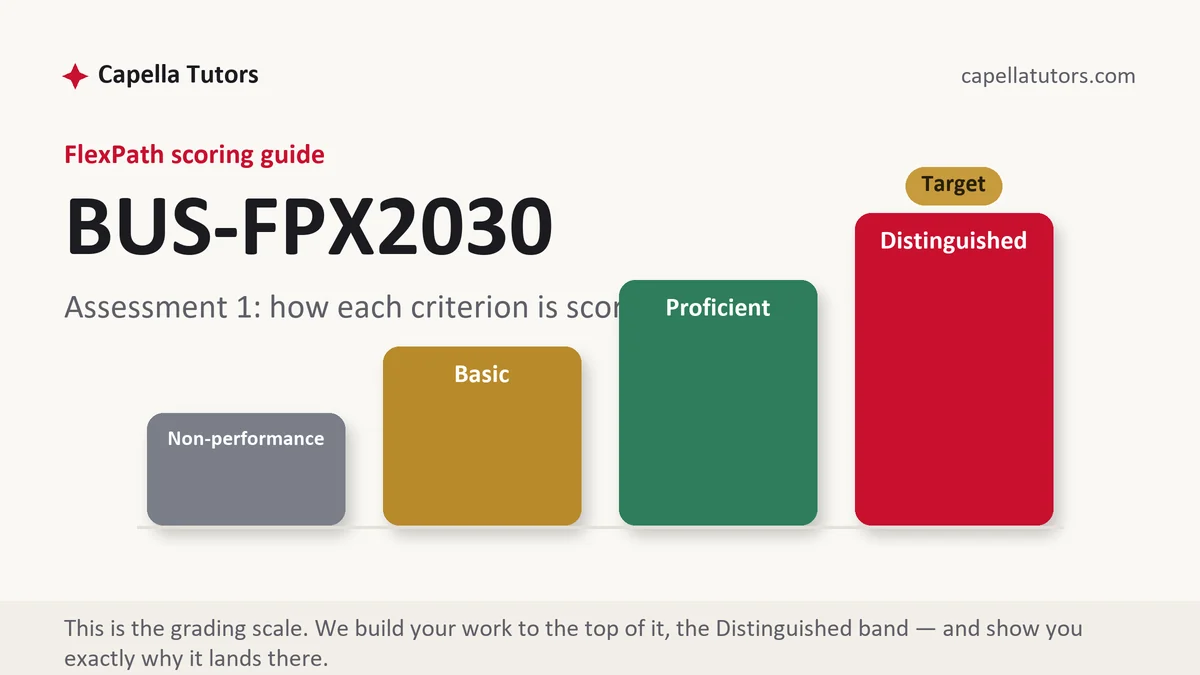
How BUS FPX 2030 Assessment 1 is scored
FlexPath does not use letter grades. Each criterion in the scoring guide lands on one of four levels, and the level descriptions are the real writing brief:
| Level | What it means on a new product analysis |
|---|---|
| Distinguished | The analysis is specific to the company and product, uses data and credible sources, applies marketing concepts accurately, and ends in a justified recommendation. |
| Proficient | The analysis is accurate, but the recommendation is general. |
| Basic | The paper defines concepts with little about the company. |
| Non-performance | A required part or the recommendation is missing. |
Keep the same company and new product across the course so each assessment builds on the last.
The BUS FPX 2030 Assessment 1 method, step by step
-
Choose the company and product
A real brand and a plausible new product, such as a line extension.
-
Define the target market
Demographics, needs and buying behavior.
-
Set brand identity and positioning
How the product fits the brand and a positioning statement.
-
Describe packaging and design
What the package communicates.
-
Explain the product strategy
Features, differentiation and the path to success.
-
Support with evidence
Market data and company sources.
A structure that maps to the criteria
Word counts are planning targets our tutors use, not Capella rules; follow the length and format your scoring guide states.
| Section | What it must do | Guide |
|---|---|---|
| Product description and target market | The product and who buys it. | ~200 words |
| Brand identity and positioning | Fit with the brand and a positioning statement. | ~175 words |
| Packaging and visual design | What it communicates. | ~100 words |
| Product strategy and path to success | Differentiation and plan. | ~175 words |
| Conclusion and references | Close, then references. | ~75 words |
Annotated sample excerpt
An original model excerpt from our team, written to show the register that reaches the top of the guide. Learn the moves, then write your own version.
For busy professionals aged 25 to 40 who want caffeine without the sugar crash, the new cold brew line is the energy coffee that keeps the brand's edge while fitting a morning routine.1 The positioning stretches the brand from late-night energy into the breakfast occasion, which is where most of the growth in ready-to-drink coffee has come from in recent years.2 Keeping the familiar can shape and color scheme protects brand recognition on the shelf, while a coffee-brown accent signals the new category at a glance.3
- 1Makes a specific decision for the product.
- 2Supports it with market reasoning or data.
- 3Shows how it connects to the rest of the marketing mix or the brand.
The full premium sample for your exact assessment, written fresh to your scoring guide and topic, is free to request. Study it, revise it into your own voice, and submit work you understand.
The five mistakes that cost Distinguished
- Definitions only. Apply concepts to the company.
- No data. Use market figures and sources.
- A different product each time. Keep the same product across the course.
- No recommendation. End with a justified decision.
- Weak sources. Use company and credible business sources.
Pre-submission checklist
- Same company and product as earlier work
- Analysis specific and supported
- Marketing concepts applied accurately
- Justified recommendation
- Effects on the marketing mix
- References
Want the new product analysis written?
Send the scoring guide and any materials from your courseroom. Our team returns a premium original new product analysis in 24 to 48 hours, revised free until it meets the guide.