This manual is for BUS FPX 3022 Assessment 3, start to submission. SCM Case Analysis: Information Technology asks you to analyze how a company uses information technology in its supply chain: its dependence on information management systems, how technology improves customer experience, automation in fulfillment, the effect on sales and satisfaction, its competitive position, and the future of automation including ethical considerations. The grade turns on linking technology to supply chain performance. Listing systems scores lower than showing what each system changes in speed, accuracy, cost or service. Below is the method our tutors use, a structure that maps to the criteria, and an annotated sample excerpt. Prefer to hand it off? A premium original sample for this exact assessment comes back in 24 to 48 hours, revised free until it meets the guide. Capella's catalog lists the course as BUS-FPX3022, and some courserooms print BUS3022; both point to this same Assessment 3. In current courserooms this assessment typically appears as "SCM Case Analysis: Information Technology".
One honesty note before the manual: Capella revises courses and scoring guides over time, so always write to the exact scoring guide attached to your assessment in the courseroom. The course identity above is verified on capella.edu; the method and structure below are our tutors' approach to it, not Capella's official rubric text.
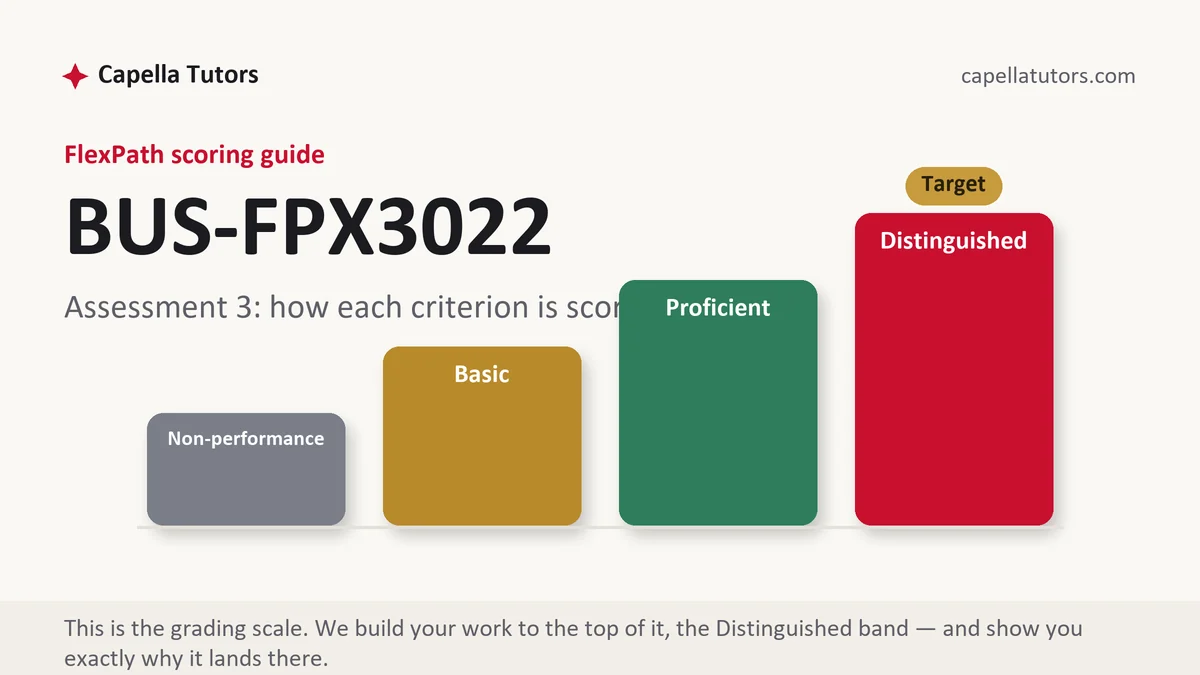
How BUS FPX 3022 Assessment 3 is scored
FlexPath does not use letter grades. Each criterion in the scoring guide lands on one of four levels, and the level descriptions are the real writing brief:
| Level | What it means on a supply chain technology case |
|---|---|
| Distinguished | The company's information systems are described accurately, their effects on operations and customers are analyzed with evidence, competition and future automation are discussed, and ethical issues are addressed. |
| Proficient | All parts are accurate, but effects are described generally. |
| Basic | The paper lists technologies with little analysis. |
| Non-performance | The effects, the competition discussion or the ethics are missing. |
Use the company your courseroom names and cite recent sources on its systems.
The BUS FPX 3022 Assessment 3 method, step by step
-
Describe the systems
Inventory, warehouse, order and data systems.
-
Explain dependence
What would fail without them.
-
Analyze customer effects
Delivery speed, tracking, personalization.
-
Analyze automation
Robotics and its effect on cost and accuracy.
-
Assess competition
How technology supports market position.
-
Address ethics
Workforce effects, data privacy and surveillance.
A structure that maps to the criteria
Word counts are planning targets our tutors use, not Capella rules; follow the length and format your scoring guide states.
| Section | What it must do | Guide |
|---|---|---|
| Information systems and dependence | What the company uses. | ~125 words |
| Customer experience and sales | Effects with evidence. | ~125 words |
| Automation in fulfillment | Effects on cost and accuracy. | ~100 words |
| Competition and future of automation | Position and outlook. | ~100 words |
| Ethical considerations and references | Issues, then references. | ~100 words |
Annotated sample excerpt
An original model excerpt from our team, written to show the register that reaches the top of the guide. Learn the moves, then write your own version.
In the company's newer fulfillment centers, robots bring shelves to workers instead of workers walking the aisles, which shortens the time from order to packed box and reduces picking errors.1 That speed is what makes same-day and next-day delivery affordable at scale, and delivery speed is one of the main reasons customers cite for choosing the company.2 The same systems raise ethical questions, because pace targets set by software have been linked in reporting to injury rates, so the analysis weighs efficiency gains against worker safety.3
- 1Describes a technology and its operational effect.
- 2Links it to customer value.
- 3Raises the ethical issue with evidence.
The full premium sample for your exact assessment, written fresh to your scoring guide and topic, is free to request. Study it, revise it into your own voice, and submit work you understand.
The five mistakes that cost Distinguished
- Listing systems. Analyze their effects.
- Ignoring customers. Link technology to service and sales.
- No ethics. Address workforce and privacy issues.
- Old sources. Use recent evidence.
- No competitive analysis. Explain the market effect.
Pre-submission checklist
- Systems described
- Operational effects analyzed
- Customer and sales effects
- Automation and competition
- Ethical considerations
- References
Want the supply chain technology case written?
Send the scoring guide and any materials from your courseroom. Our team returns a premium original supply chain technology case in 24 to 48 hours, revised free until it meets the guide.