This manual is for BUS FPX 3022 Assessment 2, start to submission. SCM Case Analysis: Forecasting and Planning asks you to analyze the supply chain planning of a company, often by comparing two well-known firms: their business and supply chain models, how they forecast and plan, their transportation strategies, the risks they face and how they mitigate them, the economic and political factors affecting them, and how pricing and promotions interact with planning. The grade turns on comparison and planning logic. Describing each company separately scores lower than explaining why their planning choices differ. Below is the method our tutors use, a structure that maps to the criteria, and an annotated sample excerpt. Prefer to hand it off? A premium original sample for this exact assessment comes back in 24 to 48 hours, revised free until it meets the guide. Capella's catalog lists the course as BUS-FPX3022, and some courserooms print BUS3022; both point to this same Assessment 2. In current courserooms this assessment typically appears as "SCM Case Analysis: Forecasting and Planning".
One honesty note before the manual: Capella revises courses and scoring guides over time, so always write to the exact scoring guide attached to your assessment in the courseroom. The course identity above is verified on capella.edu; the method and structure below are our tutors' approach to it, not Capella's official rubric text.
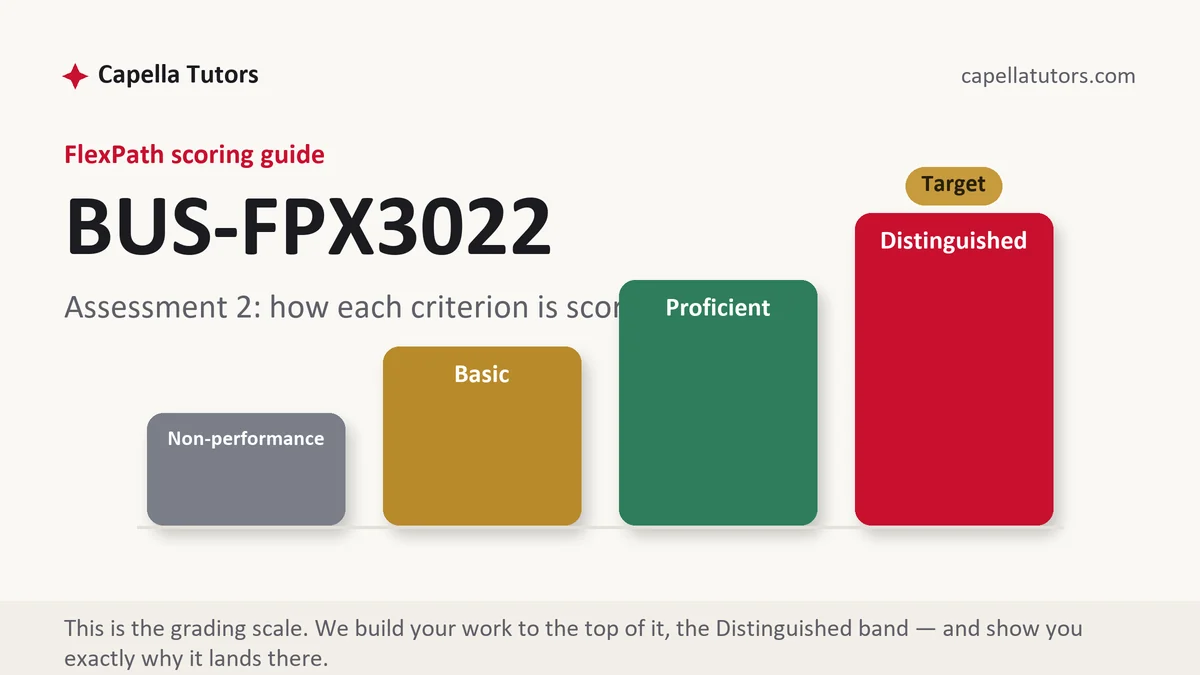
How BUS FPX 3022 Assessment 2 is scored
FlexPath does not use letter grades. Each criterion in the scoring guide lands on one of four levels, and the level descriptions are the real writing brief:
| Level | What it means on a supply chain planning case |
|---|---|
| Distinguished | Both supply chain models are described accurately, forecasting and planning are compared, transportation, risk and external factors are analyzed with evidence, and conclusions are specific. |
| Proficient | All parts are accurate, but the comparison is brief. |
| Basic | The paper describes the companies with little analysis. |
| Non-performance | The comparison, the risk analysis or the external factors are missing. |
Use the companies your courseroom names and recent, credible sources.
The BUS FPX 3022 Assessment 2 method, step by step
-
Describe each business model
How each company makes and sells.
-
Compare supply chain approaches
Vertical integration versus outsourcing, centralized versus distributed.
-
Analyze forecasting and planning
How each anticipates demand.
-
Compare transportation strategies
Modes, networks and speed.
-
Assess risks and mitigation
Supplier concentration, disruption, inventory.
-
Consider external factors and pricing
Tariffs, trade policy, economic cycles and promotions.
A structure that maps to the criteria
Word counts are planning targets our tutors use, not Capella rules; follow the length and format your scoring guide states.
| Section | What it must do | Guide |
|---|---|---|
| Business models | Each company. | ~125 words |
| Supply chain comparison | Approaches compared. | ~150 words |
| Transportation strategy | Modes and networks. | ~100 words |
| Risks, mitigation and external factors | Analysis with evidence. | ~150 words |
| Pricing, promotions and references | Interaction with planning, then references. | ~100 words |
Annotated sample excerpt
An original model excerpt from our team, written to show the register that reaches the top of the guide. Learn the moves, then write your own version.
Apple plans a narrow product line far in advance and secures components with long contracts, which works because demand for a few models can be forecast and suppliers are tightly controlled.1 Amazon plans for millions of items with unpredictable demand, so it relies on data-driven forecasting at the item level and positions inventory across a dense network of fulfillment centers close to customers.2 The difference is not that one plans better, but that each company's planning fits its product range: concentration rewards long-range commitments, while breadth rewards speed and flexibility.3
- 1Explains one company's planning through its product line.
- 2Contrasts the other's planning and network.
- 3Draws a conclusion about why they differ.
The full premium sample for your exact assessment, written fresh to your scoring guide and topic, is free to request. Study it, revise it into your own voice, and submit work you understand.
The five mistakes that cost Distinguished
- Separate descriptions. Compare directly.
- Ignoring risk. Analyze risks and mitigation.
- No external factors. Include economic and political forces.
- Old sources. Use recent evidence.
- No conclusion. Explain why their choices differ.
Pre-submission checklist
- Business models described
- Supply chains compared
- Transportation analyzed
- Risks and mitigation
- External factors and pricing
- References
Want the supply chain case analysis written?
Send the scoring guide and any materials from your courseroom. Our team returns a premium original supply chain case analysis in 24 to 48 hours, revised free until it meets the guide.