This manual is for BUS FPX 3022 Assessment 1, start to submission. In current courserooms, Assessment 1 of Fundamentals of Supply Chain Management asks you to analyze how a company uses a direct-to-consumer (DTC) distribution strategy within its supply chain: why supply chain management matters, how DTC works, its advantages and disadvantages for the company, and recommendations for improving the strategy or applying it at a competitor. The grade turns on supply chain reasoning. A summary of the company's DTC moves scores lower than an analysis of what DTC does to inventory, cost, speed and customer relationships. Below is the method our tutors use, a structure that maps to the criteria, and an annotated sample excerpt. Prefer to hand it off? A premium original sample for this exact assessment comes back in 24 to 48 hours, revised free until it meets the guide. Capella's catalog lists the course as BUS-FPX3022, and some courserooms print BUS3022; both point to this same Assessment 1.
One honesty note before the manual: Capella revises courses and scoring guides over time, so always write to the exact scoring guide attached to your assessment in the courseroom. The course identity above is verified on capella.edu; the method and structure below are our tutors' approach to it, not Capella's official rubric text.
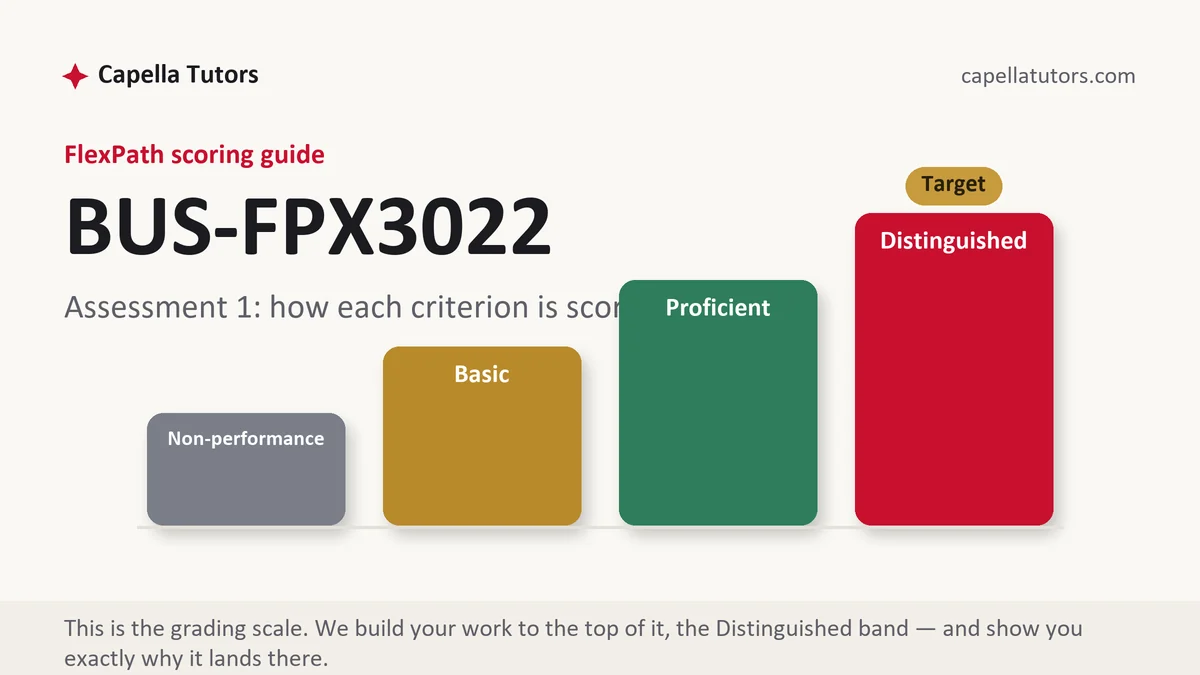
How BUS FPX 3022 Assessment 1 is scored
FlexPath does not use letter grades. Each criterion in the scoring guide lands on one of four levels, and the level descriptions are the real writing brief:
| Level | What it means on a DTC supply chain analysis |
|---|---|
| Distinguished | Supply chain management is explained, the company's DTC strategy is described accurately, advantages and disadvantages are analyzed with evidence, and recommendations are specific and supported. |
| Proficient | All parts are accurate, but the analysis is general. |
| Basic | The paper summarizes the company's strategy with little analysis. |
| Non-performance | The advantages and disadvantages or the recommendations are missing. |
Use the company your courseroom names or a well-documented example, and cite recent sources.
The BUS FPX 3022 Assessment 1 method, step by step
-
Explain supply chain management
Its role in cost, speed and service.
-
Describe the DTC strategy
How the company sells directly and what changed in its network.
-
Analyze advantages
Margins, customer data, brand control.
-
Analyze disadvantages
Fulfillment cost, inventory risk, channel conflict with retailers.
-
Recommend improvements
Specific changes to the strategy.
-
Apply to a competitor
If the guide asks, how another firm could use DTC.
A structure that maps to the criteria
Word counts are planning targets our tutors use, not Capella rules; follow the length and format your scoring guide states.
| Section | What it must do | Guide |
|---|---|---|
| Significance of supply chain management | Why it matters. | ~100 words |
| DTC distribution | How it works for the company. | ~125 words |
| Advantages and disadvantages | Analysis with evidence. | ~150 words |
| Recommendations | Specific improvements. | ~125 words |
| Conclusion and references | Close, then references. | ~50 words |
Annotated sample excerpt
An original model excerpt from our team, written to show the register that reaches the top of the guide. Learn the moves, then write your own version.
Selling direct moves costs the company used to push onto retailers back into its own supply chain: it now picks, packs and ships individual orders instead of full pallets, and it carries the inventory risk for every size and color it offers online.1 Pulling products from some wholesale partners also opened shelf space that competitors filled, a channel conflict that cost visibility with shoppers who still buy in stores.2 The lesson for the recommendation is that DTC works best as one channel balanced against wholesale, not as a replacement for it.3
- 1Explains a disadvantage in supply chain terms.
- 2Adds a second disadvantage from channel strategy.
- 3Draws a balanced conclusion for the recommendation.
The full premium sample for your exact assessment, written fresh to your scoring guide and topic, is free to request. Study it, revise it into your own voice, and submit work you understand.
The five mistakes that cost Distinguished
- Summarizing news. Analyze supply chain effects.
- Only advantages. Weigh both sides.
- Vague recommendations. Make them specific.
- Old sources. Use recent evidence.
- Ignoring retailers. Consider channel conflict.
Pre-submission checklist
- Supply chain management explained
- DTC strategy described
- Advantages and disadvantages analyzed
- Specific recommendations
- Recent sources
- References
Want the supply chain analysis written?
Send the scoring guide and any materials from your courseroom. Our team returns a premium original supply chain analysis in 24 to 48 hours, revised free until it meets the guide.