This manual is for BUS FPX 1050 Assessment 2, start to submission. The middle deliverable in Principles of Microeconomics usually hands you a price change and a pair of quantities and asks what it did to revenue, which means the arithmetic belongs in the body of the paper with the formula named beside it. Below is the method our tutors use for it, a structure that maps to the criteria, and an annotated sample excerpt. Prefer to hand it over? A premium original sample for this exact assessment comes back in 24 to 48 hours, revised free until it meets the guide. Capella's catalog lists the course as BUS-FPX1050, and some courserooms print BUS1050; both point to this same Assessment 2.
One honesty note before the manual: Capella revises courses and scoring guides over time, so always write to the exact scoring guide attached to your assessment in the courseroom. The course identity above is verified on capella.edu; the method and structure below are our tutors' approach to it, not Capella's official rubric text.
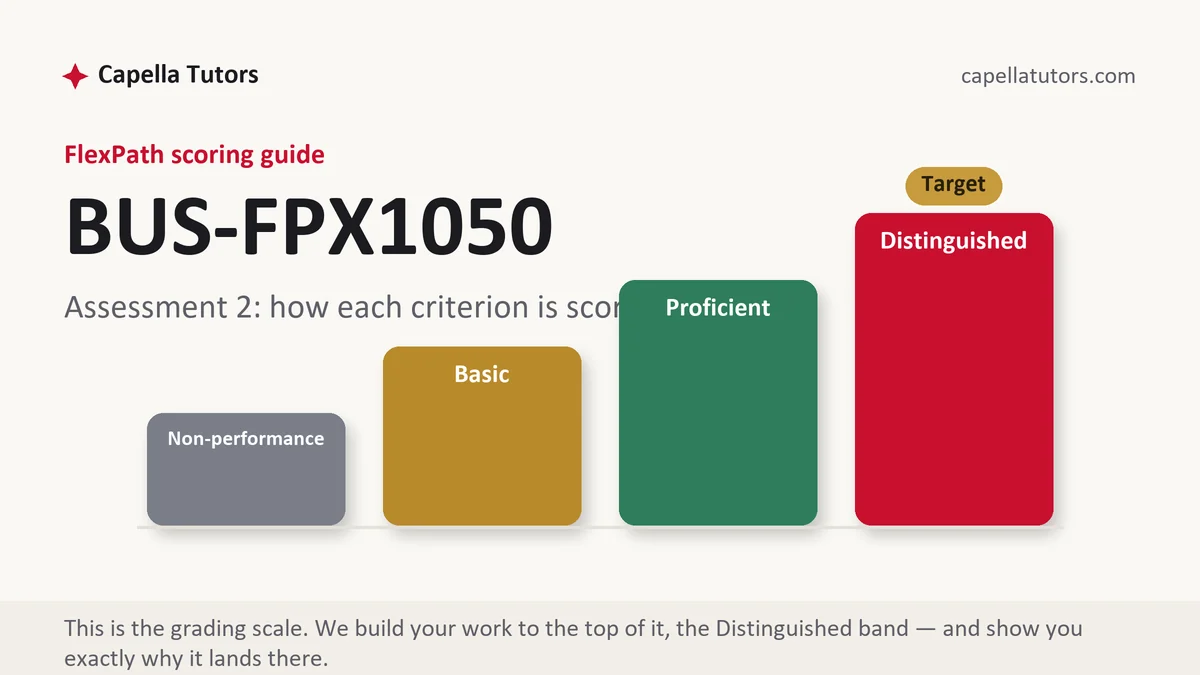
How BUS FPX 1050 Assessment 2 is scored
There are no letter grades in FlexPath. Each criterion on the scoring guide lands on one of four levels, and the level language is the writing brief:
| Level | What it means on an elasticity and revenue paper |
|---|---|
| Distinguished | The working appears line by line, the method is named, the coefficient is interpreted against one, and the revenue result is reconciled with that interpretation. The paper also names the time horizon the elasticity belongs to. |
| Proficient | The coefficient is computed correctly and labeled elastic or inelastic, with the revenue consequence stated but not tied back to the coefficient. |
| Basic | A discussion of how sensitive customers are to price, accurate in spirit, carrying no computation a reader could repeat. |
| Non-performance | A number with no formula behind it, or an elasticity contradicted by the revenue figures in the same paper. Internal disagreement is worse than an omission. |
Every figure in this deliverable has to agree with every other figure. If the coefficient says demand is inelastic and the revenue table shows revenue falling after a price rise, one of the two is wrong and the evaluator will find it.
The BUS FPX 1050 Assessment 2 method, step by step
-
Find out whether the guide names a formula
Your scoring guide decides. Where it stays silent, name the method you used and show the other one if the two differ enough to change the story. Reporting a coefficient without saying how it was produced leaves the row unanswerable.
-
Lay the four numbers out before computing anything
Old price, new price, old quantity, new quantity, each with its unit and the period it covers. Setting them down as a short table first catches the transposition errors that otherwise survive into the conclusion, and it gives the reader something to check your arithmetic against.
-
Show the division on the page
Write the percentage change in quantity, the percentage change in price, and then the quotient, each on its own line. An evaluator scoring a computation row is looking for steps, and a single figure asserted in a sentence gives that row nothing to award.
-
Interpret the coefficient against one, in words
Above one is elastic and a price increase reduces revenue. Below one is inelastic and a price increase raises it. At one revenue does not move. Report the absolute value unless your guide asks for the sign, and say which side of one you landed on before you discuss anything else.
-
Compute revenue both ways and reconcile it
Multiply price by quantity before and after, state the difference in dollars and as a percentage, and then write the sentence connecting it to the coefficient. That sentence is where most of the top-column credit in this deliverable actually sits.
-
Name the horizon, then self-score and submit
Elasticity is not a fixed property of a good; it depends on how long buyers have had to react and whether a substitute exists nearby. State the window your figures cover, note how the answer would change over a longer one, then grade every row yourself before submitting.
A structure that maps to the criteria
These lengths are planning targets our tutors use for a computational microeconomics deliverable, not Capella rules; follow your own guide wherever it asks for more.
| Section | What it must do | Guide word target |
|---|---|---|
| The setting | The seller, the good, the customers, and the period, plus where the price and quantity figures came from. | ~175 words |
| The data | Old and new price, old and new quantity, in a small labeled table with units and the window they cover. | ~125 words |
| The computation | Percentage changes and the quotient, line by line, with the method named and the coefficient rounded consistently. | ~325 words |
| Interpretation | The coefficient read against one, in words, with the substitutes and necessities that explain why it came out that way. | ~275 words |
| Revenue and the decision | Revenue before and after, the difference in dollars and percent, reconciled with the coefficient, ending in a recommendation on the price. | ~300 words |
| Horizon, sources, format | The time window the result belongs to, official series cited by title and period, current APA matched both ways. | ~150 words |
Annotated sample excerpt
An original model excerpt from our team, showing the register that scores at the top of the guide. It is study material: learn the moves, then write your own version.
Millrace Laundry raised the price of a standard wash cycle from $3.25 to $3.75 in March, and weekly cycles across the store fell from 2,480 to 2,210 over the eight weeks that followed.1 Using the simple percentage change method from the starting values, price rose by $0.50 on $3.25, or 15.4 percent, and quantity fell by 270 cycles on 2,480, or 10.9 percent, giving a price elasticity of demand of 10.9 divided by 15.4, or 0.71 in absolute value; the midpoint method returns 0.81 on the same figures, so both place demand below one.2 Weekly revenue therefore moved from 2,480 at $3.25, which is $8,060, to 2,210 at $3.75, which is $8,287.50, a gain of $227.50 or 2.8 percent, exactly the direction an inelastic coefficient predicts for a price increase.3
- 1Four numbers, their units, and the window, in one sentence. Everything that follows can be recomputed from here.
- 2Method named, both percentages shown with their denominators, the quotient given, and the second method reported because it does not change the interpretation.
- 3Revenue computed both ways and then reconciled with the coefficient in the same sentence. That reconciliation is the move the top column is written for.
The full premium sample for your exact assessment, written fresh to your scoring guide and issue, is free to request. Study it, revise it into your own voice, and submit work you understand.
The five mistakes that cost Distinguished
- A coefficient with no working. The computation row cannot award marks for a result it cannot follow.
- Elastic and inelastic used loosely. The terms are defined against one, and using them to mean sensitive or insensitive drops the precision the row is scoring.
- Revenue that contradicts the coefficient. Two claims pointing opposite ways means one is arithmetic and the evaluator will locate it.
- Rounding that changes mid-paper. A figure carried to two decimals in one section and to none in another looks like two different calculations.
- No horizon stated. A one-week response and a three-year response are different elasticities, and a paper silent on which one it measured has left the question open.
Pre-submission checklist
- Old and new price and quantity laid out with units and the period they cover
- The formula named, and both methods shown where they would change the reading
- Percentage changes and the quotient written as separate lines a reader can repeat
- The coefficient interpreted against one, in words, before any conclusion
- Revenue computed before and after and reconciled with the coefficient in one sentence
- Rounding consistent, horizon stated, sources in current APA, self-scored Distinguished
Want this assessment done with backup?
Send the prompt, the scoring guide, and the price and quantity figures you were given. A team of eight returns a premium original sample with the arithmetic shown line by line and every total agreeing with every other, inside 24 to 48 hours, revised until it clears the guide.