This manual is for BHA FPX 3008 Assessment 3, start to submission. The assessment usually asks you to compare a budget with what actually happened and explain the difference to somebody who has to do something about it. That means decomposing the variance rather than reporting it, separating the part caused by volume from the part caused by rate or by price, assigning each part to the function that controls it, and closing with a recommendation carrying a dollar figure. What comes next is our tutors' method, the structure we build to, and an annotated sample excerpt. Prefer to pass it to us? A premium original sample for this deliverable returns in 24 to 48 hours, with revision included until the guide is met. Capella's catalog lists the course as BHA-FPX3008, and some courserooms print BHA3008; both point to this same Assessment 3.
One honesty note before the manual: Capella revises courses and scoring guides over time, so always write to the exact scoring guide attached to your assessment in the courseroom. The course identity above is verified on capella.edu; the method and structure below are our tutors' approach to it, not Capella's official rubric text.
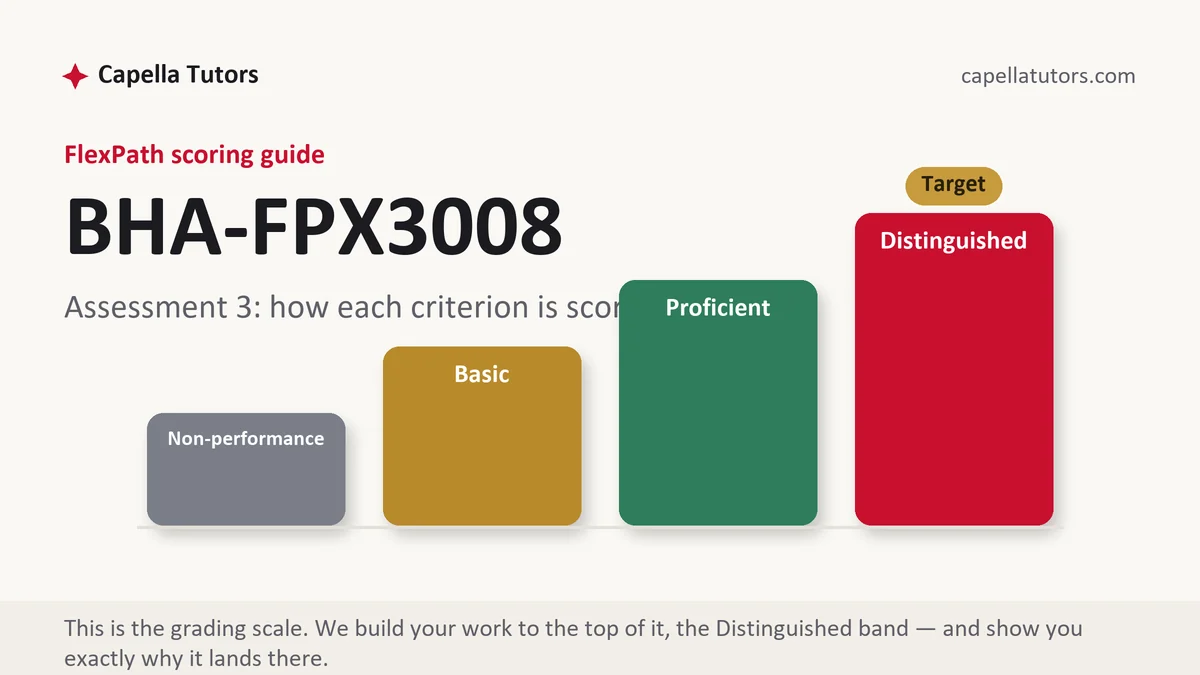
How BHA FPX 3008 Assessment 3 is scored
Criteria carry the grade in FlexPath, one level at a time, and the level language is the closest thing to instructions you will get:
| Level | What it means on a variance report |
|---|---|
| Distinguished | The total variance is split by cause with the arithmetic shown, each part is assigned to a function that could act on it, favorable results are examined as closely as unfavorable ones, and the recommendation carries a figure. The top column always adds one move; find it and make it. |
| Proficient | Variances are calculated correctly and explained plausibly. Accurate work whose causes are asserted rather than separated. |
| Basic | A table of budget against actual with a column of differences and a paragraph noting that expenses exceeded plan. |
| Non-performance | A required element is absent, most often the explanation of cause or the recommendation. Absence sits at the floor regardless of how good the table is. |
One habit earns more here than any other: treat a favorable variance with the same suspicion as an unfavorable one. Spending under budget because volume collapsed is not a saving, and a report that celebrates it has misread the department it is describing.
The BHA FPX 3008 Assessment 3 method, step by step
-
Turn the criteria into headings and lock the period
Every criterion gets a section, and the reporting period gets stated once at the top and never drifts. Comparing a thirteen-week quarter against a three-month budget without saying so introduces an error that will contaminate every percentage in the report.
-
Rebuild the budget assumptions before touching the actuals
Write down what the budget assumed: volume, rate per unit, staffing hours, supply cost per case. A variance is a comparison against assumptions, so a report that never states the assumptions is comparing an outcome against a number of unknown origin.
-
Split the difference into volume and rate
Hold rate constant and price the volume gap, then hold volume constant and price the rate gap. Two effects can point in opposite directions and nearly cancel, which is why a small total variance can conceal two large problems that belong to different managers.
-
Assign each part to somebody who could change it
Volume belongs to access, scheduling and referral work. Rate belongs to contracting and payer mix. Supply cost per case belongs to purchasing and clinical practice. A variance with no owner is a fact, and the criteria are asking for management information.
-
Test the favorable lines as hard as the unfavorable ones
Ask what produced each favorable figure and whether it is repeatable. Vacancy savings in a salary line usually mean overtime elsewhere and work not done, so trace the money instead of banking it.
-
Recommend one action with a number, then self-score
Name the line, the amount, the owner and the period over which the effect should appear. Then mark every criterion D, P, B or N, rewrite what falls short, and check that the totals in your narrative match the totals in your table before submitting early in the week.
A structure that maps to the criteria
Treat these counts as planning targets our tutors use for a variance report of this scope rather than as Capella rules, and expand wherever the guide puts its weight.
| Section | What it must do | Guide word target |
|---|---|---|
| Purpose and period | The department, the reporting period, and the decision this report is meant to support. | ~150 words |
| Budget assumptions | Volume, rate, staffing and supply assumptions the budget was built on, with their basis. | ~200 words |
| Results against budget | The table, the totals, and the headline variance in dollars and as a percentage. | ~250 words |
| Variance decomposed | Volume effect and rate effect priced separately, with the arithmetic on the page. | ~350 words |
| Ownership and action | Who controls each part, the recommended action, its dollar effect and its timeline. | ~250 words |
| References | Definitions and benchmark figures cited with their year, current APA both directions. | as needed |
Annotated sample excerpt
An original model paragraph from our team, written the way the top of the guide reads. Use it as study material and produce your own version from your own figures.
The pediatric urgent care budgeted 1,450 visits for the quarter at an average net payment of 132 dollars, or 191,400 dollars, and closed at 1,286 visits averaging 141 dollars, or 181,326 dollars, an unfavorable total of 10,074 dollars that a summary line would describe as a five percent miss.1 Decomposed, the story changes: 164 visits below budget at the budgeted rate is 21,648 dollars unfavorable on volume, while nine dollars more per visit across 1,286 visits is 11,574 dollars favorable on rate, and the two partly offset.2 Volume sits with access and marketing after a mild respiratory season and a competing clinic opening two miles north, rate sits with the contracting office following the commercial renewal that took effect in the first month of the quarter, and only one of those is inside the clinic manager's control this year.3
- 1Budget and actual arrive with their volume and rate assumptions attached, so the reader can reproduce the total before the analysis starts.
- 2The two effects are priced separately and shown as arithmetic. The offsetting result is the finding, and it is invisible in the headline number.
- 3Each effect is handed to the function that controls it, with the last clause telling a manager which conversation is worth having.
The full premium sample for your exact assessment, written fresh to your scoring guide and issue, is free to request. Study it, revise it into your own voice, and submit work you understand.
The five mistakes that cost Distinguished
- Reporting the total and stopping. A single difference figure tells nobody what to do, and the analysis criterion is asking for the split.
- Explaining variance with adjectives. Higher than expected utilization is not a cause, it is a restatement of the number.
- Favorable lines left unexamined. Underspending caused by unfilled positions is a warning, and a report that banks it has missed the point.
- No owner for any part of the variance. Volume, rate and unit cost belong to different functions, and the criteria expect them to be assigned.
- A recommendation with no dollar figure. Improve efficiency is a sentiment, and the guide wants a line, an amount and a date.
Pre-submission checklist
- Each criterion has a labeled section and the reporting period is stated once and held
- The budget assumptions are written out before any comparison is made
- Volume and rate effects are priced separately with the arithmetic visible
- Every part of the variance is assigned to a function that could change it
- Favorable results are examined and traced rather than accepted
- Self-scored D on every criterion, tables reconciled with the narrative totals
Variance report to hand in?
Send the budget, the actuals and the scoring guide. We rebuild the assumptions, split the variance by cause, and hand each part to the function that owns it, with a second reader recomputing every figure before delivery. Back in 24 to 48 hours, revised at no cost until the criteria are cleared.