This manual is for BHA FPX 3008 Assessment 2, start to submission. The assessment usually gives you a service, a set of operating figures and a decision, and asks what the numbers say about it: which costs move with volume and which do not, what one more unit of service contributes, how many units cover the base, and what happens to that answer when one input changes. The arithmetic is simple and the discipline is not. The rest of this page is the method, a structure that answers the criteria one at a time, and an annotated sample excerpt. Want it handled instead? A premium original sample keyed to your figures comes back inside 24 to 48 hours, revised free until every criterion clears. Capella's catalog lists the course as BHA-FPX3008, and some courserooms print BHA3008; both point to this same Assessment 2.
One honesty note before the manual: Capella revises courses and scoring guides over time, so always write to the exact scoring guide attached to your assessment in the courseroom. The course identity above is verified on capella.edu; the method and structure below are our tutors' approach to it, not Capella's official rubric text.
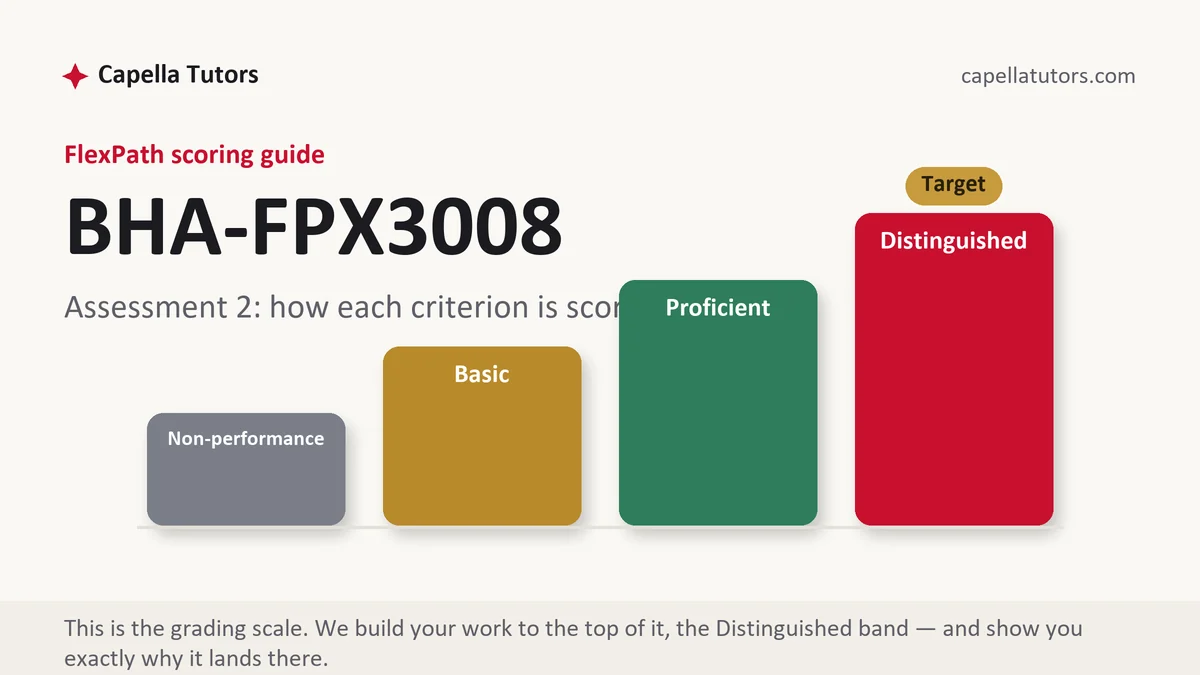
How BHA FPX 3008 Assessment 2 is scored
No letter grades appear anywhere in FlexPath. Every criterion is placed on one of four levels, and the level text is the brief you are writing to:
| Level | What it means on a cost and break-even analysis |
|---|---|
| Distinguished | Costs are sorted with the basis for each decision stated, the contribution and break-even are computed and shown, one input is flexed to test the conclusion, and the recommendation names what the organization gives up. One more move hides in the criterion; find it and make it. |
| Proficient | The split is correct, the break-even is correct, and the interpretation is accurate. Complete, and short of the top because nothing was tested against a changed assumption. |
| Basic | Costs listed without being classified, a break-even quoted from a formula with unlabeled inputs, and a recommendation to reduce expenses. |
| Non-performance | A required element is absent, usually the fixed and variable split itself, which takes the rest of the analysis down with it. |
The classification decisions are where judgment shows. A supervisor's salary does not move with the next patient, a reference laboratory charge does, and a technologist working scheduled overtime sits somewhere between, so say which bucket you put it in and why before anyone has to ask.
The BHA FPX 3008 Assessment 2 method, step by step
-
Restate the prompt as a decision with units
Write one sentence naming what is being decided, the unit of service it turns on, and the period. A question phrased as whether the service is worthwhile cannot be answered numerically, and a question phrased as whether evening hours cover their own costs can.
-
Sort every cost and record the basis
Put each line into fixed or variable and write one clause explaining the call. Costs that step up at a threshold, such as a second technologist once volume passes a level, deserve a note of their own, since treating them as smoothly variable understates the base.
-
Work in net revenue per unit, never in charges
Take the average payment actually collected per unit after contractual allowances, weighted across payers if the prompt gives you a mix. Then state that figure once and use it everywhere, because two different revenue assumptions in one paper is the error a second reader always finds.
-
Compute contribution, then break-even, showing every input
Net revenue per unit minus variable cost per unit is the contribution, and the fixed base divided by that contribution is the break-even volume. Put the division on the page. A result with no visible inputs cannot be graded as analysis because the reader cannot follow it.
-
Flex one assumption and report what moves
Change the input most likely to be wrong, usually the payment per unit or the volume forecast, and recompute. Saying that the decision still holds if volume comes in ten percent under forecast is cheap to write and reliably impressive to a reader who has watched forecasts miss.
-
Recommend with a trade-off, then self-score
Name the action, the dollar effect, the person by role who owns it, and what the organization loses by doing it. Then grade yourself criterion by criterion, rewrite anything under Distinguished, and reconcile every number in the narrative against the table it came from.
A structure that maps to the criteria
The word counts here are planning targets our tutors use on a cost analysis of this size, not Capella requirements; expand any section the guide weights heavily.
| Section | What it must do | Guide word target |
|---|---|---|
| The decision | What is being decided, the unit of service, the period, and who will act on the answer. | ~150 words |
| Cost classification | Every cost sorted into fixed or variable with the basis stated, and stepped costs flagged. | ~300 words |
| Revenue per unit | The average net payment per unit, how it was derived, and the payer mix behind it. | ~200 words |
| Contribution and break-even | The arithmetic in full, with the break-even volume translated into a working day or week. | ~300 words |
| Sensitivity and recommendation | One input flexed, the revised result, the action, its dollar effect and its trade-off. | ~250 words |
| References | Formulas credited, benchmark figures dated, current APA reconciled in both directions. | as needed |
Annotated sample excerpt
An original model paragraph from our team, showing what the top column reads like in practice. Study it, take the sequence, then run your own figures.
Opening the imaging center four evenings a week adds 18,600 dollars a month in costs that do not move with volume, made up of the technologist and receptionist premium hours committed regardless of bookings, the extended service contract, and the additional utilities and security.1 Each additional study consumes 41 dollars in contrast, supplies and per-case reading fees, and returns an average of 187 dollars in net payment across the current payer mix, so the contribution is 146 dollars per study and the block covers its base at 18,600 divided by 146, which is 127.4, or 128 studies a month.2 Across sixteen evening sessions that is eight studies a session, and if the payer mix shifts as the referring orthopedic group moves patients to a plan paying 168 dollars, the contribution falls to 127 dollars and the requirement climbs to 147 studies, close to nine a session.3
- 1The fixed base is itemized, so a reader can argue with a line rather than with a total. Premium hours committed in advance are correctly treated as fixed.
- 2Contribution and break-even are shown as arithmetic and then converted into a per-session figure a manager can compare with the booking sheet.
- 3One input is flexed and the consequence is stated in the same units. That sentence is usually what separates the top two columns on the analysis criterion.
The full premium sample for your exact assessment, written fresh to your scoring guide and issue, is free to request. Study it, revise it into your own voice, and submit work you understand.
The five mistakes that cost Distinguished
- Every cost treated as variable. Without the split there is no contribution, no break-even and no variance worth reading.
- Break-even quoted with hidden inputs. A number with no visible division is a claim, and the criterion is asking for a calculation.
- Two revenue assumptions in one paper. Using the charge in one section and the net payment in another produces two incompatible answers.
- A stepped cost smoothed into the variable column. The second staff member hired at a volume threshold is a jump, and pretending otherwise understates the base.
- A recommendation with no trade-off. Naming what the organization gives up is what distinguishes a decision from a wish.
Pre-submission checklist
- Each criterion has a section, and the decision is stated with its unit and period
- Every cost is classified, with the basis for the call written beside it
- One net revenue per unit figure is derived and used consistently throughout
- Contribution and break-even appear as arithmetic, not as results
- One assumption is flexed and the revised conclusion is reported
- Self-scored D on every criterion, with narrative and tables reconciled
Cost analysis with a deadline on it?
Send the prompt, the scoring guide and any workbook the course provided. We work inside your spreadsheet and leave the formulas visible, because a criterion about analysis is often graded on whether the reader can follow how a figure was produced. Delivered in 24 to 48 hours with free revision until the guide is met.