This manual is for BHA FPX 3008 Assessment 1, start to submission. The assessment usually hands you a set of financial statements, or asks you to find some, and expects an interpretation rather than a description: what the balance sheet says about position on one date, what the statement of operations says about performance across a period, what the statement of cash flows says about money that a margin cannot show you, and what the three say together about an organization somebody has to run. Below you will find the method our tutors apply, a structure drawn from the criteria, and an annotated sample excerpt. Prefer to delegate the draft? A premium original sample for this assessment arrives inside 24 to 48 hours and is revised at no cost until the guide is satisfied. Capella's catalog lists the course as BHA-FPX3008, and some courserooms print BHA3008; both point to this same Assessment 1.
One honesty note before the manual: Capella revises courses and scoring guides over time, so always write to the exact scoring guide attached to your assessment in the courseroom. The course identity above is verified on capella.edu; the method and structure below are our tutors' approach to it, not Capella's official rubric text.
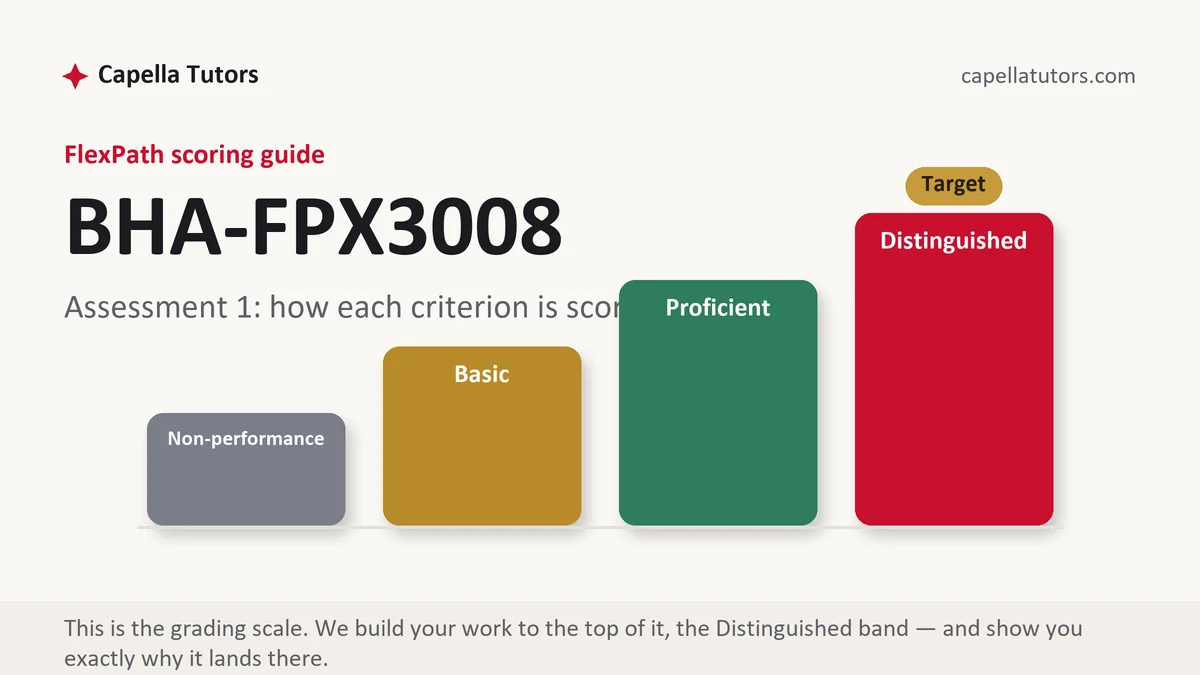
How BHA FPX 3008 Assessment 1 is scored
FlexPath grades criteria, not papers, and each one lands on a level whose wording tells you what the section owes the reader:
| Level | What it means on a statement analysis |
|---|---|
| Distinguished | Every figure quoted carries its statement, its period and its fiscal year, ratios arrive against a matched comparison, and the analysis says what a board should ask about next. The extra move lives in the criterion wording; find it and make it. |
| Proficient | The statements are read correctly and the figures are accurate. Sound work whose ratios are reported rather than interpreted. |
| Basic | Numbers copied out of the statements and restated in sentences, with charges treated as revenue and no comparison anywhere. |
| Non-performance | A required element is absent, most often the cash flow discussion or the benchmark. A missing element floors a criterion faster than a weak one. |
The distinction that decides several criteria is between margin and cash. An organization can post a surplus and still struggle to make payroll, because revenue is recorded when care is delivered and the payment lands weeks later, and a paper that never separates those two questions has read one statement three times.
The BHA FPX 3008 Assessment 1 method, step by step
-
Build the outline from the criteria, then assign a number to each
Give every criterion a heading, then write in the margin which figure or ratio will answer it. Financial assessments fail in a specific way: the prose is competent, the arithmetic is missing, and a criterion that asked for analysis received a paragraph of description instead.
-
Get real statements and label the fiscal year
Audited statements and the annual information return of a tax-exempt system are public, so use a named organization rather than a textbook illustration. Then write the fiscal year on every figure, because a year ending in June cannot be set beside a calendar year without a sentence acknowledging it.
-
Convert charges to net revenue before you analyze anything
Find gross charges, subtract contractual allowances, and work from net patient service revenue for the rest of the paper. Charges are a list price almost nobody pays, and an analysis built on them can overstate an organization by a factor of three.
-
Read the three statements as three different questions
Position on a date, performance across a period, and where the cash actually moved. Say what each one adds that the others cannot, then name the one line in each that matters most to the question your prompt asked.
-
Compute a small set of ratios and defend the comparison
Operating margin, current ratio and days cash on hand are enough for most prompts. Each one needs a peer group matched on size, ownership and region, and the same year. Then say plainly why that comparison is fair, which is the sentence that turns computation into analysis.
-
Reconcile the tables, then self-score
Read the draft once for numbers alone and confirm that every figure in the narrative matches the table it came from, since one mismatch invites the evaluator to distrust the whole document. Then mark each criterion D, P, B or N and rewrite anything below D.
A structure that maps to the criteria
These word counts are planning targets our tutors use on a statement analysis at this level rather than Capella rules; stretch any section your scoring guide treats as central.
| Section | What it must do | Guide word target |
|---|---|---|
| Introduction and organization | The organization, its ownership type, its size, and the fiscal year under review. | ~150 words |
| Position and performance | The balance sheet on its date and the operating result across the period, in net revenue terms. | ~300 words |
| Cash and liquidity | Where cash came from and went, and how much unrestricted cash the organization holds in days. | ~250 words |
| Ratios and comparison | Three or four ratios with their formulas, the peer figure, its year and the source of both. | ~300 words |
| What a board should ask | Two or three questions the numbers raise, and the decision each answer would inform. | ~200 words |
| References | Statements and benchmark sources cited to the filing organization, current APA both ways. | as needed |
Annotated sample excerpt
An original model paragraph from our team, written in the register the top of the guide rewards. It is study material: borrow the moves and write your own analysis.
For the fiscal year ended June 30, the 96-bed nonprofit community hospital reported gross patient charges of 412.8 million dollars against net patient service revenue of 148.1 million, so contractual allowances and charity care removed roughly 64 percent of the list price before a single figure of performance could be calculated.1 Operating income of 3.2 million on total operating revenue of 152.6 million gives an operating margin of 2.1 percent, which sits below the 3.4 percent reported for the same year by the state hospital association's group of independent facilities under 150 beds.2 Cash tells a different story than margin: unrestricted cash and investments of 31.4 million against average daily operating expenses of 409,000 dollars is about 77 days cash on hand, which is thin enough that a delayed payer settlement becomes an operating problem rather than an accounting one.3
- 1Charges and net revenue appear in the same sentence with the gap quantified, which settles the vocabulary question before any analysis begins.
- 2The ratio arrives with its inputs, and the comparison is matched on ownership, size and year. A benchmark without those three is decoration.
- 3Days cash on hand is shown as arithmetic and then translated into a consequence a trustee would recognize. Interpretation is the criterion, not the ratio.
The full premium sample for your exact assessment, written fresh to your scoring guide and issue, is free to request. Study it, revise it into your own voice, and submit work you understand.
The five mistakes that cost Distinguished
- Charges analyzed as revenue. The distance between the list price and the negotiated payment is the subject of the course, and ignoring it invalidates everything downstream.
- A ratio with no peer and no year. An operating margin of 2.1 percent is neither strong nor weak until something sits beside it.
- Margin and cash treated as one question. The statement of cash flows exists because a surplus does not tell you whether the money arrived.
- Tables that disagree with the sentences. One mismatched total usually costs more than one criterion, because it makes every other figure suspect.
- A textbook used as evidence about the sector. Textbooks are fine for a formula and weak for a claim, which belongs to a filing, a regulator or a peer-reviewed study.
Pre-submission checklist
- Every criterion has its own labeled section, in the order the guide lists them
- All analysis runs on net patient service revenue, with charges used only where charges are the point
- Each figure names its statement, its period and its fiscal year
- Every ratio shows its formula, its inputs and a matched comparison with a year
- Narrative figures reconcile to the tables, checked in a dedicated read
- Self-scored D on every criterion, with sources cited to the filing organization in current APA
Statement analysis due?
Send the scoring guide and whichever statements or workbook the course supplied. Eight people build the deliverable, and one pass exists only to check figures against each other and against the source they came from. Back inside 24 to 48 hours, written to the top column, revised free until the criteria clear.