This manual is for RSCH FPX 7860 Assessment 3, start to submission. The Qualitative Research Proposal asks you to propose a qualitative study: the problem and research questions, your philosophical assumptions or worldview, the qualitative design you will use, your role as researcher, the population and sampling, data collection and analysis procedures, and strategies for validating the findings. The grade turns on alignment. A design, data collection and analysis that fit the research question and worldview score above a proposal that lists methods. Below is the method our tutors use, a structure that maps to the criteria, and an annotated sample excerpt. Prefer to hand it off? A premium original sample for this exact assessment comes back in 24 to 48 hours, revised free until it meets the guide. Capella's catalog lists the course as RSCH-FPX7860, and some courserooms print RSCH7860; both point to this same Assessment 3. In current courserooms this assessment typically appears as "Qualitative Research Proposal".
One honesty note before the manual: Capella revises courses and scoring guides over time, so always write to the exact scoring guide attached to your assessment in the courseroom. The course identity above is verified on capella.edu; the method and structure below are our tutors' approach to it, not Capella's official rubric text.
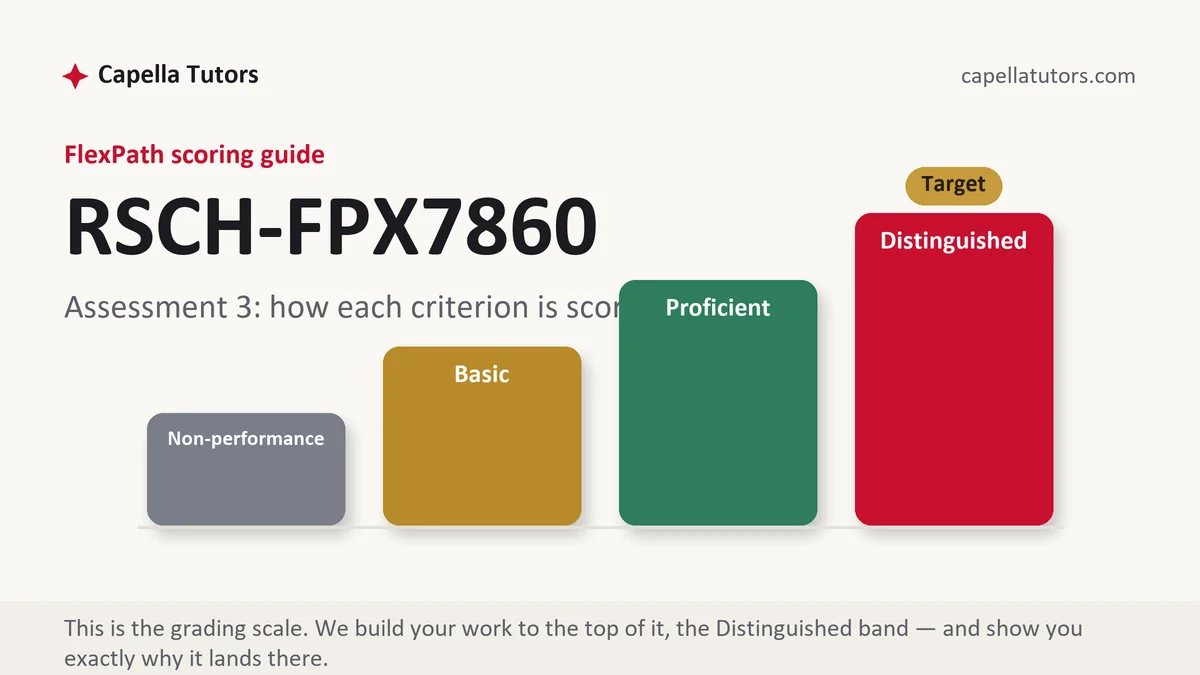
How RSCH FPX 7860 Assessment 3 is scored
FlexPath does not use letter grades. Each criterion in the scoring guide lands on one of four levels, and the level descriptions are the real writing brief:
| Level | What it means on a qualitative research proposal |
|---|---|
| Distinguished | The qualitative research proposal is specific to the organization or case, applies course concepts accurately with credible sources, and ends in justified conclusions or recommendations. |
| Proficient | The qualitative research proposal is accurate, but the application or recommendations are general. |
| Basic | The qualitative research proposal describes concepts with little application. |
| Non-performance | A required part of the qualitative research proposal is missing. |
Follow the proposal template in your courseroom and cite methodology sources such as Creswell.
The RSCH FPX 7860 Assessment 3 method, step by step
-
Frame the problem and questions
Open questions suited to qualitative inquiry.
-
State the worldview
Such as constructivist, with its implications.
-
Choose the design
Phenomenology, case study, grounded theory or narrative, with reasons.
-
Describe your role
Position, bias and reflexivity.
-
Plan data collection and analysis
Interviews, coding and themes.
-
Plan validation
Member checking, triangulation, thick description.
A structure that maps to the criteria
Word counts are planning targets our tutors use, not Capella rules; follow the length and format your scoring guide states.
| Section | What it must do | Guide |
|---|---|---|
| Introduction and research questions | Problem and questions. | ~200 words |
| Worldview and design | Assumptions and design. | ~250 words |
| Role of the researcher and population | Position and sample. | ~200 words |
| Data collection, analysis and validation | Procedures. | ~350 words |
| References | Sources. | as needed |
Annotated sample excerpt
An original model excerpt from our team, written to show the register that reaches the top of the guide. Learn the moves, then write your own version.
A phenomenological design fits the question of how first-generation college students experience their first semester, because the aim is to understand the meaning of a shared experience from the participants' perspective.1 Data will come from semi-structured interviews with 10 to 12 students, a sample size consistent with phenomenological studies, recruited through the college's first-generation student program.2 Analysis will follow the steps of identifying significant statements, grouping them into themes, and describing the essence of the experience, with participants reviewing the themes to confirm they reflect their accounts.3
- 1Justifies the design by the question.
- 2Describes sampling consistent with the design.
- 3Outlines analysis with a validation step.
The full premium sample for your exact assessment, written fresh to your scoring guide and topic, is free to request. Study it, revise it into your own voice, and submit work you understand.
The five mistakes that cost Distinguished
- Definitions without application. Apply each concept to the organization or case.
- No sources. Cite credible business sources.
- Vague recommendations. Make them specific and justified.
- Methods misaligned with the question. Align design, data and analysis.
Pre-submission checklist
- Problem and questions
- Worldview
- Design justified
- Researcher role
- Data collection and analysis
- Validation and references
Want the qualitative research proposal written?
Send the scoring guide and any materials from your courseroom. Our team returns a premium original qualitative research proposal in 24 to 48 hours, revised free until it meets the guide.