This manual is for RSCH-FPX7860 Assessment 2, start to submission. A middle deliverable in a methods course is often the ethics of a proposal: the consent process a participant could actually understand, the risks and how they are reduced, the confidentiality plan described rather than promised, and the extra protections owed when participants depend on the researcher for something. The assessment usually asks for procedure rather than sentiment, and your scoring guide decides the sections. Below is the method our tutors use for it, a structure that maps to the criteria, and an annotated sample excerpt drawn from a proposal involving students who receive emergency aid. Prefer to hand it off? A premium original sample for this exact assessment comes back in 24 to 48 hours, revised free until it meets the guide. Your courseroom may print this as RSCH FPX 7860 Assessment 2 or RSCH7860 Assessment 2; it is the same deliverable, and RSCH-FPX7860 Assessment 2 is what this manual walks through.
One honesty note before the manual: Capella revises courses and scoring guides over time, so always write to the exact scoring guide attached to your assessment in the courseroom. The course identity above is verified on capella.edu; the method and structure below are our tutors' approach to it, not Capella's official rubric text.
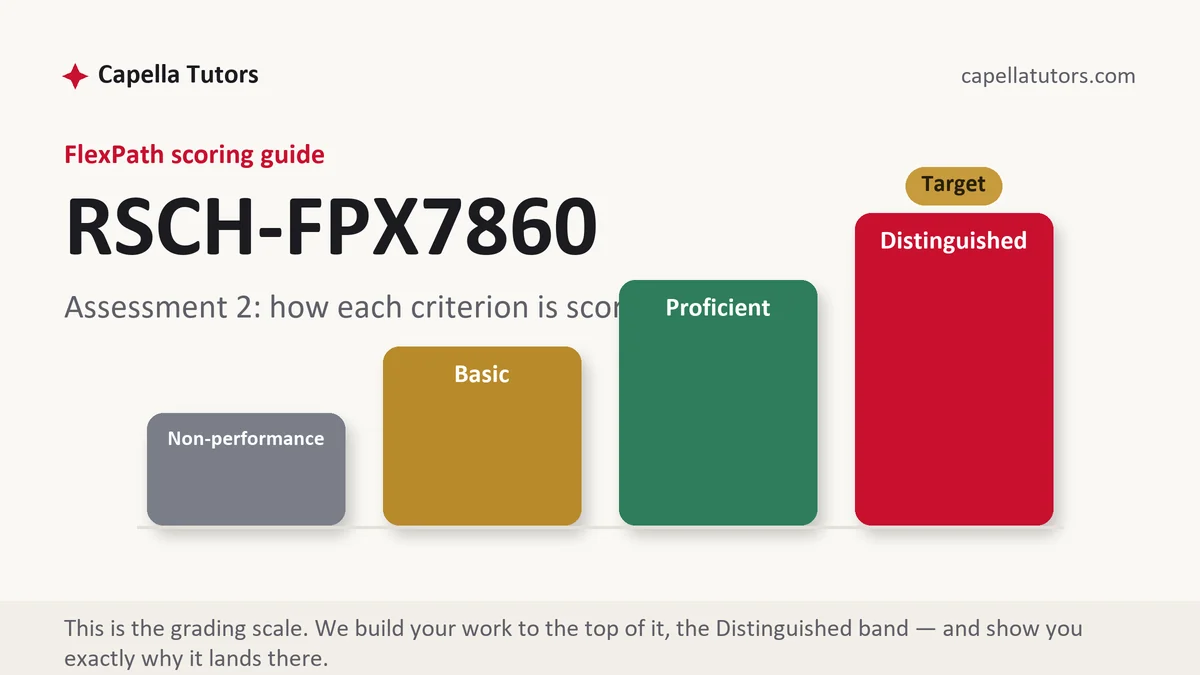
How RSCH-FPX7860 Assessment 2 is scored
Each criterion is placed at one of four levels, and the wording of the highest level is what the paragraph beneath it has to accomplish:
| Level | What it means on a research ethics analysis |
|---|---|
| Distinguished | The section reads the way a review application reads: every protection is a described procedure with a person responsible for it, the hardest tension is named as the hardest, and the participants who need more protection are identified by what makes them dependent. |
| Proficient | Consent, risk, confidentiality and withdrawal are all covered accurately and in order. Complete, and one level short, because nothing in the analysis was difficult. |
| Basic | Principles restated and protections promised, with the incentive treated as a kindness and the researcher's own position left out. The commonest landing spot for this deliverable. |
| Non-performance | A required element is missing outright, most often the data-handling plan, or the protections owed to dependent participants. |
Ethics is graded as procedure here, not as sentiment. Withholding information from participants is defensible only in narrow circumstances, is never defensible for a study that would work without it, and carries an obligation to debrief afterwards. Whether review is required belongs to your instructor and your institution's review office, so write this section as though you were applying and ask before you approach a single participant.
The RSCH-FPX7860 Assessment 2 method, step by step
-
Write down what you are actually asking people to do
List the procedures a participant will experience, in order, with the time each takes. Every ethical question in the deliverable follows from that list, and analyses written without it end up defending a study nobody could picture.
-
Find the dependency before you find the risk
Ask what each participant needs from somebody involved in the study. Students who are graded by the researcher, employees whose shifts are scheduled by the researcher, and clients whose aid is administered by the researcher's colleagues are all in a position where declining feels expensive, and that is what turns a routine invitation into a consent problem.
-
Build consent for comprehension, not for coverage
Write the form at the reading level of the people receiving it, say plainly what will happen, how long it takes, who sees the data, and that refusal changes nothing about the aid or the grade. A form that no participant could summarize back to you has not obtained informed consent, whatever it contains.
-
Size the incentive so it does not become the reason
State the amount, the form and the timing, and reason about it out loud: enough to acknowledge time, not enough that somebody in financial difficulty would accept a risk they otherwise would not. Say who receives it if a participant withdraws halfway.
-
Describe data handling as a procedure with a name on it
Where the recordings live, who holds the key linking codes to names, when identifiers are destroyed, what appears in the report, and how a small sample is described so nobody is recognizable. Confidentiality is only as real as the specific steps you can list.
-
Name the hardest tension, then self-score
Every honest proposal has one obligation it cannot fully satisfy. Write it, say what you are doing to reduce the cost, and say who else you would consult. Then grade each criterion at one of the four levels yourself and rewrite anything short of the top.
A structure that maps to the criteria
Targets our tutors plan around for a graduate ethics deliverable, not Capella rules; follow your own guide where it asks for more.
| Section | What it must do | Guide word target |
|---|---|---|
| The study and its procedures | What participants do, in order, with durations, and what data each step produces. | ~200 words |
| Participants and dependency | Who is recruited, what they need from whom, and what makes any group need extra protection. | ~280 words |
| Consent and voluntariness | The process, the reading level, the withdrawal right, and how refusal is insulated from consequences. | ~300 words |
| Risk, benefit and incentive | Foreseeable risks, how each is reduced, the incentive with its reasoning, and the benefit claimed. | ~280 words |
| Confidentiality and data handling | Storage, coding, who holds the key, destruction schedule, and reporting that protects small samples. | ~250 words |
| Tension, review and references | The obligation you cannot fully meet, the review question referred upward, primary documents cited. | ~220 words |
Annotated sample excerpt
One original model paragraph from our team, showing the register a review committee reads in. Study the moves and then write the version your own proposal needs.
Recruitment is complicated by a dependency the design cannot remove: every eligible participant currently receives emergency aid administered by the office that would host the interviews, and I teach two of the courses several of them are enrolled in.1 Invitations therefore go out from the aid office's general list rather than from me, the consent script states in its second sentence that participation is unconnected to any aid decision and to any grade, and enrolment and interviewing are handled by a research assistant who holds no teaching relationship with the sample, with my own access limited to transcripts identified by code.2 The 25 dollar card is paid at the start of the interview rather than at its end, so that withdrawal costs nothing, and the consent form says in plain terms that a participant may stop at any point, decline any question, and keep the payment.3
- 1The dependency is named as a fact of the design rather than waved at, which is what converts a worry into an analysis the criteria can score.
- 2Every protection is a procedure with a person attached to it. Promising to keep the roles separate would score lower than describing how they are separated.
- 3Reasons about the incentive's timing rather than only its amount, and ties voluntariness to something the participant can verify.
The full premium sample for your exact assessment, written fresh to your scoring guide and issue, is free to request. Study it, revise it into your own voice, and submit work you understand.
The five mistakes that cost Distinguished
- Protections promised, not described. Data will be kept confidential is a sentence with no procedure inside it, and the criterion scores procedures.
- The researcher's own position omitted. A proposal that never mentions the author's relationship to the participants has hidden the most obvious pressure on consent.
- An incentive treated as generosity. Payment large enough to outweigh a risk is a coercion problem, and the amount has to be reasoned about in the text.
- Small samples reported as though they were anonymous. A role, a site and a quotation together can identify a person after the name is removed.
- Review board approval asserted. Whether your project needs review is not yours to decide in a paper, and the honest move is to write the section and ask.
Pre-submission checklist
- Participant procedures listed in order with durations
- Every dependency between researcher and participant named and mitigated
- Consent written for comprehension, with refusal explicitly insulated from consequences
- Incentive amount, form and timing stated with the reasoning behind them
- Data handling described as steps, with storage, coding, key holder and destruction date
- The hardest obligation named, and the review question referred to instructor and review office
Ethics section due?
Send the guide, the proposal and who your participants are. The draft comes back written the way an application is written, with each protection carrying a procedure and a name. Premium original sample in 24 to 48 hours, revised at no charge until the criteria are satisfied.