How to write RSCH-FPX7860 Assessment 1

The short answer

This manual is for RSCH-FPX7860 Assessment 1, start to submission. An opening deliverable in a methods course is normally a design: a question written in measurable terms, the design that can answer it named along with the rival explanations it leaves standing, and a sampling plan whose external validity limit is stated by you rather than found by faculty. The assessment usually asks for the plan to be defended rather than announced, and your scoring guide decides which sections it wants and how deep. Below is the method our tutors use for it, a structure that maps to the criteria, and an annotated sample excerpt from a survey of adjunct faculty workload. Prefer to hand it off? A premium original sample for this exact assessment comes back in 24 to 48 hours, revised free until it meets the guide. Your courseroom may print this as RSCH FPX 7860 Assessment 1 or RSCH7860 Assessment 1; it is the same deliverable, and RSCH-FPX7860 Assessment 1 is what this manual walks through.

One honesty note before the manual: Capella revises courses and scoring guides over time, so always write to the exact scoring guide attached to your assessment in the courseroom. The course identity above is verified on capella.edu; the method and structure below are our tutors' approach to it, not Capella's official rubric text.
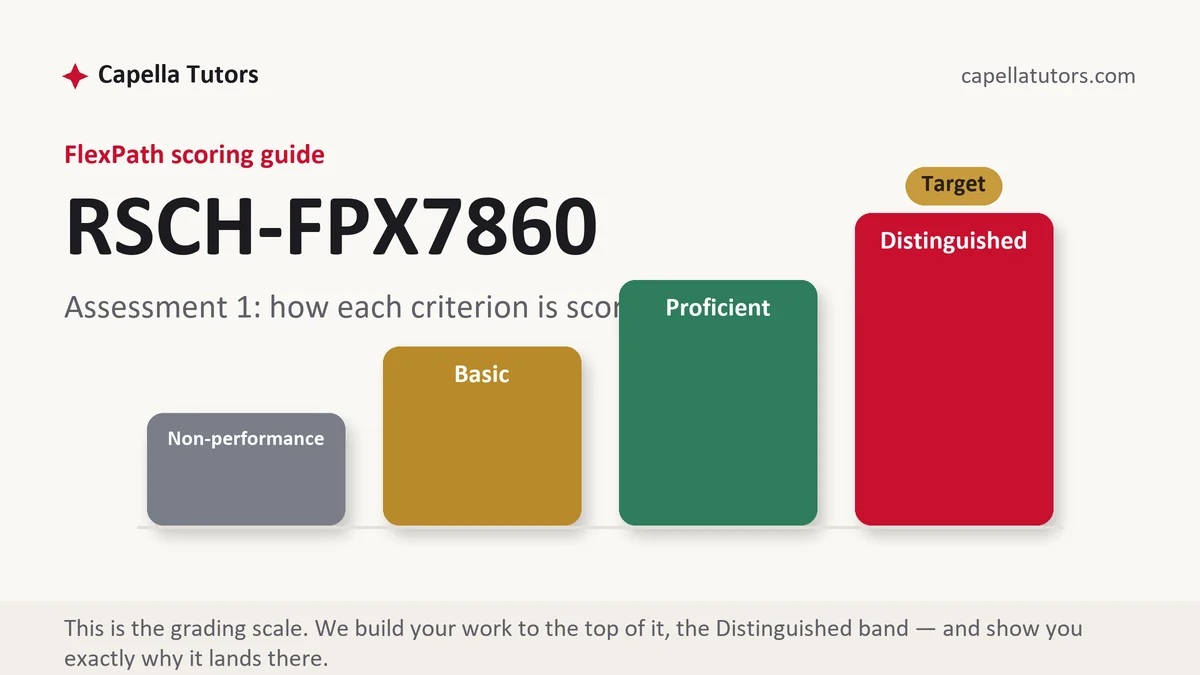
RSCH-FPX7860 Assessment 1 grading scale at Capella FlexPath, the criterion levels this assessment is scored on, from Capella Tutors
How Capella FlexPath grades RSCH-FPX7860 Assessment 1, visualized by Capella Tutors.

How RSCH-FPX7860 Assessment 1 is scored

Criteria in this model are placed at one of four levels rather than added into a score, and the top level is a set of instructions:

LevelWhat it means on a study design
DistinguishedThe question's wording already tells a reader which design is required, each rival explanation is matched to a design feature or volunteered as a limitation, and the sampling section names who is missing before anybody asks.
ProficientThe design fits the question and the sampling plan is workable and described. Competent, and one level short, because the limits were listed rather than reasoned about.
BasicA design named and a population asserted, with sampling described as a convenience sample and left there. The usual first attempt in this course.
Non-performanceA required element is absent, most often operational definitions of the variables, or the ethics section entirely.

Design choice starts with the kind of claim you intend to make. Description needs a defined population and a defensible sample, association needs both variables measured well with confounders named, difference needs a comparison you can justify, and causation needs manipulation, timing and control over rival explanations. Most losses in this course trace to a question of one type answered with a design built for another.

The RSCH-FPX7860 Assessment 1 method, step by step

  1. Draft in the order the work happens

    Criteria first, then question, then design, then sampling and measurement, then the analysis plan, then interpretation. Build it in reverse and you end up choosing a test to fit a conclusion, which is how assumptions go unchecked and how a claim outgrows the design underneath it.

  2. Write the question so it names its own design

    Put the population, the variables and the comparison in the sentence. A question asking whether workload predicts turnover intention among adjunct faculty in one system has already told the reader that this is an association study in a defined frame, and it has ruled out the causal verbs before anybody reaches the discussion.

  3. Define the frame, then say who it leaves out

    Name the sampling frame you will actually use, the inclusion and exclusion rules, the recruitment route, the achieved size you expect and the refusals you expect to lose. The people your frame cannot reach are part of the design, and naming them is what the external validity row pays for.

  4. Operationalize every variable to the point of replication

    Each variable gets its instrument, its level of measurement, its scoring, and its reliability in a comparable sample. If you reword items or drop some to fit your setting, say so and stop citing the original psychometrics as though they still applied.

  5. Put the power arithmetic in front of the design

    Decide the smallest effect worth detecting before you recruit, then work out the sample that could detect it. When your realistic sample cannot, write that in the limitations rather than discovering it in the results, because an underpowered null tells a reader almost nothing.

  6. Write the ethics section as an application, then self-score

    Consent a participant could understand, voluntary involvement with a right to withdraw, risk minimized, confidentiality supported by a described data-handling plan, and extra protection where participants are your own students or employees. Confirm with your instructor and your institution's review office what your project requires, then grade each criterion yourself.

A structure that maps to the criteria

Planning targets our tutors use for a graduate design deliverable, not Capella rules; expand whichever section your own guide weights hardest.

SectionWhat it must doGuide word target
Question and claim typeThe question in measurable terms, the hypotheses, and whether you claim description, association, difference or cause.~200 words
Design and comparisonThe design named, its comparison, the timing of measurement, and the threats it leaves open.~280 words
Sample and recruitmentFrame, sampling method, inclusion rules, route, expected size, expected refusals, and who is unreachable.~300 words
MeasuresEach variable operationalized with its instrument, level of measurement and reliability evidence.~280 words
Analysis and powerThe planned test, its assumptions, the smallest effect worth detecting, and the sample that could detect it.~220 words
Ethics and referencesConsent, risk, confidentiality plan, protections for dependent participants, current APA both ways.~250 words

Annotated sample excerpt

An original model paragraph from our team, written to show what a defended sampling plan reads like. Take the moves, then write the version your own question needs.

Sample excerpt: sampling paragraph Original model · Capella Tutors

The frame is the 1,240 adjunct instructors who held at least one contract in the system's registry during the current academic year, and the sample is drawn from that registry rather than from the departmental mailing lists, which omit anybody teaching a single online section.1 Recruitment is a stratified random draw of 400 by division, with two reminders at seven-day intervals; a 35 percent response rate is what comparable surveys of this population report, so the analysis is planned around roughly 140 usable responses and the smallest association worth detecting was fixed before the draw.2 The people this design will still miss are the ones who left mid-year and whose registry access lapsed, which matters because departure is the outcome under study, so any estimate here describes turnover intention among instructors still under contract and not turnover in the system.3

  • 1Names the frame with its denominator and says which alternative frame was rejected and why. A reader can now judge coverage instead of trusting it.
  • 2The expected response rate, the achieved size and the smallest effect worth detecting all arrive before any result, which is the order the criteria are written in.
  • 3States the external validity limit and ties it to the outcome, so the conclusion is bounded by the sample rather than by the population the writer wishes they had.

The full premium sample for your exact assessment, written fresh to your scoring guide and issue, is free to request. Study it, revise it into your own voice, and submit work you understand.

Get the full sample free

The five mistakes that cost Distinguished

  • A question that does not choose its design. If two different designs could answer your sentence, the sentence is not finished.
  • Convenience sampling described and then forgotten. Psychology runs on convenience samples and the criteria do not forbid them, they forbid conclusions written as though the sample were representative.
  • Variables named rather than operationalized. Workload is not a variable until you say which hours, counted how, from which record.
  • Power discovered after recruitment. A study that could only detect an implausibly large effect has spent its participants for nothing, and the limitation belongs in the plan.
  • Ethics written as reassurance. Promising to protect participants, with no consent process, no data plan and no debriefing, reads as a paragraph added at the end.

Pre-submission checklist

  • Each criterion has its own labeled section, in the guide's order
  • The question names its population, its variables and its claim type
  • Sampling frame, inclusion rules, expected size and expected refusals all written down
  • Every variable operationalized with instrument, level of measurement and reliability
  • Smallest effect worth detecting stated, with the sample size that could detect it
  • Ethics written as an application, with the review question referred to your instructor

Design deliverable due this week?

Send the prompt, the guide and the question you have been given. The draft comes back with the design defended rather than announced, the sampling limit stated, and the power arithmetic in front of the plan. Premium original sample in 24 to 48 hours, revised free until every criterion clears.

Keep going

Online now