This manual is for PSY FPX 7610 Assessment 2, start to submission. A middle deliverable in this course usually asks you to argue validity for a specific use, which is where master's work separates itself because the modern position is not intuitive. The assessment usually wants an argument assembled from several kinds of evidence rather than a claim that the instrument is valid. Delegation is possible too, and a premium original sample assembling the evidence into an argument for your stated use arrives inside 24 to 48 hours, revised free until it clears. Capella's catalog lists the course as PSY-FPX7610, and some courserooms print PSY7610; both point to this same Assessment 2.
One honesty note before the manual: Capella revises courses and scoring guides over time, so always write to the exact scoring guide attached to your assessment in the courseroom. The course identity above is verified on capella.edu; the method and structure below are our tutors' approach to it, not Capella's official rubric text.
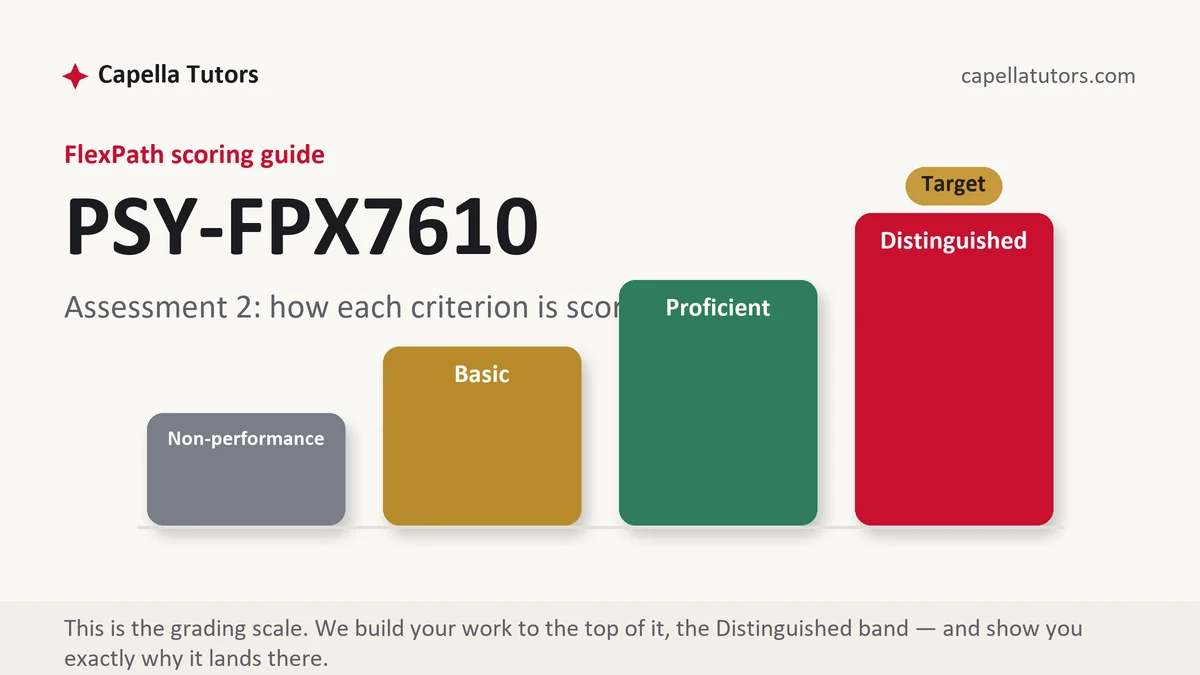
How PSY FPX 7610 Assessment 2 is scored
Each criterion is graded on its own at one of four levels, and the top wording asks for an argument rather than an assertion:
| Level | What it means on a validity argument |
|---|---|
| Distinguished | Evidence assembled into an argument for the stated use, with the weak links named and the consequences of the decisions the scores drive addressed. |
| Proficient | Several kinds of validity evidence reported and related to the intended use. |
| Basic | The instrument called valid, with a coefficient offered as proof. The commonest first-attempt result here. |
| Non-performance | A required element absent, most often the stated use or the consequences evidence. |
Validity belongs to an interpretation of scores for a proposed use, and it is built as an argument from content coverage, internal structure, relations to other variables, the response process examinees actually use, and the consequences of the decisions the scores drive. Calling an instrument valid, with no use stated, answers a question the criteria did not ask.
The PSY FPX 7610 Assessment 2 method, step by step
-
Turn the criteria into headings and state the use narrowly
The use has to be specific enough that evidence can be judged against it: which population, which decision, at what stage, with what alternative. A use stated broadly makes every piece of evidence partially relevant and none of it decisive.
-
Assemble the five kinds of evidence deliberately
Content coverage, internal structure, relations to other variables including convergent and discriminant patterns, response process, and consequences. Name which kind each source supplies, because a criterion organized by evidence type will look for the labels.
-
Handle restriction of range wherever a predictor is involved
Coefficients shrink when they are computed only among the people who were selected, so a validity figure from an incumbent sample understates the relationship in the applicant pool it will actually be used on. Say which sample produced your coefficient and in which direction the restriction moves it.
-
Name the two threats by their proper names
Construct underrepresentation means the instrument misses part of what it claims to cover. Construct-irrelevant variance means the score moves for reasons unrelated to the construct, such as reading load on a measure of something else. Say which one threatens your stated use and how you would detect it.
-
Arbitrate where the evidence disagrees
An instrument can show strong internal consistency and weak discriminant evidence at once, which means it measures something precisely and perhaps not what its title claims. Say which evidence you weight more heavily for your use and explain the weighting, because an evaluator can accept a conclusion they would not have reached if the reasoning is visible.
-
Address consequences, then self-score
Say what the decisions driven by these scores do to the people who receive them, including the people screened out, since consequences are part of the validity argument rather than an ethics appendix. Then grade each row yourself and submit with room for a review cycle.
A structure that maps to the criteria
Planning targets our tutors use on a validity deliverable, not Capella requirements; the guide attached to your assessment governs.
| Section | What it must do | Guide |
|---|---|---|
| Purpose and construct | The decision these scores will drive, the construct written out, and the group the instrument is meant for. | ~200 words |
| Content and internal structure | Coverage against the construct definition, and the factor evidence for the scoring structure. | ~260 words |
| Relations to other variables | Convergent and discriminant patterns, criterion evidence, and the sample each came from. | ~290 words |
| Range restriction and threats | Which sample produced each coefficient, which direction restriction moves it, and the two named threats. | ~270 words |
| Consequences | What the decisions do to examinees, including those screened out, and to the organization. | ~230 words |
| Argument and format | The weighting you applied, the weak links named, and current APA in both directions. | as needed |
Annotated sample excerpt
An original excerpt from our team showing evidence assembled into an argument. Study the reasoning, then rebuild it around the instrument and the use your criteria name.
The criterion evidence offered by the publisher is a correlation of .38 with supervisor ratings of counterproductive behavior, obtained in a concurrent study across a full applicant pool, and the figure that matters for this use is not that one.1 Applied as a pre-employment screen, the relationship will be computed among people who were hired, and the same relationship in an incumbent sample of this chain runs at .21, which is what restriction of range does rather than evidence that the instrument stopped working.2 The argument for this use therefore rests on the applicant-pool figure while acknowledging that the operational validity the chain will observe is the smaller one, and the weak link is not the coefficient at all but the criterion, since supervisor ratings of counterproductive behavior are themselves unreliable and partly reflect visibility rather than conduct, which means the honest recommendation adds a documented outcome such as till variance as a second criterion before the screen is scaled beyond the pilot stores.3
- 1Reports the coefficient with its design and its sample, then signals immediately that it is not the relevant figure. The distinction is the whole analytical move.
- 2Gives the restricted figure, explains the direction of the effect, and refuses the wrong inference from it. Naming restriction of range correctly is where master's work separates itself.
- 3Relocates the weak link from the predictor to the criterion, explains why the criterion is contaminated, and proposes a second outcome measure. Finding the real weak link is the top-column move.
The full premium sample for your exact assessment, written fresh to your scoring guide and issue, is free to request. Study it, revise it into your own voice, and submit work you understand.
The five mistakes that cost Distinguished
- Validity asserted where it should have been argued. With no use stated and no evidence type named, the claim answers a question the criteria did not ask.
- A coefficient from the wrong sample. An incumbent figure and an applicant-pool figure answer different questions, and using one for the other misstates the case.
- Restriction of range unmentioned. Selection compresses the predictor and shrinks the coefficient, and a paper silent on it looks unaware of the mechanism.
- The criterion assumed to be clean. Supervisor ratings carry their own error and their own bias, and the validity argument is only as good as its criterion.
- Consequences treated as an ethics appendix. Consequences of the decisions the scores drive are part of the validity argument, not an addendum to it.
Pre-submission checklist
- The use is stated narrowly enough that evidence can be judged against it
- Each source is labeled with the kind of validity evidence it supplies
- Every coefficient carries the sample and the design that produced it
- Restriction of range is addressed with its direction stated
- Construct underrepresentation and irrelevant variance are both considered
- Consequences addressed, weak links named, APA matched both ways
Validity argument due and the evidence will not assemble?
Send the guide, the instrument and the use you intend it for. The draft argues the interpretation for that use rather than for testing in general, labels each kind of evidence, handles range restriction and names the weak link. Back inside 24 to 48 hours, with rework included until nothing on the guide is left short.