This manual is for PSY-FPX7421 Assessment 3, start to submission. The final deliverable in this course is an appraisal: you are handed findings, or you go and find them, and the graded question is whether you can say what they support and what they do not. That means design and sample before results, an effect size with its interval, denominators and measurement windows on every rate, and association language wherever the design cannot carry a causal verb. Below you will find our tutors' method, a criterion-mapped structure, and an annotated excerpt from a model appraisal. Want the numbers checked by someone else first? A premium original sample returns in 24 to 48 hours with free revision until the guide is satisfied. Your courseroom may print this as PSY FPX 7421 Assessment 3 or PSY7421 Assessment 3; it is the same deliverable, and PSY-FPX7421 Assessment 3 is what this manual walks through.
One honesty note before the manual: Capella revises courses and scoring guides over time, so always write to the exact scoring guide attached to your assessment in the courseroom. The course identity above is verified on capella.edu; the method and structure below are our tutors' approach to it, not Capella's official rubric text.
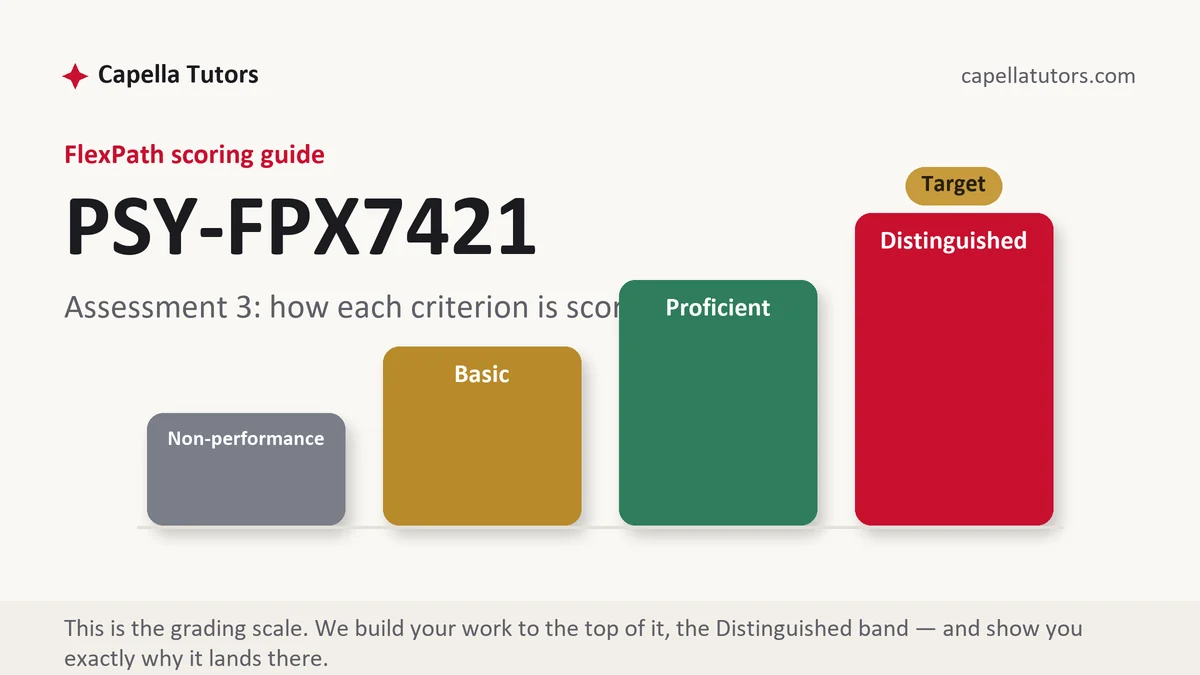
How PSY-FPX7421 Assessment 3 is scored
Every criterion sits on the same four-level ladder, and on an appraisal deliverable the levels come out like this:
| Level | What it means on an evidence appraisal |
|---|---|
| Distinguished | Design and sample are established before any result is quoted, effects arrive with intervals and in units a reader can use, and the verbs match what the design permits. The row is usually won by the sentence stating what the analysis cannot conclude. |
| Proficient | The findings are reported accurately and the main limitation is acknowledged. Reliable work that stops one step short of appraising the inference itself. |
| Basic | A summary of what the studies found, with significance treated as the verdict. This is where a well-written literature review lands when it never audits a number. |
| Non-performance | An element the criterion names is absent, most often the effect size or the limitations analysis. A paper cannot be given credit for a judgment it did not make. |
Keep one distinction at the front of the draft. A p value describes how surprising data of that kind would be if nothing were going on; it is not the probability that a hypothesis is true, it is not a measure of how large an effect is, and it does not forecast whether the result will replicate. Cumming (2014) is the useful source for building an appraisal around estimation instead, and Cohen (1988) for the conventions on effect size that most guides expect you to invoke and then qualify.
The PSY-FPX7421 Assessment 3 method, step by step
-
Write the criteria out and identify the judgment each one wants
An appraisal guide typically asks for three separable judgments: whether the method supports the claim, whether the effect matters at the size reported, and whether the conclusion generalizes. Give each one its own heading, because a paper that merges them will answer whichever is easiest.
-
Report design and sample before any finding
Who was studied, how many, how they were assigned, what the comparison condition was, and over what interval. A reader who learns the sample after the result has already formed an impression the sample then has to fight, and the criteria are written to prevent exactly that ordering.
-
Convert every effect into an interval and a usable unit
Give the standardized effect with its confidence interval, then restate it in the study's own units and as a proportion of the baseline. Twenty-eight milliseconds off a 520 millisecond mean response is a 5 percent change, and the second phrasing is the one a non-specialist can weigh against the cost of the intervention.
-
Audit the measures, including sensitivity against bias
For any detection or recognition outcome, insist on hits and false alarms rather than accuracy alone, since willingness to say yes and ability to tell two things apart are independent quantities, the separation formalized by Green and Swets (1966). For speeded outcomes, insist on error rates alongside times, because a speed gain paid for in mistakes is not a gain.
-
Match the verb to the design
Random assignment with a comparison condition licenses cautious causal language for the outcome measured; a correlational design, a self-selected sample or a single-group pre-and-post licenses association only. Then look for the narrower problem in this literature specifically, which is a trained task improving while nothing transfers, the pattern Simons and colleagues (2016) documented across commercial cognitive training claims.
-
Write what the evidence cannot settle, then self-score
Name the interval that includes trivially small values, the outcome that was measured immediately and never again, and the population absent from the sample. Then mark each criterion against the guide, repair anything short of the top descriptor, and submit early in the week rather than into a two-day evaluation queue on a Friday.
A structure that maps to the criteria
These are our tutors' planning lengths for an appraisal of this scope rather than Capella requirements; your scoring guide sets the real shape.
| Section | What it must do | Guide word target |
|---|---|---|
| The claim under appraisal | The assertion in its strongest fair form, and who is making it for what purpose. | ~150 words |
| Design and sample | Assignment, comparison condition, sample size and composition, and the measurement window. | ~250 words |
| Findings as estimates | Effect sizes with intervals, raw units, proportions of baseline, and error rates beside speeds. | ~350 words |
| Measurement audit | What each measure can and cannot separate, including sensitivity against response bias. | ~250 words |
| Inference and transfer | Which verbs the design permits, and whether improvement on the trained task transferred. | ~250 words |
| Verdict and references | A judgment stated plainly, what would change it, and current APA in text and list. | ~200 words |
Annotated sample excerpt
A model excerpt from our team showing how a number should arrive on the page. Take the ordering and the qualifications, then appraise the study your guide assigned.
The trial randomly assigned 128 adults aged 18 to 34, recruited from one university subject pool, to eight weeks of the training app or to an active control that played commercial puzzle games for the same total minutes, with the outcome measured once, in the week the programme ended.1 On the trained vigilance task the training group improved by 28 milliseconds against a 519 millisecond baseline, a 5.4 percent change, standardized as d equal to 0.31 with a 95 percent confidence interval running from 0.02 to 0.60, which means the data are consistent with an effect small enough to be invisible in any practical setting and with one of moderate size, and the reported p of .04 does not narrow that range or indicate how likely a replication would be.2 Sensitivity and bias were not separated, since only overall accuracy is reported, and the untrained working memory transfer task showed no difference between groups, so the defensible reading is that the programme is associated with better performance on the task it trained, over eight weeks, in young adults, and that nothing here supports the marketing claim about attention at work (Green and Swets, 1966; Simons and colleagues, 2016).3
- 1Assignment, sample, comparison condition and measurement window all arrive before a single result, which is the ordering the criteria reward.
- 2The effect is given in raw units, as a proportion of baseline, and standardized with an interval, and the p value is described accurately by what it cannot do.
- 3The measurement gap is named, transfer is reported honestly, and the verdict is scoped to the task, the interval and the population studied.
The full premium sample for your exact assessment, written fresh to your scoring guide and issue, is free to request. Study it, revise it into your own voice, and submit work you understand.
The five mistakes that cost Distinguished
- Significance reported as the finding. A p value under .05 says the data were surprising under a null model, and nothing at all about magnitude or importance.
- Effect sizes without intervals. A point estimate hides whether the study could distinguish a meaningful effect from a negligible one.
- Rates without denominators or windows. A percentage change with no base and no interval cannot be compared with anything, including itself later.
- Causal verbs bolted onto correlational designs. Improved, boosted and enhanced all claim an attribution that a self-selected sample cannot support.
- Trained-task gains read as transfer. Getting better at the exercise is the least interesting thing a training study can show, and the criteria expect you to say so.
Pre-submission checklist
- Design, assignment and sample appear before the first reported result
- Every effect carries an interval and at least one unit a reader can act on
- All rates carry numerator, denominator and measurement window
- Detection outcomes report hits and false alarms rather than accuracy alone
- Verbs match the design, with association language wherever cause is unavailable
- One sentence states plainly what the evidence cannot establish
Appraisal due, numbers to check?
Send the guide and the article or claim you have been given. Our eight-person pipeline delivers a premium original sample in 24 to 48 hours, with one pass whose only job is to recompute every reported figure against its source and confirm that no verb outruns the design. Revisions are free for as long as it takes.