This manual is for PSY-FPX7421 Assessment 2, start to submission. The middle deliverable in this course puts emotion at the centre of the account, and the assessment usually asks you to commit to one theoretical family, apply it to a case, and say what regulation would follow from it. The trap is familiar: three emotion theories named politely in the background and then abandoned, which satisfies no criterion in the guide. Below is the method our tutors use for it, a structure that maps to the criteria, and an annotated excerpt from a model paper. Prefer to delegate this one? A premium original sample comes back inside 24 to 48 hours, rewritten free until the guide is met. Your courseroom may print this as PSY FPX 7421 Assessment 2 or PSY7421 Assessment 2; it is the same deliverable, and PSY-FPX7421 Assessment 2 is what this manual walks through.
One honesty note before the manual: Capella revises courses and scoring guides over time, so always write to the exact scoring guide attached to your assessment in the courseroom. The course identity above is verified on capella.edu; the method and structure below are our tutors' approach to it, not Capella's official rubric text.
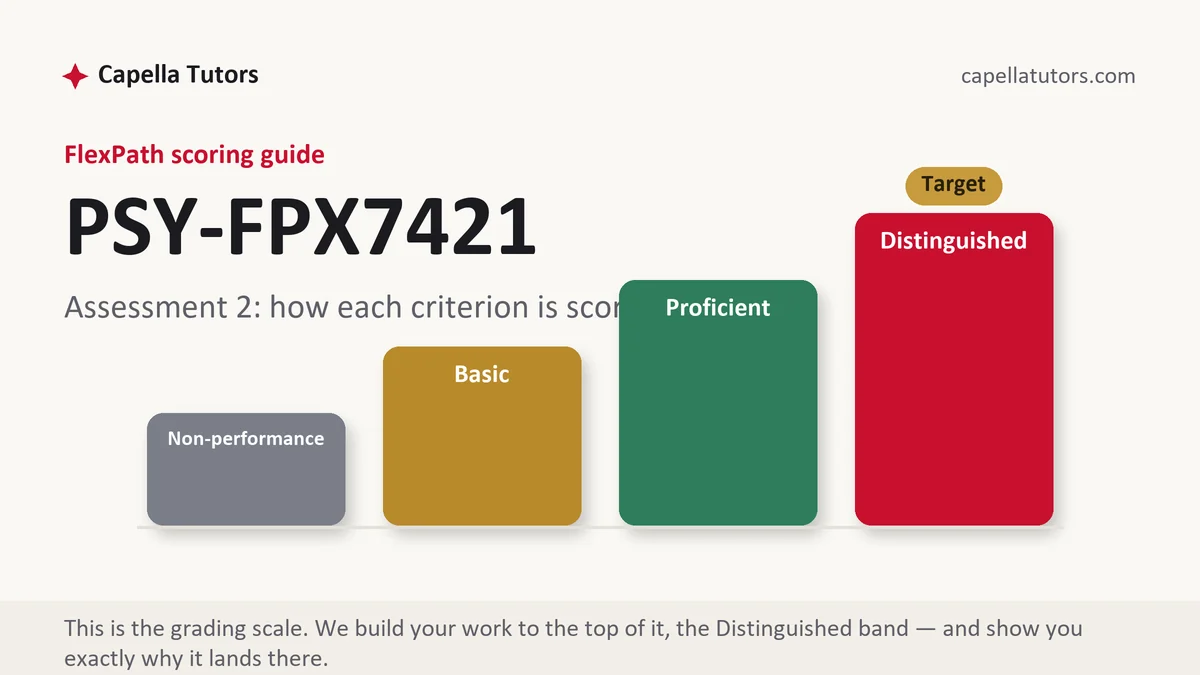
How PSY-FPX7421 Assessment 2 is scored
The scoring guide sorts every criterion into one of four levels, and on an affective deliverable the ladder reads as follows:
| Level | What it means on an emotion and regulation deliverable |
|---|---|
| Distinguished | One account is committed to and used throughout, the writer names the finding that account handles badly, and the regulation recommendation is sized to the evidence behind it. Volunteering the awkward finding is what the top descriptor is usually asking for. |
| Proficient | An account applied consistently and correctly to the case, with appropriate sources. Sound, and it never puts itself at risk. |
| Basic | A tour of the emotion theories with no choice made, or a choice made and then not used. The most frequent outcome on this kind of deliverable. |
| Non-performance | A required element does not appear, commonly the regulation component or the ethical boundary. Reviewers mark the absence rather than the quality of what surrounds it. |
Choosing an account is easier once you notice that the three families answer different questions. A discrete account, in the tradition of Ekman (1992), predicts rapid patterned responses to a class of events. An appraisal account, formalized by Lazarus (1991), predicts different emotions from the same event across people, because the evaluation against goals is the variable doing the work. A constructionist account, argued at length by Barrett (2017), predicts that a general state becomes a specific emotion through concepts and context. Match the family to what varies in your case and the commitment writes itself.
The PSY-FPX7421 Assessment 2 method, step by step
-
Lay the criteria out and mark what each one counts
Some criteria count elements, such as an account, a case application and a recommendation, and others count quality of reasoning. Note which is which under each heading, because an elements criterion is satisfied by completeness and a reasoning criterion is not.
-
Describe the episode before you name the emotion
Write what was said and done, in sequence, with the situation the person was in and the outcome that mattered to them. Naming an emotion first imports an interpretation that the rest of the paper will then defend rather than test, and the analysis rows notice the difference.
-
Commit to one account and say why these facts fit it
One sentence of selection, one of justification. If the same event produces markedly different reactions across two people in your case, that variation is an argument for an appraisal account, and saying so out loud earns the row that a survey of theories leaves empty.
-
Write the appraisal or the construction explicitly
Do not leave the mechanism implicit. Say what the person took the event to mean for something they cared about, what they judged about their capacity to do anything about it, and how that produced this emotion rather than a neighboring one. That paragraph is where a graduate paper separates from an undergraduate one.
-
Treat regulation as a family of strategies with costs
Gross's (1998) process model places strategies at different points: selecting or leaving a situation, redirecting attention within it, changing the construal, and modifying the response after the fact. The reported laboratory pattern favors reappraisal over expressive suppression, and it comes from brief instructed episodes with student samples, so name the setting where the ranking would reverse.
-
Set the professional boundary, then self-score
This is a non-licensure degree, so the paper describes and explains rather than diagnoses, and the sentence that says so reads as competence instead of hedging. Then score each criterion yourself, fix what falls short, and submit early enough that a two business day evaluation window does not cost you a week.
A structure that maps to the criteria
The lengths below are our planning targets for a deliverable of this size, not rules from Capella; follow your guide where it differs.
| Section | What it must do | Guide word target |
|---|---|---|
| The episode | Sequence, situation and stakes, described so that a reader could reach a different interpretation than yours. | ~200 words |
| The account chosen | The theoretical family, its originating source, and the feature of this case that selects it. | ~250 words |
| The mechanism applied | The appraisal or construction spelled out, producing this emotion rather than an adjacent one. | ~350 words |
| Regulation | The strategies available, where each acts, and the cost profile of the one you recommend. | ~300 words |
| Evidence and its limits | Samples, settings and durations behind the regulation findings, and where the ranking would flip. | ~250 words |
| Boundaries and references | What the analysis does not license, plus current APA in text and list. | ~150 words |
Annotated sample excerpt
An original model excerpt from our team, written to show what committing to an account looks like on the page. Study the reasoning, then write your own episode.
Two billing representatives at the same utility took the same call, a customer shouting about a disconnection notice, and reported entirely different states afterwards, one anger and one something closer to weary sympathy, which is the variation an appraisal account exists to explain (Lazarus, 1991).1 The first read the shouting as directed at her and as a threat to standing she could do nothing about, which yields anger with a sense of blocked agency; the second read it as directed at the notice, with a payment plan available to her in the system, so the same acoustic event was appraised as a solvable problem affecting somebody else's goal rather than her own.2 Regulation therefore belongs at the construal stage rather than at the response stage, because instructing representatives to keep their faces neutral is expressive suppression, which in laboratory episodes reduces the visible response while leaving physiological arousal in place and impairing memory for the exchange, whereas altering what the shouting is taken to mean acts earlier and more cheaply (Gross, 1998); the caveat belongs in the same paragraph, since those comparisons come from short instructed trials with student samples, and in a role where the expression itself is what the customer reacts to, controlling it may be the correct professional choice.3
- 1The case detail selects the account rather than the writer's preference, and the primary source arrives with the commitment.
- 2The appraisal is written out for both people, so the mechanism produces the difference instead of restating it.
- 3The regulation strategy is located in the model, the cost pattern is reported, and the boundary condition is volunteered before an evaluator has to ask.
The full premium sample for your exact assessment, written fresh to your scoring guide and issue, is free to request. Study it, revise it into your own voice, and submit work you understand.
The five mistakes that cost Distinguished
- Three theories introduced and none used. Naming the families is background, and background earns nothing once the criterion asks for an application.
- An emotion label doing the work of an explanation. Saying the representative felt frustrated describes the outcome the paper was supposed to derive.
- Reappraisal declared universally best. The comparison rests on brief instructed episodes, and the professional setting sometimes reverses the ranking.
- An internal state read off a face. Expressions map onto emotion categories far less reliably than the popular account assumes, and applied claims built on that mapping overreach.
- A recommendation that quietly diagnoses. A non-licensure master's describes behavior and appraisal, and any sentence assigning a condition to a person costs the ethics row.
Pre-submission checklist
- One theoretical account is chosen, justified from the case, and used throughout
- The appraisal or construction is written explicitly rather than implied by a label
- The regulation strategy is located at a stage of the process, with its cost profile
- Samples and durations behind each regulation finding are stated in the text
- One finding the chosen account struggles with is named by the writer
- The non-licensure boundary appears in a sentence, before the recommendation
Emotion deliverable with a case attached?
Send the guide and the episode, redacted however you need it. An eight-person pipeline returns a premium original sample in 24 to 48 hours, with one reader checking that the chosen account does real work in every section and that no sentence reads a state off an expression. Revisions are free until every criterion is answered.