This manual is for PSY-FPX7421 Assessment 1, start to submission. The opening deliverable in this course explains a cognitive process at the level of its components, normally against a case or a scenario, and the assessment usually asks which stage of the process broke rather than which topic the case belongs to. Attention is four operations, memory is three stages, and a paper that writes either as one thing cannot reach the analysis rows no matter how accurate its summary is. What follows is our tutors' method, a structure that answers the criteria in their own order, and an annotated excerpt. Want it handled with backup? A premium original sample returns in 24 to 48 hours, revised free until every criterion clears. Your courseroom may print this as PSY FPX 7421 Assessment 1 or PSY7421 Assessment 1; it is the same deliverable, and PSY-FPX7421 Assessment 1 is what this manual walks through.
One honesty note before the manual: Capella revises courses and scoring guides over time, so always write to the exact scoring guide attached to your assessment in the courseroom. The course identity above is verified on capella.edu; the method and structure below are our tutors' approach to it, not Capella's official rubric text.
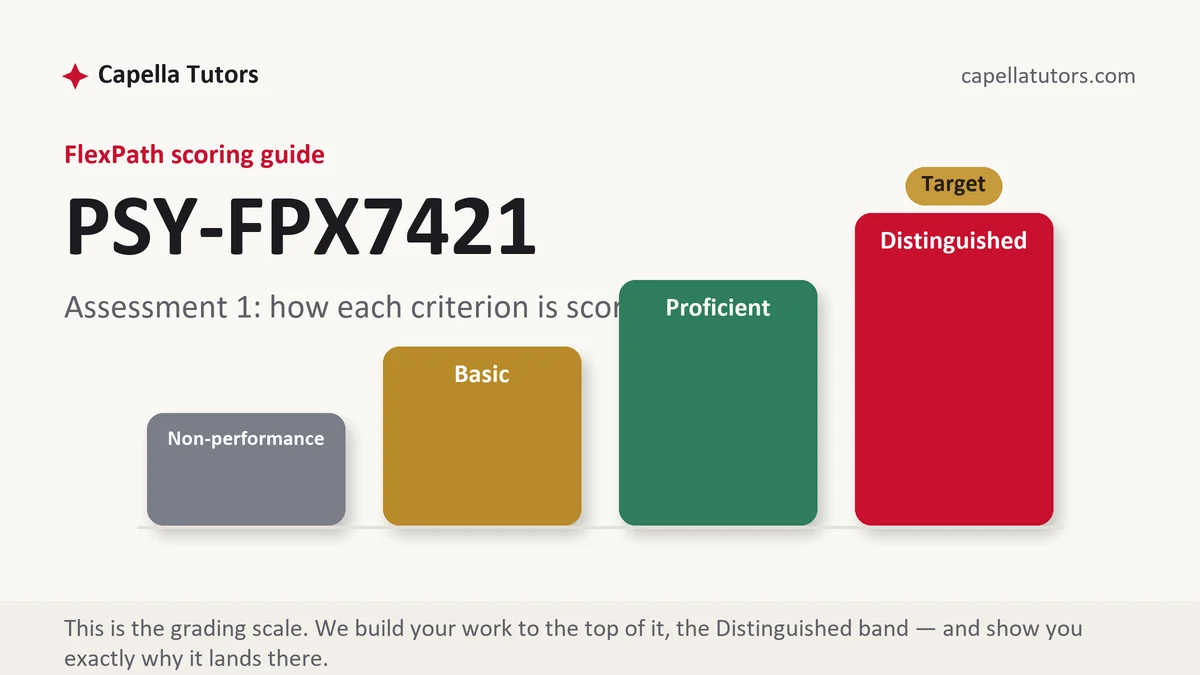
How PSY-FPX7421 Assessment 1 is scored
Nothing here is graded as a percentage. Each criterion is placed on one of four levels, and on a cognitive analysis the levels mean this:
| Level | What it means on a memory and attention analysis |
|---|---|
| Distinguished | Rival mechanisms are named, the observation that would discriminate between them is stated, and every construct is paired with the task that measures it. The discriminating observation is the sentence that buys the top column. |
| Proficient | One mechanism identified correctly and explained with the right literature behind it. Accurate, and it never tests itself against an alternative. |
| Basic | An accurate textbook account of memory or attention with the case appended. Nothing wrong in it, and nothing in it that could have come out differently. |
| Non-performance | Something the criterion requires is simply absent, most often the measure behind a construct. A process named without a task is a word, and reviewers score it that way. |
The reason the task matters as much as the construct is that recognition and recall do not behave alike, and neither behaves like a span measure. Forgetting is frequently a retrieval problem rather than an absence, which is why a cue present at encoding can recover material that seemed gone, the point Tulving and Thomson (1973) established as encoding specificity. Write memory without writing which task produced the evidence and the criteria have nothing to grade except vocabulary.
The PSY-FPX7421 Assessment 1 method, step by step
-
Build headings from the criteria, then find the verb in each
Explain asks for a mechanism, analyze asks for the parts and the relations between them, and evaluate asks for a judgment against a standard you name yourself. Paste each top descriptor under its heading so you can see which elements you have satisfied and which you have merely gestured at.
-
State the phenomenon in terms somebody could observe
Write what actually happened, in the order it happened, with times and quantities where the case supplies them. Then separate what was observed from what has been inferred about it, because most weak papers in this course inherit their errors from a scenario summary that already contains a conclusion.
-
Decompose the process before you diagnose it
For attention, decide whether selection, sustained maintenance, division of effort or switching is at issue, a partition that follows the componential work after Posner and Petersen (1990). For memory, decide whether encoding, consolidation or retrieval is the candidate stage. Then write the components you are ruling out, not only the one you keep.
-
List rival mechanisms with their discriminating evidence
For each candidate, say what you would expect to observe if it were the right one, and make the expectations differ. A selection failure predicts a decline confined to noisy conditions; a maintenance failure predicts accuracy falling across a session rather than at its start. The paper earns its analysis row on the difference between those predictions.
-
Attribute the mechanism to the work that established it
Working memory as storage plus manipulation belongs to Baddeley and Hitch (1974). The reconstructive character of memory and the influence of post-event information belong to the experimental literature after Loftus and Palmer (1974). Cite those under their own dates, and treat a textbook as a route to the paper rather than as the source.
-
Write the limits, self-score, and submit on a Monday
Close by saying what the case cannot establish, including anything about cause, and keep any neural evidence described as an association with a task rather than as the seat of a function. Then grade yourself criterion by criterion and repair whatever falls short, remembering that faculty need up to two business days per attempt.
A structure that maps to the criteria
Word targets below are our tutors' planning shape for an analysis of this size rather than Capella instructions; your guide decides the sections.
| Section | What it must do | Guide word target |
|---|---|---|
| The phenomenon | What happened, in observable terms, with observation separated from inference. | ~200 words |
| Constructs and tasks | Each construct in play named with the procedure that measures it, on first use. | ~200 words |
| Candidate mechanisms | The components that could account for the case, and what each one predicts. | ~350 words |
| The mechanism argued | The account you commit to, its primary literature, and the evidence that favors it here. | ~300 words |
| Inference limits | What the material cannot settle, plus honest treatment of any confidence or imaging evidence. | ~250 words |
| Implication and references | One recommendation traceable to the mechanism, and current APA in text and list. | ~200 words |
Annotated sample excerpt
A model excerpt from our team, at the register the analysis criteria reward. Take the structure of the reasoning and apply it to whatever case your guide gives you.
The witness at the hardware store gave a first account four hours after the theft that described a dark jacket and no hat, and a second account nine days later, after seeing a security still, that described a grey hooded top; the change is the datum to be explained rather than evidence that the witness is unreliable.1 Three mechanisms could produce it, and they predict different things. Encoding was thin, in which case the second account should be no more consistent under a different retrieval cue than the first; retrieval failed at four hours, in which case a context-reinstatement interview should recover detail the still did not supply; or the still supplied information that was incorporated into the account, in which case the added details should track the still specifically, including any feature it shows that was not present at the scene (Loftus and Palmer, 1974; Tulving and Thomson, 1973).2 The third is testable here because the still shows a hood and the report of a hood appeared only afterwards, and the witness's rise in confidence between accounts is not evidence for accuracy, since the confidence-accuracy relationship depends on the conditions under which the identification was made rather than holding in general.3
- 1The observation is stated with its intervals before any interpretation, and the writer refuses the easy conclusion the scenario invites.
- 2Three mechanisms with three different predicted observations, each attributed to primary work. This is the move the analysis criterion is written for.
- 3The discriminating detail is applied to this case, and confidence is handled as conditional evidence rather than as corroboration.
The full premium sample for your exact assessment, written fresh to your scoring guide and issue, is free to request. Study it, revise it into your own voice, and submit work you understand.
The five mistakes that cost Distinguished
- Memory written as one system. Encoding, consolidation and retrieval fail for different reasons, and a paper that never picks a stage cannot explain the case it is describing.
- Working memory used interchangeably with short-term memory. One is holding, the other is holding while operating, and the criteria are grading that distinction directly.
- Constructs without tasks. Attention, capacity and interference mean little until the procedure that produced the evidence is on the page.
- A single mechanism asserted. With no alternative considered, the paper has offered an opinion that happens to be correct rather than an analysis.
- A faculty located in a brain region. Greater activation during a task is an association with that task, and reasoning backward to the mental process is a known inferential error.
Pre-submission checklist
- Every criterion has a labeled section a reviewer can find in seconds
- Each construct is introduced with the task or measure that operationalizes it
- At least two rival mechanisms appear, each with a distinct predicted observation
- The stage of the process that failed is named, with the stages ruled out
- Primary sources carry the theory, cited under their original dates
- No sentence infers a mental process from a region of activation
Cognitive analysis due this week?
Send the scoring guide and the scenario your courseroom supplied. Eight people take it from source pull to final read and return a premium original sample inside 24 to 48 hours, with one pass reserved for checking that every construct has a task attached and no claim outruns its measure. Revisions cost nothing.