This manual is for PSY FPX 6830 Assessment 3, start to submission. Working With Diverse Populations asks you to examine how sport psychology practice must adapt to different athlete populations: choose an issue, such as competitive anxiety, compare how it shows up across groups, for example high school versus college athletes or by gender, and recommend practices that respond to those differences. The grade turns on evidence-based comparison and tailored recommendations. Showing what differs and how practice should change scores above general statements about diversity. Below is the method our tutors use, a structure that maps to the criteria, and an annotated sample excerpt. Prefer to hand it off? A premium original sample for this exact assessment comes back in 24 to 48 hours, revised free until it meets the guide. Capella's catalog lists the course as PSY-FPX6830, and some courserooms print PSY6830; both point to this same Assessment 3. In current courserooms this assessment typically appears as "Working With Diverse Populations".
One honesty note before the manual: Capella revises courses and scoring guides over time, so always write to the exact scoring guide attached to your assessment in the courseroom. The course identity above is verified on capella.edu; the method and structure below are our tutors' approach to it, not Capella's official rubric text.
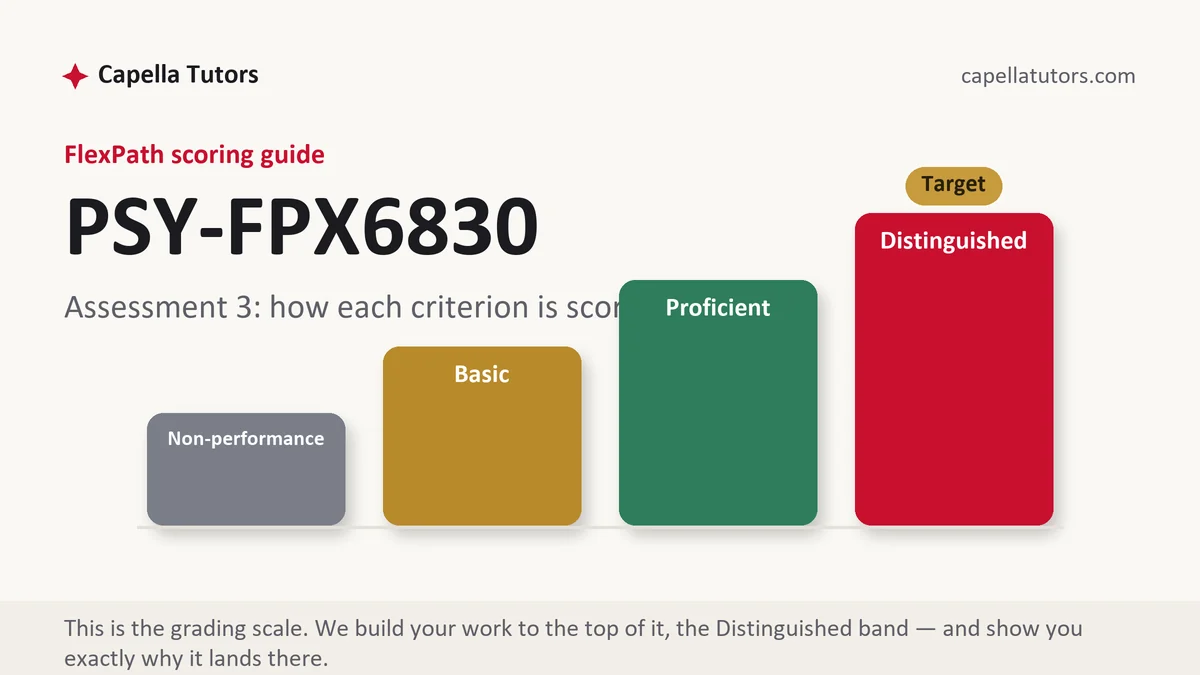
How PSY FPX 6830 Assessment 3 is scored
FlexPath does not use letter grades. Each criterion in the scoring guide lands on one of four levels, and the level descriptions are the real writing brief:
| Level | What it means on a diverse populations paper |
|---|---|
| Distinguished | The diverse populations paper is specific to the organization or case, applies course concepts accurately with credible sources, and ends in justified conclusions or recommendations. |
| Proficient | The diverse populations paper is accurate, but the application or recommendations are general. |
| Basic | The diverse populations paper describes concepts with little application. |
| Non-performance | A required part of the diverse populations paper is missing. |
Use sport psychology research on the populations you compare.
The PSY FPX 6830 Assessment 3 method, step by step
-
Choose the issue
A specific performance or wellbeing issue.
-
Choose populations
Groups that differ meaningfully.
-
Compare with evidence
How the issue differs.
-
Consider gender and culture
Additional differences.
-
Recommend practices
Tailored to each group.
-
Address ethics
Competence with diverse clients.
A structure that maps to the criteria
Word counts are planning targets our tutors use, not Capella rules; follow the length and format your scoring guide states.
| Section | What it must do | Guide |
|---|---|---|
| Introduction | Issue and populations. | ~75 words |
| Comparison | Evidence on differences. | ~200 words |
| Gender, culture and other differences | Analysis. | ~125 words |
| Recommendations and references | Then references. | ~100 words |
Annotated sample excerpt
An original model excerpt from our team, written to show the register that reaches the top of the guide. Learn the moves, then write your own version.
High school athletes often report anxiety tied to parents' expectations and team selection, while college athletes describe pressure linked to scholarships, academic demands and the prospect of professional careers.1 The source of pressure matters for practice, because a younger athlete may benefit most from work that includes parents, while a college athlete may need help with identity and time management alongside performance skills.2 Research also finds female athletes report higher anxiety on average, which practitioners should treat as a reason to screen carefully, not as a stereotype.3
- 1Compares sources of the issue across groups.
- 2Links differences to practice.
- 3Adds a gender difference with care.
The full premium sample for your exact assessment, written fresh to your scoring guide and topic, is free to request. Study it, revise it into your own voice, and submit work you understand.
The five mistakes that cost Distinguished
- Definitions without application. Apply each concept to the organization or case.
- No sources. Cite credible business sources.
- Vague recommendations. Make them specific and justified.
- General diversity statements. Compare with evidence.
Pre-submission checklist
- Issue chosen
- Populations compared
- Gender and culture
- Recommendations
- Ethics
- References
Want the diverse populations paper written?
Send the scoring guide and any materials from your courseroom. Our team returns a premium original diverse populations paper in 24 to 48 hours, revised free until it meets the guide.