How to write PSY-FPX6830 Assessment 2

The short answer

This manual is for PSY-FPX6830 Assessment 2, start to submission. The middle deliverable in Applied Sport Psychology moves from understanding a client to serving one, and the assessment usually asks for a written service delivery plan: sessions, content, the people around the athlete, and the way you would know whether the work is landing. Your guide decides the criteria and each is scored at one of four levels, at graduate applied register, inside a degree that does not license you to treat. Below are our tutors' method, a criterion-mapped structure, and an annotated excerpt on targets and measures. Prefer to hand it over? A premium original sample built to your prompt arrives in 24 to 48 hours and is revised free until the criteria are met. Your courseroom may print this as PSY FPX 6830 Assessment 2 or PSY6830 Assessment 2; it is the same deliverable, and PSY-FPX6830 Assessment 2 is what this manual walks through.

One honesty note before the manual: Capella revises courses and scoring guides over time, so always write to the exact scoring guide attached to your assessment in the courseroom. The course identity above is verified on capella.edu; the method and structure below are our tutors' approach to it, not Capella's official rubric text.
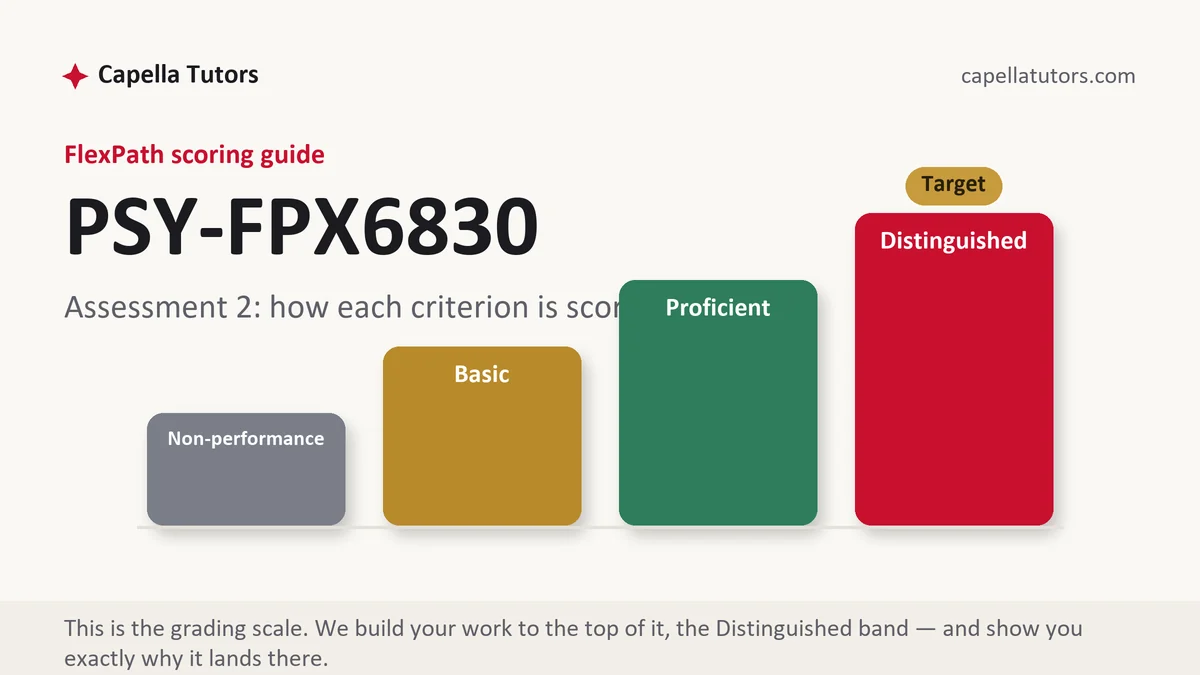
PSY-FPX6830 Assessment 2 grading scale at Capella FlexPath, the criterion levels this assessment is scored on, from Capella Tutors
How Capella FlexPath grades PSY-FPX6830 Assessment 2, visualized by Capella Tutors.

How PSY-FPX6830 Assessment 2 is scored

Criterion by criterion, four levels each, and a plan can sit at the top on content while losing a level on the practicalities:

LevelWhat it means on a service delivery plan
DistinguishedThe plan is timed against the rehabilitation or competitive schedule it has to live inside, the targets are measured with named instruments, and the document says what happens when a session is missed or the timeline slips.
ProficientSessions, spacing and content are specified and appropriate to the case. Everything works on paper and assumes the paper survives contact.
BasicA list of techniques with a weekly heading over it, the other professionals mentioned once, and progress reviewed by asking the athlete how it is going.
Non-performanceA required component never appears, most often the coordination with other providers or the way progress is measured at all.

The quiet test in this deliverable is whether anyone else could run your plan on your behalf next week. Names, roles, session lengths and the point at which somebody else has to be told are what make that possible.

The PSY-FPX6830 Assessment 2 method, step by step

  1. Anchor the plan to the schedule it has to fit inside

    Find out what week of the medical or competitive timeline the athlete is in and write your phases against it. In rehabilitation settings, progression is criteria-based rather than calendar-based, so your sessions attach to milestones and clearances rather than to dates you invented.

  2. Read the psychological response as a process, not a queue of stages

    Wiese-Bjornstal and colleagues set out an integrated model in which appraisal, emotion and behavior loop through the recovery rather than proceeding in fixed order. Grief-stage sequences imported from elsewhere have never held up in injury data, so cite the model that fits and say why the stage account was rejected.

  3. Pick two or three targets you can actually measure

    Adherence, confidence in the injured region, and fear of reinjury are all measurable with published instruments. Name the instrument, give its range, and say when it will be administered. A target with no instrument becomes an opinion at the review meeting.

  4. Write the sessions around the other professionals' week

    The physiotherapist, the strength coach and the physician all have contact time, and your work either supports it or competes with it. State who you speak to, what you share, how often, and what you would not pass on without the athlete's agreement.

  5. Keep the verbs honest on the readiness evidence

    Psychological readiness scores are associated with returning to sport and with subsequent injury in cohort studies, which is a correlation collected over time rather than an experiment. Write associated with and predicted, and leave caused for designs that could support it.

  6. Build the failure paths, then self-score

    Say what happens if adherence drops below a level you have named, if the timeline extends, or if screening flags something clinical. Then grade every criterion yourself against the guide and repair anything short of the top before submitting.

A structure that maps to the criteria

The word targets are ours for planning purposes only; expand whichever section your scoring guide asks to carry the most weight.

SectionWhat it must doGuide word target
Case summary and stageThe athlete, the injury or situation, the week of the timeline, and what has already been done.~200 words
Targets and measuresTwo or three targets, each with a named instrument, its range, and the schedule for administering it.~300 words
Session planPhases, session length and frequency, content per phase, and the athlete's independent work between sessions.~350 words
Working with the teamThe other providers, what is shared with each, how often, and what stays with the athlete.~250 words
Contingencies and referralThe adherence threshold, the timeline slip, the clinical trigger, and the named route in each case.~200 words
ReferencesCurrent APA, primary injury psychology research, instrument papers, ethics standards cited by number.as needed

Annotated sample excerpt

A short original model from our team on how to state a target so that a review meeting has something to read. Take the pattern and rebuild it for your client.

Sample excerpt: targets and measurement Original model · Capella Tutors

This constructed sevens winger is in week nine after reconstruction, cleared for straight-line running and not for cutting, so the plan carries two targets: adherence to prescribed rehabilitation sessions, recorded by the physiotherapist as sessions completed out of sessions prescribed, and confidence in the reconstructed knee, recorded on a published return-to-sport scale that runs from 0 to 100.1 Baseline over the four weeks before intake is 17 of 24 prescribed sessions completed, with a scale score of 38, and both will be recorded on the same day every second Tuesday so that the measurement window never drifts into a competition weekend.2 A rise on that scale is associated with returning to play in cohort studies rather than shown to produce it, and no threshold on it has been established as a clearance criterion, so the number informs the conversation with the physician and never replaces it.3

  • 1Two targets, each with the person who records it and the form the record takes. Adherence given as a fraction rather than as a percentage keeps the denominator visible.
  • 2Baseline and a fixed measurement window, chosen so the schedule itself does not bias the numbers. Evaluators notice when a plan measures on convenient days.
  • 3States what the instrument can and cannot decide, and hands the clinical judgment back to the clinician. That is the scope boundary written into the sentence rather than into a footnote.

The full premium sample for your exact assessment, written fresh to your scoring guide and issue, is free to request. Study it, revise it into your own voice, and submit work you understand.

Get the full sample free

The five mistakes that cost Distinguished

  • A calendar plan for a criteria-based recovery. Promising graded exposure in week eleven ignores that clearance depends on physical milestones, and it reads as unfamiliarity with the setting.
  • Grief stages applied to injury. A fixed emotional sequence has not survived testing in injured athletes, and citing it signals that the injury literature itself was not read.
  • Targets with no instrument. Improved motivation cannot be reviewed, cannot be reported to a physician, and cannot support any claim at the end of the engagement.
  • The medical team mentioned once. A plan that names the physiotherapist in the introduction and never again has not addressed the coordination the criterion asks for.
  • A questionnaire score used as clearance. No published cut score on a readiness scale substitutes for a physician's decision, and treating one as a gate crosses the scope line.

Pre-submission checklist

  • The week of the medical or competitive timeline is stated in the case summary
  • Every target has a named instrument, a range and an administration schedule
  • Session length, frequency and independent work specified per phase
  • Information sharing with each other provider written down explicitly
  • Adherence threshold, timeline slip and clinical trigger each given a named response
  • Readiness evidence written with association verbs, not causal ones

Service plan due in a week?

Send the guide, the case and the stage the athlete is at. A pipeline of eight, including a research analyst and two reviewers, returns the premium original inside 24 to 48 hours with the instruments, the measurement schedule and the referral thresholds already written, and revises it free until the criteria are met.

Keep going

Online now