This manual is for PSY FPX 6830 Assessment 1, start to submission. The opening deliverable in Applied Sport Psychology is a consulting document rather than an essay, and the assessment usually asks you to state how you work, show how you would take a client in, and produce a case formulation that follows from what you found. Each criterion in your own scoring guide is scored at one of four levels, and the work is graduate applied writing inside a non-licensure degree, which is what fixes the boundary of everything you propose. Below are the method our tutors use, a structure keyed to the criteria, and an annotated excerpt from a formulation. Would you rather delegate it? A premium original sample written to your prompt returns in 24 to 48 hours, revised free until the guide is satisfied. Capella's catalog lists the course as PSY-FPX6830, and some courserooms print PSY6830; both point to this same Assessment 1.
One honesty note before the manual: Capella revises courses and scoring guides over time, so always write to the exact scoring guide attached to your assessment in the courseroom. The course identity above is verified on capella.edu; the method and structure below are our tutors' approach to it, not Capella's official rubric text.
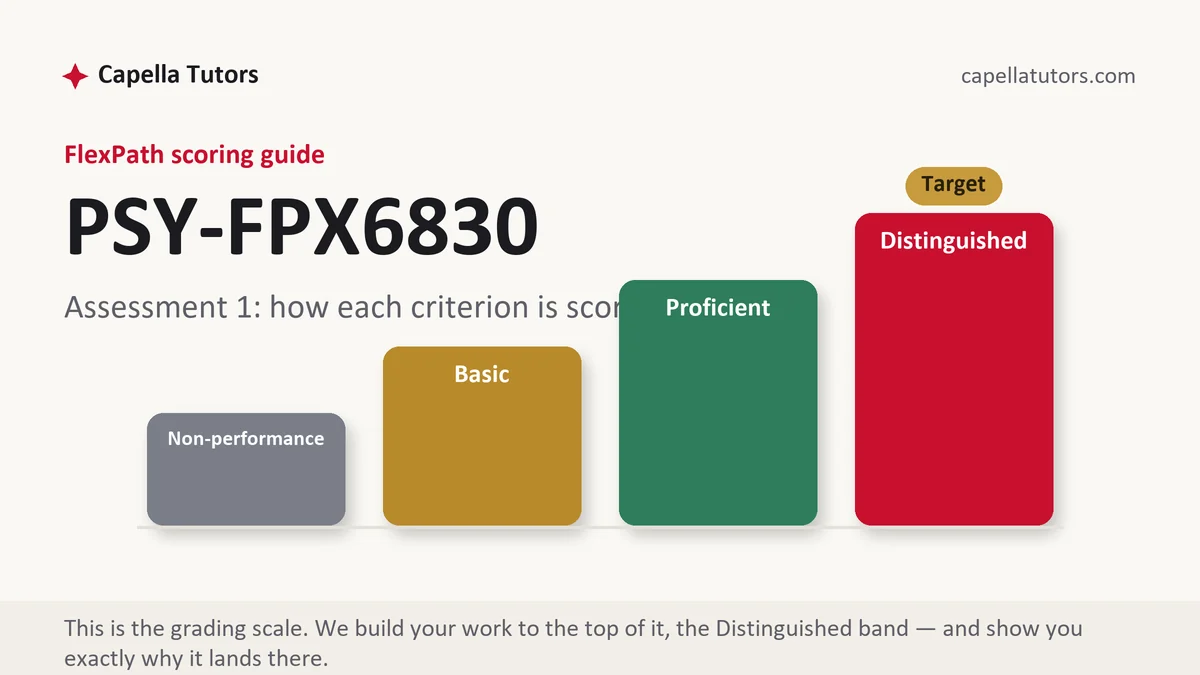
How PSY FPX 6830 Assessment 1 is scored
No letter grade arrives at the end of this. Every criterion is placed at one of four levels, and the level descriptions are the brief you write to:
| Level | What it means on an intake and formulation document |
|---|---|
| Distinguished | The philosophy runs as a chain from assumption to practice, every intake question earns its place, and the formulation is a hypothesis specific enough to be wrong, with the alternative explanation named. The extra move is in the criterion wording; supply it deliberately. |
| Proficient | Philosophy, intake and formulation are all present, coherent and defensible. Complete work in which the formulation reads as a summary of the athlete rather than a claim about them. |
| Basic | A description of the client with an approach attached, where the questions could have been asked of anyone in the sport. It is what a first draft looks like before the reasoning is put in. |
| Non-performance | Something required is simply not there, usually the consent paragraph or the referral screen. A criterion with no text to read cannot be scored above the floor. |
Read the criterion wording for the word your evaluator will look for. Justify, evaluate and analyze are different instructions, and a document that describes when the criterion said justify has answered a question nobody asked.
The PSY FPX 6830 Assessment 1 method, step by step
-
Convert the criteria into headings, then put them in consultation order
Criteria first, sequence second. A reader following a case wants the reasoning before the plan, so philosophy, intake, formulation and boundaries is the order that reads well even when the guide lists them differently. Keep the top descriptor under each heading while you draft.
-
Write the philosophy as a chain, not as a mood
Four links: what you assume makes athletes change, the orientation that follows, what a session therefore looks like, and what you would decline. Choose between a skills view, an insight view and a systems view rather than gesturing at all three, and cite the orientation you name.
-
Give every intake question a job in one clause
Beside each question, write what it is meant to establish and what you would do differently depending on the answer. Questions that cannot change your next move are filler, and an intake made of filler leaves the assessment criterion nothing to grade.
-
State the formulation so that it could turn out wrong
Formulation in the clinical literature, from Eells onward, is treated as a working hypothesis rather than a portrait. Write yours as a mechanism plus a prediction: if this account is right, then this should happen next, and if that does not happen, the alternative account is this one.
-
Screen for what sits outside your scope, in writing
Put the screening questions in the document, name the licensed provider and the team physician you would route to, and state whether you would remain involved afterwards. A non-licensure performance role can hold that boundary only if the boundary was written before somebody tested it.
-
Draft the consent in language an athlete could repeat back, then self-score
Say what you do, what the coach receives, what the department sees, how notes are kept, and the circumstances that would override confidence. Then grade yourself criterion by criterion against the guide and rewrite anything that is not at the top level.
A structure that maps to the criteria
Treat the word figures as planning arithmetic from our tutors rather than as requirements; the guide attached to your assessment decides which sections exist at all.
| Section | What it must do | Guide word target |
|---|---|---|
| Professional philosophy | Assumption, orientation, session shape and stated limits, each following from the one before. | ~250 words |
| Intake design | The questions, the reason for each, what would be observed, and any instrument with its purpose and range. | ~300 words |
| What the intake found | The presenting concern in the athlete's words, the referrer's account kept separate, and the history that bears on it. | ~250 words |
| Case formulation | The maintaining factors, the working hypothesis, its prediction, and the alternative account you would test next. | ~350 words |
| Consent and referral | What is shared and with whom, the limits of confidence, the screening questions, and the named route out of scope. | ~250 words |
| References | Current APA, ethics codes cited by standard, applied journals for service models, measurement papers for instruments. | as needed |
Annotated sample excerpt
An original model paragraph from our writers, showing the register a formulation needs. Learn the moves from it and write yours around your own case.
The working hypothesis is that this goalkeeper's withdrawal from penalty duty is maintained by how he reads his own arousal rather than by a decline in technique: across the last eight fixtures his save percentage from open play sits within the range recorded before the shootout in April, while he has declined every one of the four opportunities to take a spot kick since.1 He describes the same physical signs, a fast heart rate and heavy legs, as readiness before open play and as evidence he will fail before a shootout, which is the appraisal difference the hypothesis turns on.2 If the account is right, work on interpreting arousal should change his willingness before it changes any technical measure; if willingness moves only after the technical work in week five, the better explanation is the confidence account and the plan changes with it.3
- 1The hypothesis is stated as a mechanism, then supported by two figures that discriminate between rival accounts. Technique data are used to rule something out, which is the harder and better move.
- 2Uses the athlete's own words for the evidence, and keeps the interpretation of arousal separate from the arousal itself. That distinction has a literature behind it and it is doing real work in the sentence.
- 3Attaches a prediction and a falsifier, so the formulation could be shown wrong by the next six weeks. This is the sentence that separates a formulation from a description of a person.
The full premium sample for your exact assessment, written fresh to your scoring guide and issue, is free to request. Study it, revise it into your own voice, and submit work you understand.
The five mistakes that cost Distinguished
- A philosophy made of adjectives. Athlete-centred, holistic and evidence-based tell an evaluator nothing about how you would open a first meeting, which is exactly what the criterion is testing.
- An intake that is a form rather than a set of decisions. Twenty questions with no stated purpose cannot show judgment, and judgment is the graded quality.
- A hypothesis with no way to fail. An account that fits every possible next month has not committed to anything, so nothing in it can be credited as reasoning.
- Screening questions implied but never written. Saying you would refer if needed is not a pathway; the questions, the threshold and the named recipient are the pathway.
- The referrer's story and the athlete's story merged. A coach's account of the problem and the athlete's account are two pieces of evidence, and blending them destroys the only disagreement worth analyzing.
Pre-submission checklist
- Each scoring-guide criterion has its own labeled section, in consultation order
- Philosophy runs assumption to orientation to session to stated limit
- Every intake question carries the decision it would inform
- Formulation written with a prediction and a named alternative account
- Consent paragraph states what the coach receives and what overrides confidence
- Referral screen with threshold, named route and your role afterwards
Intake and formulation to write?
Send the prompt, the guide, the setting and who is paying. Eight people work each draft, with one pass dedicated to the ethics and scope language that gets flagged most in this course, and the premium original comes back inside 24 to 48 hours with free revisions until every criterion is met.