How to write PSY-FPX6820 Assessment 3

The short answer

This manual is for PSY-FPX6820 Assessment 3, start to submission. The synthesis deliverable in Performance Enhancement in Sports pulls the course together, and the assessment usually asks for a complete psychological skills program with the design that would show whether it worked, evaluated against a literature you appraise rather than summarize. Your scoring guide sets the sections and the levels, and the work is written as graduate applied practice inside a non-licensure degree, which limits what it may claim. Below you get the method our tutors run, a structure keyed to the criteria, and an annotated excerpt from an evaluation section. Rather hand it over? A premium original sample for your exact prompt lands in 24 to 48 hours and is revised free until the guide is satisfied. Your courseroom may print this as PSY FPX 6820 Assessment 3 or PSY6820 Assessment 3; it is the same deliverable, and PSY-FPX6820 Assessment 3 is what this manual walks through.

One honesty note before the manual: Capella revises courses and scoring guides over time, so always write to the exact scoring guide attached to your assessment in the courseroom. The course identity above is verified on capella.edu; the method and structure below are our tutors' approach to it, not Capella's official rubric text.
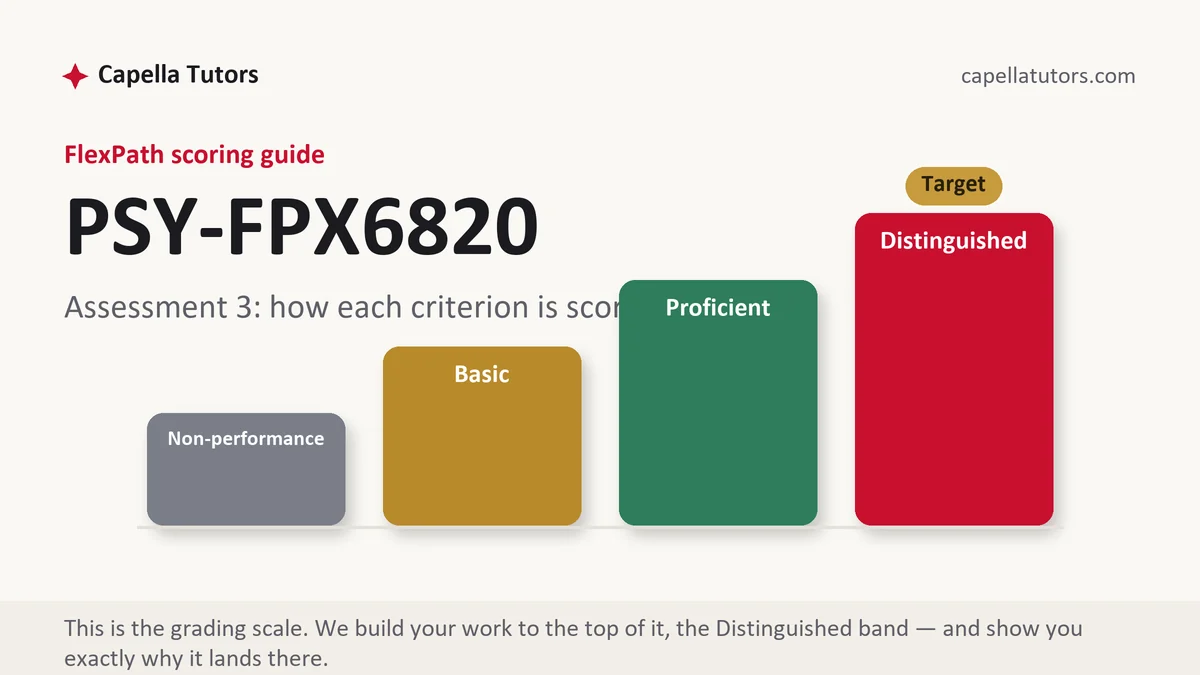
PSY-FPX6820 Assessment 3 grading scale at Capella FlexPath, the criterion levels this assessment is scored on, from Capella Tutors
How Capella FlexPath grades PSY-FPX6820 Assessment 3, visualized by Capella Tutors.

How PSY-FPX6820 Assessment 3 is scored

Four levels, one per criterion, and the top level almost always asks for a move beyond completeness rather than more words:

LevelWhat it means on a full program with an evaluation design
DistinguishedThe program is periodized against a real calendar, the evaluation could detect its own failure, and the appraisal separates the strength of the recommendation from the strength of the evidence. Uncertainty is stated as a quantity, not as a disclaimer.
ProficientA coherent program with a baseline, a target and measurement points. Everything present, with the appraisal reading as summary rather than judgment.
BasicTechniques, a schedule and a promise to review progress. The evaluation section names no measure the athletes did not produce for themselves.
Non-performanceThe evaluation design or the baseline is absent, which is the single most common way this deliverable falls to the floor rather than merely losing a level.

Team-level programs raise the bar on attribution rather than lowering it. More people means more things happening at once, so the design has to give the evaluator a reason to believe the change followed the intervention rather than the season.

The PSY-FPX6820 Assessment 3 method, step by step

  1. Assemble the program from the needs finding, not from a menu

    Open by restating what the assessment established, then let the technique list follow from it. Where a squad-level need drives the plan, say which athletes it applies to and which it does not, because a program delivered to everybody for a problem some of them do not have will dilute any effect you hope to see.

  2. Choose the construct you will measure and cite its instrument

    Group cohesion has a measurement literature: Carron, Widmeyer and Brawley built the Group Environment Questionnaire on a model that separates task from social cohesion and individual attraction from group integration. Name the subscale you are tracking, its range, and what a one-point movement on it would mean.

  3. Pair the psychological measure with a performance measure

    Report both, and keep them apart. Later meta-analytic work by Carron and colleagues reports a positive association between cohesion and performance whose direction runs both ways, so a squad that starts winning becomes more cohesive as readily as the reverse. Two measures let you show which moved first.

  4. Design for attribution with the tools a season allows

    You will not get randomization. You can get a stable multi-session baseline, a staggered start across two units of the squad, and repeated measurement on a fixed schedule. An effect that appears in each unit only after the program reaches it is far harder to explain by maturation or by fixture difficulty.

  5. Report the result with an interval and a denominator

    Give the change, the number of athletes it was computed from, the window, and an interval around the estimate. A mean difference whose interval includes zero has told you the study was too small to settle the question, which is a finding, and writing it that way scores better than rounding it into success.

  6. Appraise the field, then recommend anyway

    Say what the intervention literature is: many small samples, packages that confound their own components, and no blinding worth the name. Then recommend, on grounds of consistent direction, low risk and low cost, and self-score every criterion before submitting.

A structure that maps to the criteria

Lengths here are our planning targets for a squad-level program; your guide governs the section list and may want the appraisal carried longer.

SectionWhat it must doGuide word target
Program rationaleThe need restated as a measure, who the program applies to, and the outcome it is built to move.~200 words
Program contentTechniques by phase, each with its function, the session structure, and the athlete's independent work.~350 words
PeriodizationThe program laid against the competitive calendar, with load-heavy weeks and travel accounted for.~200 words
Evaluation designBaseline, target outside the baseline spread, measurement schedule, the staggered start, and the psychological and performance measures kept separate.~350 words
Appraisal and limitsWhat the evidence base supports, what the design cannot rule out, and the recommendation with its grounds stated.~250 words
ReferencesCurrent APA, measurement papers for the instrument, primary trials for effects, reviews only to frame the question.as needed

Annotated sample excerpt

An original model paragraph written by our team to show what honest reporting looks like when the result is inconclusive. Take the moves and apply them to your own numbers.

Sample excerpt: evaluation and reporting Original model · Capella Tutors

Task cohesion was recorded on the same nine-point subscale at four points across the season for both units of the constructed squad, with the defenders beginning the program in week three and the midfield in week six, so that any movement could be checked against the week the program arrived rather than against the calendar alone.1 Across the 22 athletes who completed all four administrations, the mean subscale score moved from 6.1 to 6.7, a difference of 0.6 points with a 95 percent confidence interval running from minus 0.1 to 1.3.2 An interval that crosses zero means this squad was too small to settle the question, and the honest reading is that the program was followed by a shift in the expected direction on a measure whose uncertainty is wider than the shift itself.3

  • 1The design is stated before the result, including the staggered start. An evaluator who reaches the number already knows how much weight it can carry.
  • 2Denominator, measurement points, scale range, effect and interval, in one sentence. Note that the 22 completers are reported rather than the squad list, because the analysis used the smaller number.
  • 3Says what the interval means instead of hiding behind it, and keeps the verb at followed rather than improved. Reporting an inconclusive result cleanly is graded above reporting a flattering one loosely.

The full premium sample for your exact assessment, written fresh to your scoring guide and issue, is free to request. Study it, revise it into your own voice, and submit work you understand.

Get the full sample free

The five mistakes that cost Distinguished

  • A single post-program measure. One reading at the end cannot say when anything changed, and it leaves every rival explanation standing.
  • Cohesion treated as a cause. The association runs in both directions, so a paper that reads cohesion into performance without acknowledging the reverse path has misread the literature it cites.
  • A significance test doing the interval's job. A p value cannot tell a reader how large the change was or how precisely it was estimated, and in a squad of this size that is the whole question.
  • Feedback forms presented as outcome data. Athletes reporting that they enjoyed the sessions establishes acceptability, and acceptability is not a result.
  • A calendar the program ignores. A plan that schedules acquisition work through a tournament week will fail on adherence, and the criterion notices before the athletes do.

Pre-submission checklist

  • Program content traced back to a stated need for the athletes receiving it
  • Named instrument with its subscale, range and source
  • Psychological and performance measures reported separately
  • Baseline over several sessions, with a target set outside its spread
  • Result given with a denominator and an interval, and the verb matched to the design
  • Appraisal that separates the strength of the recommendation from the strength of the evidence

Program and evaluation to build?

Send the guide, the squad or athlete, and the competitive calendar. Our eight-person pipeline returns a premium original sample in 24 to 48 hours with the periodization, the measurement schedule and the interval arithmetic already in place, revised at no charge until every criterion is met.

Keep going

Online now