This manual is for PSY-FPX6820 Assessment 2, start to submission. The middle deliverable in Performance Enhancement in Sports is the application one, and the assessment usually asks you to select psychological skills for a stated demand, justify each choice by mechanism and by evidence, and specify how the work would be delivered week by week. Everything is scored against the criteria printed in your own guide, one level per criterion, and the writing stays at graduate applied register inside a non-licensure program. What follows is our tutors' method, a criterion-mapped structure, and an annotated excerpt with the reasoning marked. Would you rather delegate it? A premium original sample built to your prompt returns in 24 to 48 hours with free revisions until the criteria are met. Your courseroom may print this as PSY FPX 6820 Assessment 2 or PSY6820 Assessment 2; it is the same deliverable, and PSY-FPX6820 Assessment 2 is what this manual walks through.
One honesty note before the manual: Capella revises courses and scoring guides over time, so always write to the exact scoring guide attached to your assessment in the courseroom. The course identity above is verified on capella.edu; the method and structure below are our tutors' approach to it, not Capella's official rubric text.
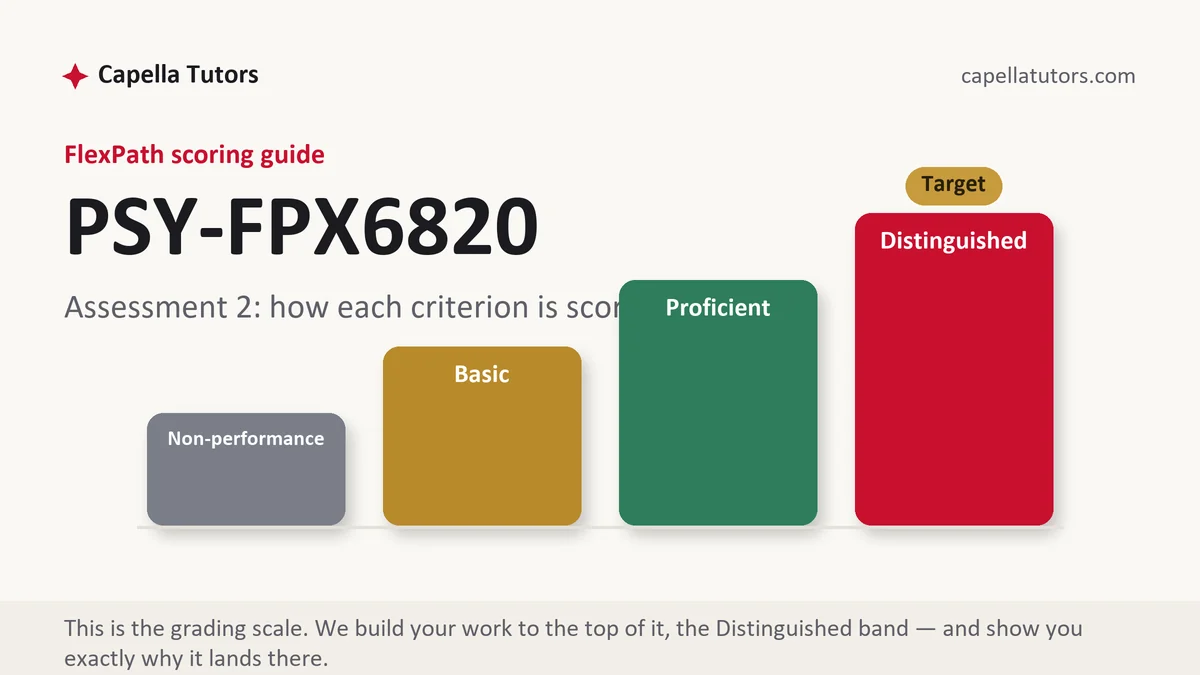
How PSY-FPX6820 Assessment 2 is scored
Each criterion is judged on its own and settles at one of four levels, so a paper can be Distinguished on justification and Basic on delivery in the same submission:
| Level | What it means on a technique selection and delivery plan |
|---|---|
| Distinguished | Each technique is paired to a demand by a named mechanism, the supporting evidence is reported at the strength its design allows, and the delivery schedule survives a missed week. The rejected alternative is named and its rejection explained. |
| Proficient | Techniques are appropriate, justified with citations and scheduled coherently. Complete work with the mechanism sentence left implicit. |
| Basic | Techniques defined correctly and attached to the athlete by assertion, with a schedule that says weekly and stops there. This is the glossary failure in its second form. |
| Non-performance | A required element never appears, most often the delivery detail or the evidence behind one technique. A criterion with nothing to read scores at the floor. |
The other thing this deliverable is quietly graded on is whether the plan is deliverable by somebody other than you. Session length, who runs it, what the athlete does alone, and how adherence is recorded are the details that turn a proposal into a program.
The PSY-FPX6820 Assessment 2 method, step by step
-
Restate the demand in one sentence before choosing anything
Write the task demand as a physical description: closed or open skill, precision or force, self-paced or reactive, low or high physical load. Every later justification hangs off that sentence, and a technique chosen before the demand is written is a preference wearing a citation.
-
Match cue type to task type on the evidence, not on optimism
The self-talk meta-analytic work by Hatzigeorgiadis and colleagues separates instructional cues, which suit fine and precision-dependent tasks, from motivational cues, which suit gross force and endurance efforts. Say which you are using and why the task class calls for it. General positive thinking is not a technique.
-
Build imagery from its elements and give it one function
Holmes and Collins set out the physical, environmental, task, timing, learning, emotion and perspective elements that a script has to specify. Decide first whether the imagery rehearses mechanics or regulates arousal, because the script, the timing and the outcome you later measure all change with that choice.
-
Put attention where the movement is, then routinize it
Wulf's program of work on attentional focus reports an advantage for attending to the effect of a movement over the body part producing it, across a range of tasks and skill levels. Convert that into a cue the athlete can say in three words, and anchor it inside a pre-performance routine with a fixed count.
-
Write the schedule as a calendar, including the coach's part
Education, acquisition and rehearsal under competitive conditions is the standard teaching sequence, and each phase needs dates, session lengths and a named deliverer. Where a coach carries the cue into practice, their wording is part of the intervention and belongs in the plan in quotation marks.
-
Grade your own evidence sentences, then self-score
For each cited effect, check that you reported what was measured, in whom, and how large the effect was rather than only that it was significant. Then score every criterion yourself against the guide, repair anything below the top level, and submit early in the week so an evaluation returned with one gap still leaves you room.
A structure that maps to the criteria
Use these lengths as planning arithmetic rather than as rules, and expand any section your own guide weights more heavily.
| Section | What it must do | Guide word target |
|---|---|---|
| Demand analysis | The skill described in physical terms, the competitive setting, and the specific failure the plan is built to address. | ~200 words |
| Technique selection | Each chosen technique with the demand it answers, the mechanism expected to do the work, and the evidence for that pairing. | ~400 words |
| The rejected option | One plausible technique you did not select, and the reason the demand does not call for it. | ~120 words |
| Delivery plan | Phases with dates, session length and frequency, who delivers each part, the athlete's independent practice, and how adherence is recorded. | ~350 words |
| Coach and environment | What the coach says and does differently, how that language was agreed, and what happens if it is not followed. | ~180 words |
| References | Current APA, primary technique papers rather than summaries, effect sizes reported as the source reported them. | as needed |
Annotated sample excerpt
A short original model from our writers, showing how a justification paragraph carries its own evidence honestly. Study the structure and write your own version around your athlete.
The tumble turn is a closed, self-paced, precision-dependent skill performed under moderate physical load, which is the task class in which instructional cues have the better support, so the plan attaches a three-word cue to the moment of tuck rather than a general encouragement to attack the wall.1 The cue is delivered by the coach in the wording agreed at the planning meeting, quoted here as chin to chest, and delivered on entry to the final stroke rather than after the turn, because feedback arriving during the next repetition competes with the movement it is meant to shape.2 Across the reviewed self-talk trials the average effect on skill-based tasks is small to moderate, drawn largely from samples of a few dozen athletes with no blinding, which supports the pairing without promising a time drop.3
- 1Opens with the demand in physical terms, then derives the technique from it. The order of those two clauses is what the justification criterion is reading for.
- 2Specifies the delivery down to the words and the timing, and gives the mechanism for the timing choice. A plan somebody else could run is the mark of the delivery criterion at the top level.
- 3Reports the evidence at the size and the quality its design allows, then states what it does not promise. Overclaiming here costs more credit than citing a smaller effect.
The full premium sample for your exact assessment, written fresh to your scoring guide and issue, is free to request. Study it, revise it into your own voice, and submit work you understand.
The five mistakes that cost Distinguished
- Technique first, demand never. A plan that opens on imagery and works backwards to a justification leaves the reader unable to test whether the pairing was reasonable.
- Imagery written as picture the win. Without timing, physical position, perspective and a stated function, the script has dropped the elements the evidence is actually attached to.
- Cue wording left to the coach. If the exact phrase and the moment it is spoken are not in the document, two people will deliver two different interventions.
- A schedule that says regularly. Frequency, duration, deliverer and a record of adherence are the four details the delivery criterion looks for, and regularly supplies none of them.
- Significance reported instead of size. A finding described only as significant tells a reader nothing about whether the effect matters to a swimmer with a half-second problem.
Pre-submission checklist
- The task demand is written in physical terms before any technique appears
- Each technique carries a demand, a mechanism and a primary citation
- One rejected technique named, with the reason for rejecting it
- Session length, frequency, deliverer and adherence record all specified
- Cue wording quoted exactly, with the moment of delivery stated
- Every cited effect reported at its size and with its sample described
Delivery plan that has to hold up?
Send the prompt, the guide, the sport and the skill. Eight people touch every draft, one of them doing nothing but checking that each cited effect is reported at the size its source reported, and the sample comes back inside 24 to 48 hours with revisions free until the criteria are satisfied.