How to write PSY-FPX6820 Assessment 1

The short answer

This manual is for PSY-FPX6820 Assessment 1, start to submission. The first deliverable in Performance Enhancement in Sports sits at the analysis end of the course, and the assessment usually asks you to establish what an athlete actually needs and to convert that finding into goals a reader could check, before a single technique is selected. It is graded the FlexPath way, criterion by criterion against the guide attached to your own courseroom, and it is master's work inside a non-licensure degree, so the register stays applied and measured rather than clinical. The method our tutors run on it, a structure keyed to the criteria, and an annotated sample excerpt all follow below. Prefer to hand it off? A premium original written to this exact prompt returns inside 24 to 48 hours, and the revisions until it meets the guide cost nothing. Your courseroom may print this as PSY FPX 6820 Assessment 1 or PSY6820 Assessment 1; it is the same deliverable, and PSY-FPX6820 Assessment 1 is what this manual walks through.

One honesty note before the manual: Capella revises courses and scoring guides over time, so always write to the exact scoring guide attached to your assessment in the courseroom. The course identity above is verified on capella.edu; the method and structure below are our tutors' approach to it, not Capella's official rubric text.
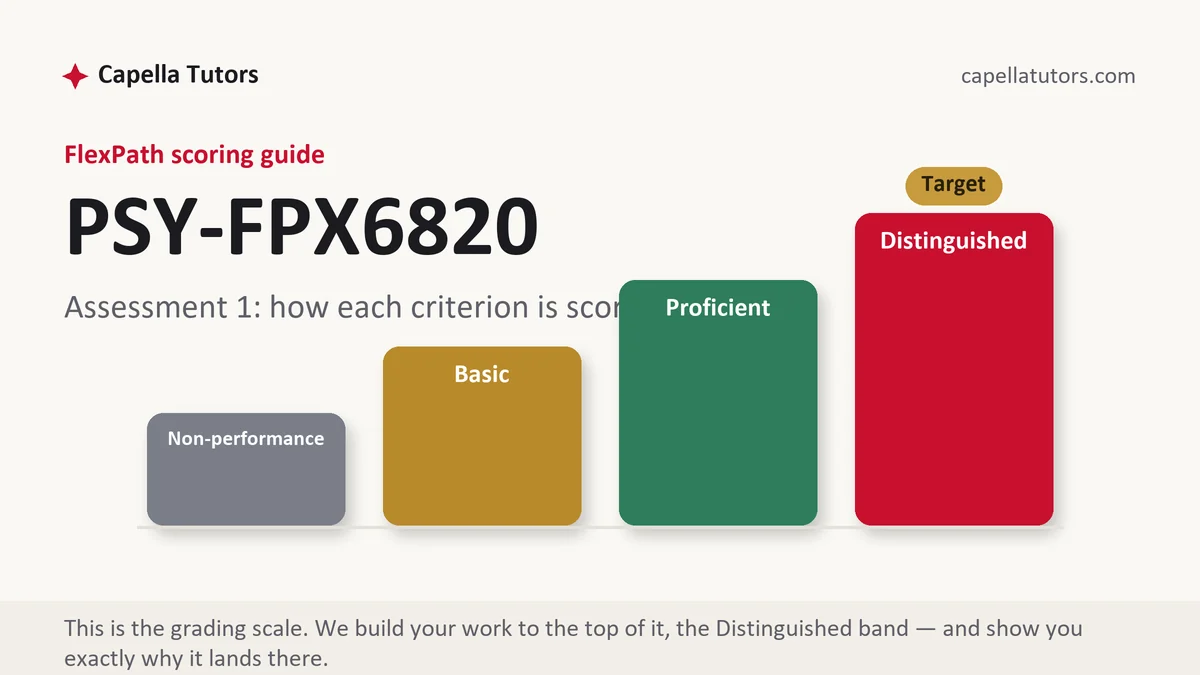
PSY-FPX6820 Assessment 1 grading scale at Capella FlexPath, the criterion levels this assessment is scored on, from Capella Tutors
How Capella FlexPath grades PSY-FPX6820 Assessment 1, visualized by Capella Tutors.

How PSY-FPX6820 Assessment 1 is scored

FlexPath replaces the letter grade with four levels per criterion, and the wording of those levels is the only writing brief that counts:

LevelWhat it means on a needs assessment and goal plan
DistinguishedThe need is traced to evidence a reader can inspect, the goals separate outcome from performance from process, and the paper states what the assessment could not establish. That last clause is written into the criterion; find it and supply it.
ProficientThe need is identified and the goals are specific, measurable and complete. Sound work that stops one move short of the top of the guide.
BasicA profile of the athlete with goals attached, where the link between the two is asserted rather than shown. That is where most first attempts in this course settle.
Non-performanceA required element is missing, most often the baseline measure or the process layer of the goals. A criterion falls to the floor for something being absent rather than for being thin.

Treat the output of this deliverable as the input to everything after it. A need stated as a number carries forward into technique justification and into an evaluation design, while a need stated as an adjective has to be rebuilt later under time pressure.

The PSY-FPX6820 Assessment 1 method, step by step

  1. Turn the criteria into headings before you read the prompt twice

    The prompt describes a document; the criteria decide the score. Paste each criterion into your outline as a heading, keep its top-level descriptor underneath while you draft, and delete any paragraph that answers none of them. Anything outside that outline is unpaid work.

  2. Pick an athlete whose problem has a countable form

    Choose a sport and a skill where performance leaves a record: attempts, splits, coded video, error counts. A constructed case is normally acceptable and often cleaner, because you can specify the record. If the problem cannot be counted, the evaluation criterion later in the course has nothing to attach to.

  3. Assess with three sources before you conclude with one

    Interview the athlete, observe or code performance, and add one validated instrument if the guide allows it. Say what each source contributes and where they disagree. A needs assessment that reports only what the athlete said is an interview, and one that reports only the numbers has thrown away the athlete's account of why.

  4. Do the baseline arithmetic in front of the reader

    Give the denominator with every rate, the window the data cover, and the spread rather than the mean alone. Five sessions of the same measure tell you what this athlete produces unaided, and any later improvement inside that spread is noise. Name the instrument, the conditions and the person who recorded it.

  5. Write goals in three layers, and make the process layer physical

    Locke and Latham established that specific and difficult goals outperform vague or easy ones, which is the reason the guide separates the layers. Outcome goals depend on opponents, performance goals are measured against this athlete's own record, and process goals name what the body will do differently on the next repetition.

  6. Audit your verbs, then self-score

    Read every finding sentence and ask whether the design supports the verb. Observation and interview data support words like accompanied, preceded and was associated with; they do not support caused. Then mark each criterion yourself as Distinguished, Proficient, Basic or Non-performance, and rewrite anything below the top before you submit.

A structure that maps to the criteria

The targets below are planning figures our tutors use for a needs assessment of this size, not Capella requirements; your scoring guide decides what has to be there and how long it runs.

SectionWhat it must doGuide word target
Athlete and contextWho the athlete is, the competitive level, the skill in question, and the reason an assessment was requested now.~150 words
Assessment methodThe interview questions and why each one is there, what was observed and how it was recorded, and any instrument with its purpose.~300 words
Findings as measuresThe baseline with denominators, windows and spread, the athlete's own account, and the point at which the two converge.~350 words
Goal architectureOutcome, performance and process goals, each with a timeframe, a target set outside the baseline spread, and a check.~300 words
Limits of the assessmentWhat this method could not establish, the alternative explanation for the pattern, and what you would measure next.~150 words
ReferencesCurrent APA, primary sources for the goal and assessment frameworks, measurement papers for any instrument.as needed

Annotated sample excerpt

An original model paragraph from our team, pitched at the register the top of the guide rewards.

Sample excerpt: findings stated as measures Original model · Capella Tutors

Across six recorded games this Division II hitter took 41 plate appearances, 23 of which reached a two-strike count, and on those 23 she put the ball in play 9 times, a contact rate of 39 percent against 61 percent on the same measure earlier in the count.1 The interview and the coded video point at the same moment from different directions: she reports rehearsing the strikeout during the pitcher's windup, and the footage shows her stride beginning later on two-strike pitches in 17 of those 23 appearances.2 The late stride and the reported thought are associated with the drop and neither establishes it, so the goal plan below targets the stride, which is observable, and treats the thought as a mechanism to be tested rather than assumed.3

  • 1Every rate arrives with its denominator and its window, so an evaluator can recompute the figures. That is all a measured finding takes.
  • 2Two sources of evidence, kept apart and allowed to agree only where they do. Merging self-report into observation loses the ability to say which one carries the finding.
  • 3Names the inference the design supports and no more, then turns the limit into a design decision. This is usually what separates a graduate assessment from a coaching report.

The full premium sample for your exact assessment, written fresh to your scoring guide and issue, is free to request. Study it, revise it into your own voice, and submit work you understand.

Get the full sample free

The five mistakes that cost Distinguished

  • A profile in place of an assessment. Background, personality and training history are context; without a measure of the performance problem there is no finding for the goals to answer.
  • A percentage with no denominator. A 39 percent contact rate means one thing over 23 attempts and another over 400, and an evaluator who cannot tell will not credit the number.
  • Goals that only name a result. Winning the conference series is a wish, not a goal an athlete can act on during the next repetition, and a plan built from results alone teaches nothing.
  • Causal verbs on correlational evidence. Interview and video data cannot show that a thought produced a movement, and one word carries that error into the appraisal criterion.
  • An instrument reported as decoration. A questionnaire score with no scale range, no interpretation and no comment on what it measures reads as a citation performing a job it cannot do.

Pre-submission checklist

  • Every criterion in the scoring guide has its own labeled section
  • Each rate carries a denominator, a measurement window and the spread across sessions
  • Three assessment sources named, with what each contributed stated separately
  • Goals split into outcome, performance and process, with targets outside the baseline spread
  • Every finding verb matched to what an observational design can support
  • Self-scored Distinguished on each criterion, with the limits section written by you

Needs assessment due this week?

Send the scoring guide, the sport and whatever performance record you have. A team of eight, including a research analyst and two QA reviewers, returns a premium original sample written to the top descriptor in 24 to 48 hours, with free revisions until it lands there. The baseline arithmetic arrives already done, because that is the part faculty read twice.

Keep going

Online now