This manual is for PSY FPX 6740 Assessment 3, start to submission. Assessment 3 of PSY FPX 6740, Industrial/Organizational Psychology Practices in Personnel and Human Resource Management, is the training and evaluation deliverable: a needs assessment run at three levels, a design whose transfer is planned rather than hoped for, and an evaluation that reaches behavior instead of stopping at applause. Master's credit here rests on how you report, so denominators, windows, an effect with an interval around it, and the difference between associated and caused all get graded. Below is the working order our psychology desk uses, a structure that answers the criteria, and an annotated excerpt of an evaluation section. Prefer to have it built for you? A premium original sample for this exact deliverable comes back inside 24 to 48 hours, revised at no cost until the descriptors are met. Capella's catalog lists the course as PSY-FPX6740, and some courserooms print PSY6740; both point to this same Assessment 3.
One honesty note before the manual: Capella revises courses and scoring guides over time, so always write to the exact scoring guide attached to your assessment in the courseroom. The course identity above is verified on capella.edu; the method and structure below are our tutors' approach to it, not Capella's official rubric text.
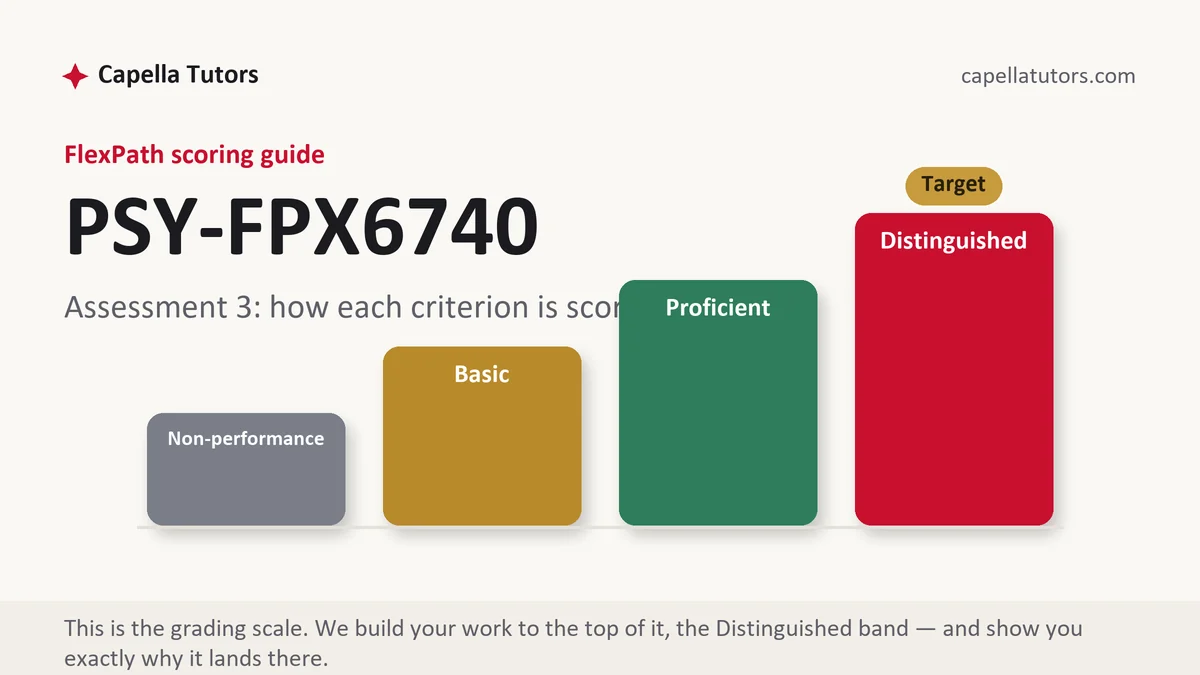
How PSY FPX 6740 Assessment 3 is scored
Criteria, not scores, are what come back. Each one is set at one of four levels, and the top level reads as a reporting standard:
| Level | What it means on a training design and evaluation deliverable |
|---|---|
| Distinguished | Needs are established at organization, task and person level, transfer support is designed into the workplace, results carry denominators, windows and an interval around the effect, and the causal language matches the design that produced the data. |
| Proficient | A sound design evaluated beyond reaction, with results reported accurately and no interval or rival explanation offered. |
| Basic | A curriculum proposed from an assumed need and judged by satisfaction scores and a completion rate. Extremely common in this deliverable and capped by its own evidence. |
| Non-performance | A required element never appears, most often the needs assessment itself or any measure above the learning level. |
One reporting habit carries most of these criteria. Give the number of people the figure refers to, the moment it was taken, and the range the estimate could plausibly occupy.
The PSY FPX 6740 Assessment 3 method, step by step
-
Run the needs assessment at all three levels
McGehee and Thayer set the tradition: what the organization requires, what the task demands, and what this person lacks. Skipping the organizational level produces a course nobody needed, and skipping the person level produces one everybody sits through twice. Report what you found at each level, including the level where you found nothing.
-
Design for the workplace, not the classroom
Baldwin and Ford framed transfer as the point where most programs fail, and the constraint is usually the supervisor and the schedule rather than the content. Write the supervisor briefing, the protected practice time and the follow-up prompt into the design as named components with owners.
-
Plan the evaluation before the first session
Kirkpatrick's reaction, learning, behavior and results give you four levels, and the honest note is that reaction data barely predicts the other three. Decide now which levels you will measure, with what instrument, at what interval after the program, and who observes the behavior.
-
Report every figure with its denominator and its window
Twenty-three of sixty-four at 120 days and twenty-three of forty-one still in role at 120 days are different claims about the same people. Give the count, the base, the date, and the subgroup sizes for any comparison you draw, and reconcile every base that changes between one paragraph and the next.
-
Give the effect an interval, and say what the p value cannot
A difference in proportions deserves the difference itself and a confidence interval around it, because the interval is what tells a reader how precise the estimate is. A p value speaks to how surprising the data would be under a null hypothesis; it does not report the size of the effect, the probability that your explanation is right, or the importance of the finding to the organization.
-
Match the verb to the design, then self-score
Groups that chose to participate cannot support caused, produced or drove, however large the gap. Write associated with, then name the rival explanation and the design that would settle it. Then mark each criterion D, P, B or N and revise before submitting inside a session that does not extend.
A structure that maps to the criteria
Lengths below are planning figures from our psychology desk for an evaluation deliverable, not Capella requirements; expand whichever section your guide weights hardest.
| Section | What it must do | Guide word target |
|---|---|---|
| Needs assessment | Organization, task and person level findings, with the method and the data behind each. | ~300 words |
| Program design | Objectives written observably, the content, the sequence, and who delivers what. | ~250 words |
| Transfer plan | Supervisor involvement, protected practice, follow-up prompts, and the owner of each. | ~250 words |
| Evaluation plan | The levels measured, the instruments, the intervals, the observers, and the harm measure. | ~250 words |
| Results and interpretation | Counts with bases and windows, an interval around the effect, and verbs the design supports. | ~300 words |
| Business case and references | The value argued in currencies the employer tracks, with assumptions listed and APA sourcing. | ~200 words |
Annotated sample excerpt
An original model excerpt from our team, showing how an evaluation paragraph reports a finding it is not entitled to explain.
Sixty-four of the transit authority's 96 first-line supervisors completed the program in two cohorts, mean reaction was 4.5 of 5 and the knowledge test rose from 58 percent to 79 percent, which is where an evaluation report usually stops and declares success.1 Observed use of the structured coaching conversation at 120 days tells a different story: 23 of the 64 completers, or 36 percent, with 17 of the 29 whose depot managers attended a briefing against 6 of the 35 whose managers did not.2 That is a difference of 42 percentage points with a 95 percent confidence interval running from roughly 20 to 63 points, wide because the subgroups are small, and it is an association between briefing and observed behavior rather than a demonstration that briefing produced it, since depots volunteered their managers and the volunteering depots differ from the others in ways this design never measured.3
- 1Reports reaction and learning honestly, with the completion base attached, and names the trap of stopping there instead of walking into it.
- 2Moves to observed behavior with the window, the count, the base and both subgroup denominators, so the comparison can be checked line by line.
- 3Gives the effect an interval, explains why the interval is wide, then keeps the verb inside what a self-selected comparison can support.
The full premium sample for your exact assessment, written fresh to your scoring guide and issue, is free to request. Study it, revise it into your own voice, and submit work you understand.
The five mistakes that cost Distinguished
- Satisfaction reported as an outcome. A room that enjoyed the session tells you very little that is reliable about behavior four months later.
- A design with no transfer components. Content delivered into an unchanged workplace is the standard way a good program produces nothing.
- Percentages without their base. A figure whose denominator moves between paragraphs cannot be reconciled, and the reporting criterion is scored on exactly that.
- An effect with no interval. A point estimate from two small subgroups implies a precision the data does not have.
- A p value doing work it cannot do. Significance is not an effect size, not a probability that your account is correct, and not evidence that the change mattered.
Pre-submission checklist
- Needs established at organization, task and person level, each with its method
- Objectives written so an observer could tell whether they were met
- Transfer components named with owners, not implied by the curriculum
- Evaluation levels, instruments, intervals and observers all fixed in advance
- Every count paired with its base and its measurement window, and every base reconciled
- An interval around the effect, association verbs where the design requires them, every criterion self-scored D
Training evaluation due and the numbers look flattering?
Send the scoring guide with whatever reaction, test and observation data you hold. A team of eight, including a research analyst and two quality reviewers, returns a premium original sample inside 24 to 48 hours, and one pass exists purely to recompute every rate and interval the draft prints. Revisions run until the criteria clear.