How to write PSY-FPX6740 Assessment 2

The short answer

This manual is for PSY-FPX6740 Assessment 2, start to submission. Assessment 2 of PSY-FPX6740, Industrial/Organizational Psychology Practices in Personnel and Human Resource Management, is the performance management deliverable: a purpose decided before a format, raters treated as the instrument they are, and a documentation trail that would survive a challenge. The graduate move here is small and rarely made, which is to stop recommending a rating form and start recommending the three decisions that surround it. Below is the order our psychology desk works in, a structure that answers the criteria, and an annotated excerpt of a redesign rationale. Would you rather not draft it yourself? A premium original sample for this exact deliverable returns inside 24 to 48 hours and is reworked at no cost until the descriptors are met. Your courseroom may print this as PSY FPX 6740 Assessment 2 or PSY6740 Assessment 2; it is the same deliverable, and PSY-FPX6740 Assessment 2 is what this manual walks through.

One honesty note before the manual: Capella revises courses and scoring guides over time, so always write to the exact scoring guide attached to your assessment in the courseroom. The course identity above is verified on capella.edu; the method and structure below are our tutors' approach to it, not Capella's official rubric text.
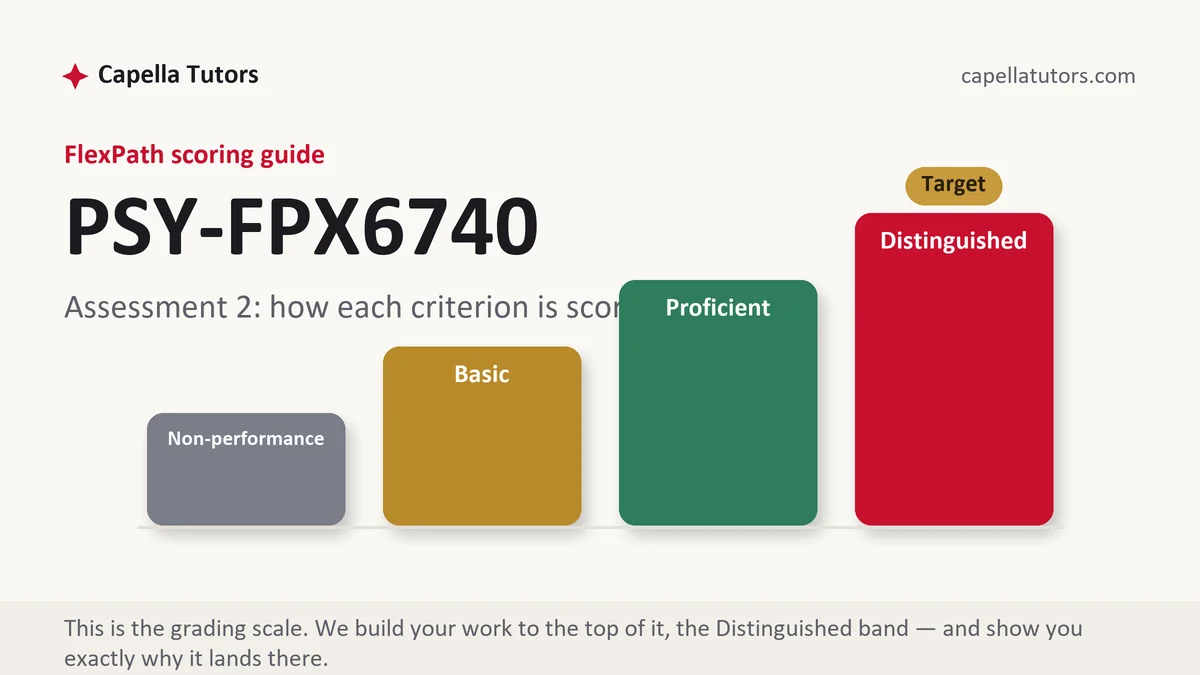
PSY-FPX6740 Assessment 2 grading scale at Capella FlexPath, the criterion levels this assessment is scored on, from Capella Tutors
How Capella FlexPath grades PSY-FPX6740 Assessment 2, visualized by Capella Tutors.

How PSY-FPX6740 Assessment 2 is scored

There is no grade point to accumulate. Each criterion is placed at one of four levels, and the highest one describes the appraisal system your paper has to build:

LevelWhat it means on a performance management deliverable
DistinguishedAdministrative and developmental purposes are separated on purpose, rater training is specified rather than mentioned, sources of rating are chosen with a rule for disagreement, and the rating errors the design invites are named.
ProficientA coherent system with a defensible format and a purpose stated once. Correct, and short of the top by the rater and the source decisions.
BasicA rating scale recommended on its merits, with purpose, raters and documentation treated as implementation detail. Very common, and capped low by design.
Non-performanceSomething the guide requires is not present at all, most often the rater training plan or the documentation trail.

Keep private records out of a course document. Aggregate anything drawn from a real employer, keep individual pay and disciplinary detail outside the file, and describe a person by role rather than by name.

The PSY-FPX6740 Assessment 2 method, step by step

  1. Decide the purpose first, and keep the purposes apart

    An appraisal built to allocate pay and an appraisal built to develop skill pull against each other, and asking one conversation to serve both is why so many systems produce inflated ratings and no usable feedback. Write which purpose your design serves, and say where the other conversation happens instead.

  2. Choose a format, then stop defending it

    Behaviorally anchored rating scales, developed by Smith and Kendall, exist to replace adjectives with concrete behavioral anchors, and a simple behavior-frequency scale is defensible too. Give one paragraph to the format and spend the rest of the section on the decisions that actually move rating quality.

  3. Train the raters, because the rater is the instrument

    Specify frame-of-reference training with its length, its practice material and who delivers it, since an untrained instrument drifts. Name the errors your design invites, which are usually halo, leniency, central tendency and recency, and say what in the process is meant to catch each one.

  4. Choose the sources, and write the disagreement rule

    A manager who sees a third of the work needs input from the people who see the rest, so decide whether peers, internal customers or project leads contribute. Then decide in advance what happens when two sources disagree, because a multi-source design without that rule collapses into whichever rater is loudest.

  5. Handle a forced distribution as a claim about a distribution

    Imposing a curve on a team of eight assumes that team has a distribution it has no reason to have. If your scenario runs one, argue against it with the team sizes in front of you, and propose calibration between managers as the alternative to arithmetic between them.

  6. Write the documentation trail, then self-score

    Say what is recorded, by whom, when, and what an employee is entitled to see, because a system whose evidence lives in one manager's memory cannot be defended later. Then mark every criterion D, P, B or N yourself and rewrite anything below the top before you submit.

A structure that maps to the criteria

Targets below are planning figures our psychology desk uses for an appraisal deliverable, not Capella requirements; scale them to your own guide.

SectionWhat it must doGuide word target
The current system and its faultsHow performance is rated today, with team sizes, cycle length and the observed rating pattern.~250 words
PurposeThe purpose this system serves, what it will not serve, and where the other conversation lives.~200 words
Format and criteriaThe scale, its anchors, the performance dimensions rated, and their link to job documentation.~250 words
Raters and sourcesWho rates, what training they receive, and the rule that resolves disagreement between sources.~300 words
Documentation and appealWhat is recorded and retained, what the employee sees, and how a disputed rating is reviewed.~250 words
Evidence and referencesPeer-reviewed support described by design, primary sources under their own dates, current APA.~200 words

Annotated sample excerpt

An original model excerpt from our team, showing how a redesign rationale reads when it is written to the top descriptor rather than around it.

Sample excerpt: the case for the redesign Original model · Capella Tutors

The division employs 210 engineers in nineteen teams with a median team size of eight, and the current cycle requires each manager to place ten percent of a team in the lowest of five bands, which last year meant 21 people across a population where 71 percent had been rated in the top two bands before the curve was applied.1 A curve is a claim that a distribution exists, and in a team of eight it is a claim no manager can support from eight observations, so the redesign replaces the quota with a calibration session in which the nineteen managers rate four written work samples against the same anchors before rating anyone they employ.2 Ratings did become less compressed in the two divisions that ran calibration first, from 71 percent in the top two bands to 54 percent over a single cycle, and that is an association across two self-selected divisions in one twelve-month window rather than evidence that calibration produced the change.3

  • 1Establishes headcount, team size, the quota and the pre-existing rating pattern in one sentence, so the problem is quantified before it is criticized.
  • 2Attacks the forced distribution as a statistical claim rather than as an unpopular policy, then names the replacement with its mechanics.
  • 3Reports the change with both figures and the window, then refuses the causal verb and says why. Self-selected units cannot carry a claim about what produced what.

The full premium sample for your exact assessment, written fresh to your scoring guide and issue, is free to request. Study it, revise it into your own voice, and submit work you understand.

Get the full sample free

The five mistakes that cost Distinguished

  • Pay and development in one conversation. A design that never separates the purposes has guaranteed inflated ratings and called it a process.
  • Rater training mentioned rather than specified. Without length, content and a deliverer, the training is an intention and the criterion reads it that way.
  • Multi-source input with no disagreement rule. Collecting four views and staying silent about conflict moves the decision to whoever speaks last.
  • A curve accepted as given. Small teams have no reason to hold the distribution the quota assumes, and the paper that notices this scores above the paper that complies.
  • Ratings improved and a cause announced. A before-and-after across units that chose to participate supports an association and nothing stronger.

Pre-submission checklist

  • The purpose of the system stated, with the other purpose given somewhere else to live
  • Performance dimensions traced back to job documentation rather than to the form
  • Frame-of-reference training specified with length, material and deliverer
  • Rating sources chosen, with a written rule for handling disagreement
  • Documentation, retention and appeal all described, with people identified by role
  • Relational claims kept in association language, and every criterion self-scored D

Appraisal redesign due?

Send the scoring guide, the team structure, and how ratings work today. A team of eight, including a research analyst and two quality reviewers, returns a premium original sample inside 24 to 48 hours with the purposes separated and the rater plan written out. Revisions are included until the criteria clear.

Keep going

Online now