How to write PSY-FPX6740 Assessment 1

The short answer

This manual is for PSY-FPX6740 Assessment 1, start to submission. Assessment 1 of PSY-FPX6740, Industrial/Organizational Psychology Practices in Personnel and Human Resource Management, puts a staffing system on trial: a role documented through job analysis, a selection sequence justified hurdle by hurdle, and a value estimate whose assumptions are printed beside it. Master's credit is not awarded for describing what employers usually do, but for saying what each step measures and what happens to an applicant when it measures badly. Below is the sequence our psychology desk works in, a structure that answers the criteria, and an annotated excerpt of a utility argument. Want it lifted off your week? A premium original sample for this exact deliverable lands inside 24 to 48 hours, revised free until every descriptor is satisfied. Your courseroom may print this as PSY FPX 6740 Assessment 1 or PSY6740 Assessment 1; it is the same deliverable, and PSY-FPX6740 Assessment 1 is what this manual walks through.

One honesty note before the manual: Capella revises courses and scoring guides over time, so always write to the exact scoring guide attached to your assessment in the courseroom. The course identity above is verified on capella.edu; the method and structure below are our tutors' approach to it, not Capella's official rubric text.
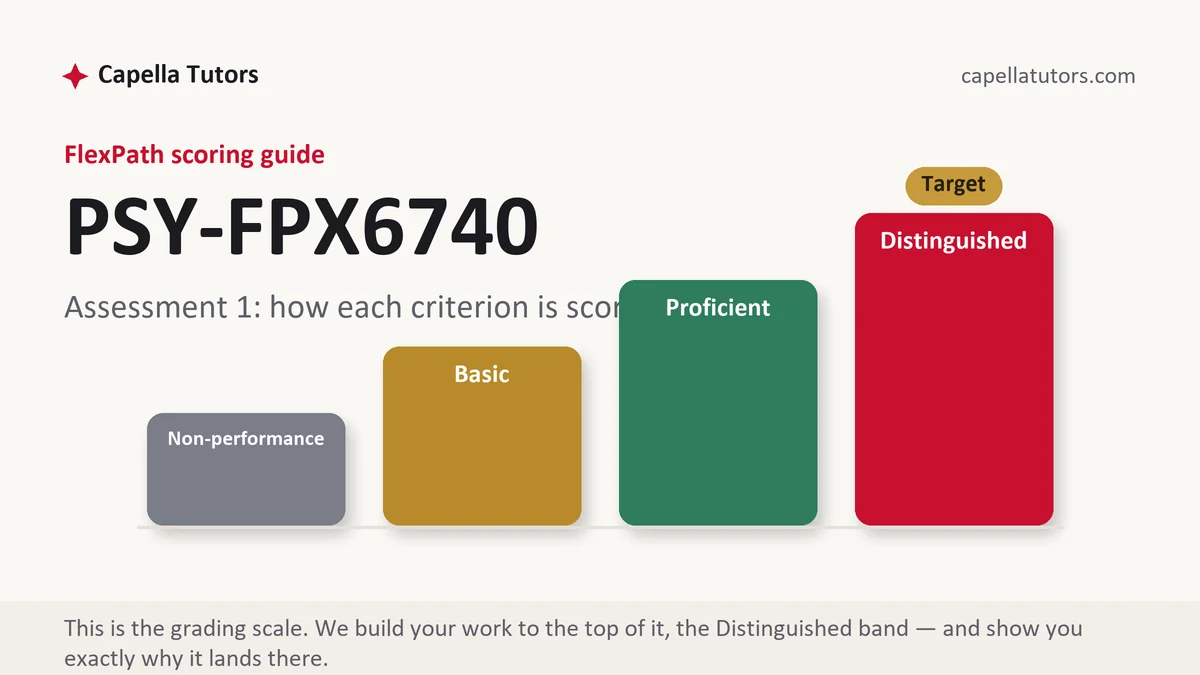
PSY-FPX6740 Assessment 1 grading scale at Capella FlexPath, the criterion levels this assessment is scored on, from Capella Tutors
How Capella FlexPath grades PSY-FPX6740 Assessment 1, visualized by Capella Tutors.

How PSY-FPX6740 Assessment 1 is scored

Nothing here converts to a letter. Your guide places every criterion at one of four levels, and the top descriptor is the specification you draft against:

LevelWhat it means on a staffing and selection deliverable
DistinguishedEach hurdle is tied to an attribute the job analysis documented, the order of the hurdles is defended against what it does to the applicant pool, and the value estimate arrives with the numbers that would overturn it.
ProficientA defensible sequence built on adequate documentation, with the arithmetic present and its inputs unexamined.
BasicCommon practice recommended because it is common, with a job description quoted rather than produced and validity mentioned as a virtue. This is the ceiling for a paper that argues from convention.
Non-performanceThe guide asks for something the paper never supplies, usually the job analysis method or the legal boundary statement.

Watch how you handle law. Naming the Uniform Guidelines on Employee Selection Procedures and the Equal Employment Opportunity Commission as the governing documents is competence; declaring a practice lawful is a conclusion that belongs to counsel.

The PSY-FPX6740 Assessment 1 method, step by step

  1. Build the outline out of the criteria

    Copy each criterion into the document as a heading and keep its top-level wording underneath while you write. Then read the verb: evaluate wants a judgment against a stated standard, recommend wants something a manager could authorize on Monday, and analyze wants the system taken apart into the decisions it makes.

  2. Document the job before you design anything

    Say how the job analysis was done, whether that was structured interviews with incumbents, a task inventory, observation, or existing documentation you are treating as a source. List the tasks, then the attributes each task requires. Every later recommendation points back to this section or it points nowhere.

  3. Treat the battery as a sequence, not a set

    Each hurdle changes the pool arriving at the next one, so a structured interview placed after a screening test is evaluating a narrower group than the published validity evidence assumed. Give the order, say what each stage measures, and state what the previous stage removed.

  4. Set expectations before hire, not after

    Wanous argued that realistic job previews lower early turnover by adjusting what applicants expect before they accept, which makes the preview a selection decision rather than a courtesy. Say what the unattractive parts of this role are and where in the process a candidate hears about them.

  5. Do the utility arithmetic, then publish its inputs

    Show the multiplication rather than a conclusion and list every quantity you supplied yourself: the dollar value of a standard deviation of performance is a convention, the validity coefficient came from other people's samples, and the model assumes performance converts to money in a straight line. Attack all three.

  6. Self-score against the guide, then submit

    Mark yourself D, P, B or N on every criterion and rewrite anything that is not at the top. Faculty have two business days for each attempt and a flat 12-week session holds up to two courses, so the cheapest resubmission is the one you never needed.

A structure that maps to the criteria

Lengths below are planning targets our psychology desk uses for a staffing deliverable, not Capella rules; fit them to your guide.

SectionWhat it must doGuide word target
The role and the job analysisThe method used, the tasks identified, the attributes required, and the description that results.~300 words
Attraction and the previewWhere candidates come from, what they are told before accepting, and what the pipeline costs.~200 words
The selection sequenceEach hurdle in order, the attribute it measures, and its effect on the pool that follows.~300 words
Evidence for each methodPeer-reviewed and meta-analytic support described by design and sample rather than by headline.~250 words
Utility and metricsThe arithmetic in full, the inputs you chose, and process metrics paired with quality of hire.~300 words
Boundaries and referencesRegulatory documents cited as documents, legal questions referred, current APA throughout.~150 words

Annotated sample excerpt

An original model excerpt from our team, showing the register a top-level utility argument uses.

Sample excerpt: the utility argument Original model · Capella Tutors

The chain fills 72 assistant store manager vacancies a year across 58 stores, average tenure in the role is four years, and adding a scored work-sample exercise to the existing sequence raises the validity of the process from about .28 to about .46 on the meta-analytic estimates cited above.1 Taking the standard deviation of performance in dollars at $21,000, a conventional figure near 40 percent of the $52,000 salary, and the average standardized predictor score of those hired at 0.9, the arithmetic is 72 hires times 4 years times .18 times $21,000 times 0.9, or roughly $980,000 across one cohort's tenure, against $29,450 to administer the exercise to the 310 candidates who reach that stage at $95 each.2 Three of those inputs are mine rather than the employer's: the dollar value is an estimate and not a measurement, the .46 was observed in other organizations and other jobs, and the model assumes performance converts to money linearly, which is doubtful in a role whose output is capped by store size, so the case should also be read at a dollar value of $15,000 where it still holds and at a validity gain of .08 where it does not.3

  • 1Establishes hires, tenure and the validity change with a source before any money appears. Nothing in the sentence is asserted without a quantity attached.
  • 2Shows the multiplication and the cost side with its own denominator, so a reader can rebuild the figure instead of trusting it.
  • 3Names which inputs the writer supplied, then reruns the case at values that hurt. The sentence where the case fails is the sentence that earns the criterion.

The full premium sample for your exact assessment, written fresh to your scoring guide and issue, is free to request. Study it, revise it into your own voice, and submit work you understand.

Get the full sample free

The five mistakes that cost Distinguished

  • A method recommended from convention. Widely used is not a justification, and the criterion asks which documented attribute the method measures.
  • A job description with no job analysis behind it. Copying a posting gives you nothing to defend an essential function or a selection choice with.
  • Hurdles listed as a menu. Ignoring the order hides that each stage hands the next a narrower pool.
  • Cost per hire optimized on its own. Cheap hiring that produces early leavers has relocated the cost rather than removed it.
  • A legal verdict delivered. Naming the regulatory question and referring it reads as competence; answering it reads as confidence in place of training.

Pre-submission checklist

  • The job analysis method stated, with tasks and required attributes listed
  • Every selection hurdle tied to a documented attribute and placed in a defended order
  • Validity evidence described by design and sample, with meta-analytic sources preferred
  • Utility arithmetic shown in full, with the inputs you supplied labeled as yours
  • Process metrics paired with quality of hire, each with a denominator and a window
  • Regulatory documents cited as documents, legal conclusions referred, every criterion self-scored D

Selection system deliverable due?

Send the scoring guide, the role, and how hiring runs today. A team of eight returns a premium original sample inside 24 to 48 hours, and one reader recomputes every figure before you see it. Revisions continue at no charge until the criteria clear.

Keep going

Online now