How to write PSY-FPX6730 Assessment 3

The short answer

This manual is for PSY-FPX6730 Assessment 3, start to submission. Assessment 3 of PSY-FPX6730, Consultation Psychology, is where a diagnosis becomes a proposal: an intervention aimed at the level the evidence implicates, sequenced with owners and dates, priced in the organization's own currency, and paired with measures agreed before anyone starts. Graduate work separates itself from a workshop pitch in one paragraph, the one where you dismantle your own arithmetic. Below is the order our psychology desk builds in, a structure that answers the criteria, and an annotated excerpt of a costed recommendation. Would you rather not fight the arithmetic? A premium original sample for this exact deliverable comes back inside 24 to 48 hours, revised at no charge until the descriptors are met. Your courseroom may print this as PSY FPX 6730 Assessment 3 or PSY6730 Assessment 3; it is the same deliverable, and PSY-FPX6730 Assessment 3 is what this manual walks through.

One honesty note before the manual: Capella revises courses and scoring guides over time, so always write to the exact scoring guide attached to your assessment in the courseroom. The course identity above is verified on capella.edu; the method and structure below are our tutors' approach to it, not Capella's official rubric text.
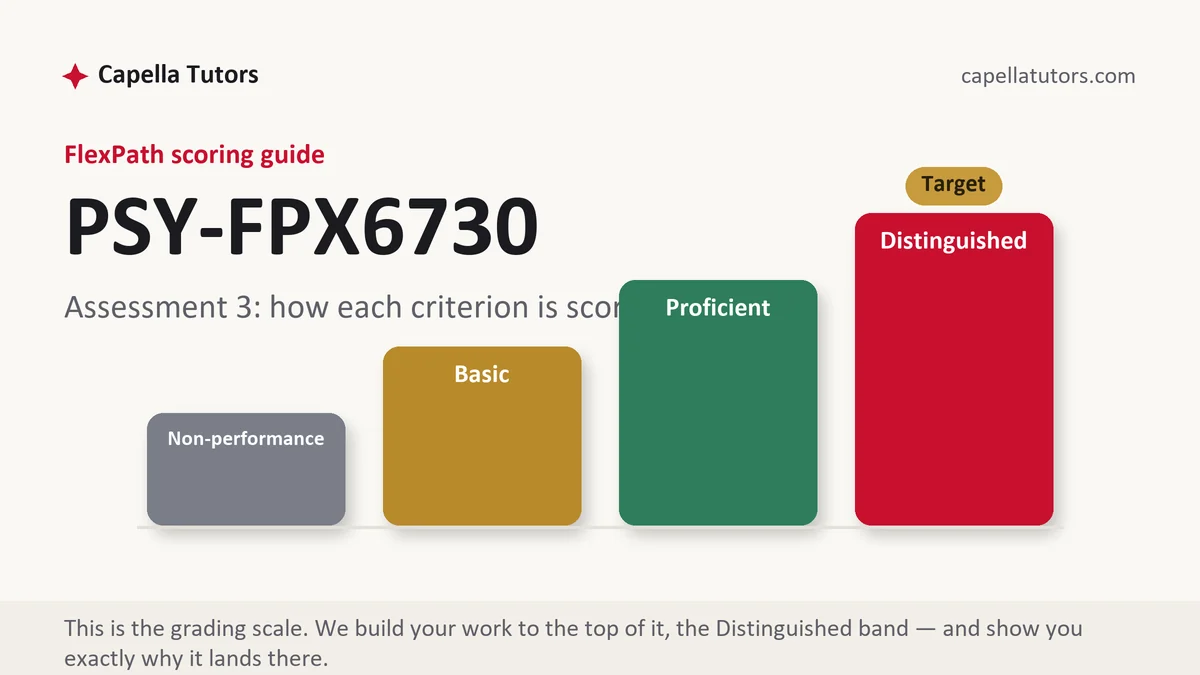
PSY-FPX6730 Assessment 3 grading scale at Capella FlexPath, the criterion levels this assessment is scored on, from Capella Tutors
How Capella FlexPath grades PSY-FPX6730 Assessment 3, visualized by Capella Tutors.

How PSY-FPX6730 Assessment 3 is scored

FlexPath scores criteria, not papers. Each one comes back at one of four levels, and the top level tells you what a proposal has to contain:

LevelWhat it means on an intervention and evaluation proposal
DistinguishedThe intervention addresses the level the diagnosis implicated, the sequence has named owners, the cost case states the assumption that would break it, and the success measures are fixed before the work begins rather than chosen afterwards.
ProficientA well-designed intervention that follows from the diagnosis, with the evaluation described in general terms. Strong, and one stress-tested assumption short.
BasicTraining proposed for a structural problem, benefits asserted without arithmetic, and evaluation reduced to a satisfaction survey. The most common shape of a first attempt.
Non-performanceAn element the guide requires is missing outright, most often the evaluation plan or the ethical scope statement.

Keep the boundary visible while you write. The MS in Psychology carries no license, so the proposal you author is educational and organizational in scope, and individual distress is routed to a referral.

The PSY-FPX6730 Assessment 3 method, step by step

  1. Aim the intervention at the level the diagnosis implicated

    If the evidence points at a target nobody can meet, a workflow with no owner, or work distributed unevenly across shifts, then a course for individuals cannot move it. Write one sentence connecting the finding to the level of the fix.

  2. Decide whether you are correcting or questioning

    Argyris separated single-loop correction, which improves performance inside the existing rules, from double-loop learning, which puts the governing assumption itself in question. Say which one you are proposing, because a double-loop recommendation delivered as a process tweak will be implemented as a tweak and then judged as a failure.

  3. Sequence it, with owners and dates

    Lewin's unfreezing, moving and refreezing sequence is the ancestor of every staged change model, and practitioner sequences such as Kotter's eight steps are worth citing as practitioner sources rather than as findings. Turn your own sequence into rows: the step, the owner by role, the week, and what tells you the step is done.

  4. Cost it in the client's currency, then attack the arithmetic

    Build the case from numbers the organization already keeps, show the multiplication, and then spend three sentences on what would make it wrong. A margin that disappears when one assumption moves is a margin you should not have led with, and saying so is exactly what the top level pays for.

  5. Fix the success measures before the work starts

    Name the measure, the denominator, the window and the owner, and get them agreed in advance so nobody redefines success after the fact. Add the measure that would show the intervention did harm, since a proposal that can only succeed has not been designed to be evaluated.

  6. Write the scope, then self-score

    State what falls outside your role, where distressed individuals are referred, and how confidentiality survives the reporting you have promised. Then grade the draft criterion by criterion, D, P, B or N, and rewrite anything below the top before you submit inside a session that does not extend.

A structure that maps to the criteria

Targets below are planning figures from our psychology desk, not Capella requirements; expand any section your own guide weights more heavily.

SectionWhat it must doGuide word target
From diagnosis to targetThe finding restated in one paragraph and the level of the system the intervention will act on.~200 words
The interventionWhat changes, who does it, the theory behind the choice, and what was rejected and why.~300 words
Sequence and ownershipSteps in order with an owner by role, a week, and a completion test for each one.~250 words
The cost caseThe arithmetic shown, the assumptions listed, and the assumption whose movement breaks the case.~300 words
EvaluationMeasures with denominators, windows and owners, agreed in advance, including one harm measure.~250 words
Ethics, scope and referencesConsent, confidentiality in practice, referral boundaries, and current APA sourcing throughout.~200 words

Annotated sample excerpt

An original model excerpt from our team, showing how a costed recommendation reads at the top of a guide. Study material, not a submission.

Sample excerpt: the cost case Original model · Capella Tutors

The carrier's inbound service center employs 480 advisers, the presenting request was resilience training, and the diagnosis found an after-call handling target of 25 seconds against a median of 68, which is a target no adviser met in the sampled fortnight.1 Voluntary exits ran at 31 percent of that headcount over the trailing twelve months, or 149 people, and at a replacement cost of $4,100 each the annual figure is $610,900; moving the rate to 25 percent would leave 120 leavers, recovering roughly $118,900 against $54,000 of engagement fees and about $50,600 of supervisor time, a net of some $14,000.2 That margin is smaller than the error in every input to it, since the replacement cost is an estimate, the six-point improvement is a figure I chose, and exits respond to the local labor market as much as to anything a consultant changes, so the case is better argued in the currencies this client already reviews weekly: first-year exits, adviser occupancy, and the proportion of advisers who can meet the quality standard without breaching the target.3

  • 1Puts the presenting request and the diagnosed problem in the same sentence, with the measurement window attached to the median. The gap between the two is the whole argument.
  • 2Shows the multiplication rather than announcing a saving. Every figure has a denominator or a source, so a finance reader can rebuild the calculation and check it.
  • 3Dismantles the writer's own case, then switches currency to measures the client already trusts. This is the paragraph that separates a proposal from a pitch.

The full premium sample for your exact assessment, written fresh to your scoring guide and issue, is free to request. Study it, revise it into your own voice, and submit work you understand.

Get the full sample free

The five mistakes that cost Distinguished

  • Training proposed for a structural finding. A course cannot move a target nobody can meet, and the mismatch tells an evaluator the recommendation was decided before the data arrived.
  • Benefits asserted with no arithmetic. A proposal that promises improved engagement and shows no multiplication has declined to be checked.
  • A sequence with no owners. Steps listed in the passive voice leave every step unassigned, and unassigned steps never happen.
  • Evaluation invented afterwards. Measures chosen once results exist can only confirm the result, which is why the criterion asks for them in advance.
  • Scope left open. A design that quietly absorbs individual distress into an organizational plan reads as a boundary problem, not as thoroughness.

Pre-submission checklist

  • The intervention aimed at the level the diagnosis actually implicated
  • Single-loop or double-loop stated explicitly, with Argyris cited for the distinction
  • Every step carrying an owner by role, a week, and a completion test
  • The cost case shown as arithmetic, with the assumption that breaks it named
  • Success measures with denominators, windows and owners, fixed before the work
  • Referral boundary and confidentiality written in plain sentences, and every criterion self-scored D

Proposal due and the numbers will not behave?

Send the scoring guide, your diagnosis, and whatever figures the organization lets you use. A team of eight returns a premium original sample inside 24 to 48 hours, and one pass exists purely to check that the intervention and the diagnosis are about the same problem. Revisions are free until the criteria clear.

Keep going

Online now